When you're packing up your home, it's easy to think, "a box is just a box." But I can tell you from years of experience in moving, especially here in Perth, that when it comes to books, this couldn't be further from the truth. Your choice of box is one of the single most important decisions for getting your library from A to B without a single casualty.
The Hidden Challenge of Packing Books
The real problem with books isn't their size, but their sheer, surprising density. A single paperback is nothing, but once you start packing them together, the weight adds up incredibly fast.
It’s a classic moving day mistake. You grab a large, general-purpose box, fill it to the brim with your favourite hardcovers, and suddenly you’re faced with a carton that weighs over 30 kilograms. Not only is that a serious risk for your back, but most standard boxes simply aren't built to handle that kind of concentrated weight.
What Happens When You Use the Wrong Box
Using a flimsy or oversized box for your book collection is a recipe for disaster. We've seen it all: the bottom of a cheap box giving way on a staircase, sending a treasured collection tumbling down, resulting in heartbreak and damage.
These are the all-too-common consequences:
- Bent Covers & Broken Spines: When books have too much room to slide around, their covers get snagged and their spines can easily crack.
- Total Box Failure: A large box packed with books puts immense pressure on the cardboard and seams. It’s not a matter of if it will collapse, but when.
- Personal Injury: Trying to hero-lift a box that's far too heavy is one of the quickest ways to end your moving day with a serious back strain.
To help you sidestep these common issues, here's a quick reference guide to picking the right box from the get-go.
Quick Guide to Choosing the Right Book Box
This table breaks down the best box types for your books, so you can make a smart choice quickly. Think of it as a cheat sheet for protecting your collection.
| Box Type | Best For | Typical Weight Limit | Key Feature |
|---|---|---|---|
| Small "Book" Box | Paperbacks, small hardcovers, and mixed collections. | 15-20 kg | Small size prevents over-packing and keeps weight manageable. |
| Heavy-Duty Small Box | Large, heavy hardcovers, textbooks, and art books. | 20-25 kg | Double-walled construction provides superior strength and stacking stability. |
| Archive Box | Protecting valuable or collectible books and comics. | 10-15 kg | Often comes with a lid for easy access and is designed for long-term storage. |
| Repurposed Boxes | A small number of non-valuable books (use with caution). | Varies Widely | Free, but inspect for strength and avoid anything with water damage or weakness. |
Picking from the top of this list, especially the dedicated "Book Box," is always your safest bet.
A proper book box is your library's insurance policy. The small upfront investment in the right supplies completely removes the risk of damaging your beloved books.
Ultimately, choosing the right boxes for moving books is about more than just getting them from one place to another. It's about protecting your collection, ensuring your own safety, and making the entire move more efficient.
Using uniform, sturdy, and correctly-sized boxes—just like professional removalists do—allows for a secure, stable stack in the moving truck. It makes everything smoother, from the initial lift to the final unpack. It's the foundation of a successful move for any book lover.
Selecting the Right Box Size and Strength
When you’re packing up a treasured book collection, the two things that will make or break your move are the size of your boxes and how sturdy they are. After years in the moving business, I can tell you the most common mistake we see is people grabbing the biggest box they can find. It seems logical, but it’s a recipe for disaster.
Think of it this way: books are basically stylish, colourful bricks. They are incredibly dense. The number one rule we live by is simple: small boxes are for heavy items. A large box packed to the brim with books is not just a back-breaker; it’s putting immense strain on the cardboard itself. You’re one wrong lift away from the bottom giving out and your beloved library crashing to the floor.
Size Matters: Small vs. Medium Boxes
For nearly all books, especially hefty hardcovers and textbooks, you want a small book box. These are the workhorses of the moving world. They’re typically about 1.5 cubic feet (around 30cm x 30cm x 40cm) and are designed to hold a manageable 15-20 kg when full. This is the sweet spot—heavy enough to make progress, but light enough that you (or your movers) can handle it safely.
Now, you might be tempted to use medium-sized boxes, and sometimes they can work for lighter paperbacks. It’s a common sight; we’ve noticed that here in Perth, around 65% of homeowners tend to use medium boxes when packing their own books. If you go this route, be incredibly careful. A medium box filled with 40-50 paperbacks can quickly exceed a safe lifting weight and put the box at risk of collapse.
This decision tree nails the thought process perfectly. It's all about starting with a solid foundation.

As the visual shows, choosing a sturdy box is your first line of defence against damage. Skimp on this, and you’re just asking for trouble.
Construction is Key: Single vs. Double-Walled Boxes
Size is only half the battle. The box’s actual construction is just as critical. Those standard single-wall boxes you get from the supermarket? They’re fine for doonas and cushions, but they have no place in a library move. They simply can't handle the weight and will crush, bend, or tear when you stack them.
This is where double-walled boxes come in. They have two layers of corrugated cardboard, giving them the strength and rigidity your books deserve.
Double-walled construction isn't just a recommendation; it's a necessity for moving books. It provides the backbone needed to withstand being stacked in a moving truck and protects your books from crushed corners and other damage.
Think about these real-world scenarios we see all the time:
- A Uni Student Moving Textbooks: A whole semester's worth of dense, heavy textbooks demands small, double-walled boxes. Anything less will fail.
- A Collector Moving First Editions: For valuable or sentimental books, the extra protection of a double-walled box is non-negotiable. It’s cheap insurance for priceless items.
Our team at Emmanuel Transport uses double-walled boxes for moving books as a standard. Why? Because they work. Based on our own records, using the right boxes can lead to a 40% reduction in damage claims.
For a deeper look into your options, check out this excellent guide to the best moving boxes for books. And if you're trying to figure out just how many boxes you'll need for your collection, our handy online packing calculator can give you a pretty solid estimate.
Professional Techniques for Packing Your Books

Alright, you’ve got your sturdy little boxes ready to go. Now for the crucial part: getting your books packed securely. How you arrange them inside the box is just as important as the box itself. It’s the difference between opening a carton of pristine books and discovering a mess of bent covers and broken spines.
There's no single "correct" way to pack every book, as the best method depends on its size and type. The main goal, though, is to eliminate movement. A perfectly packed box will have no empty space, meaning your books can't shift, slide, or tumble around during the journey.
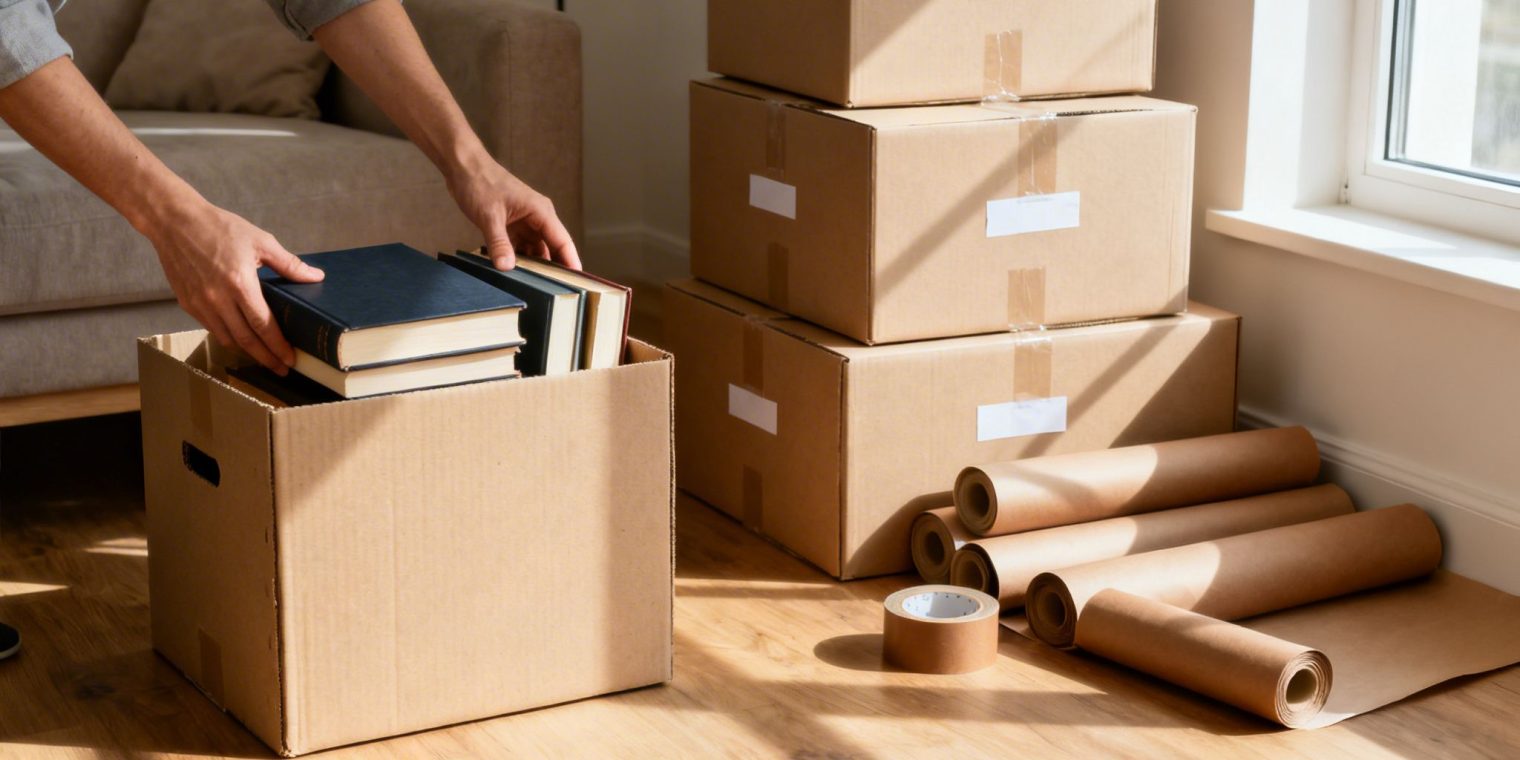
This is where crumpled packing paper becomes your best friend. Before you even think about putting a book in, create a soft, cushioned base at the bottom of the box. This simple layer acts as a shock absorber, protecting the edges from any bumps along the way.
Mastering Different Packing Methods
For your standard hardcovers and paperbacks, we've found the upright method works wonders. Think of it as placing them on a bookshelf, just inside a box.
- Stand them up: Place books vertically with their spines against the side of the box. This position gives the spine the support it needs and stops pages from warping.
- Alternate the spines: To keep everything level and stable, pack one book with the spine facing in, and the next with the spine facing out. It’s a simple trick that prevents the books from leaning and creating a lopsided, unstable box.
- Group similar sizes: Try to keep books of a similar height together. This creates even pressure and stops smaller books from getting lost or damaged between larger ones.
When it comes to those big, heavy coffee table books, atlases, or large art books, you need to switch things up. Lay these items flat at the bottom of the box to create a solid, stable base. You can stack two or three of a similar size, but don't overdo it.
Here's a key takeaway from the pros: always fill the gaps. Once your books are in position, stuff any remaining voids—at the top and on the sides—with more crumpled packing paper. When you give the sealed box a gentle shake, nothing should move inside.
Weight Distribution and Safe Lifting
Managing the weight of your boxes for moving books is non-negotiable for both safety and efficiency. Sticking to a strict weight limit not only saves your back but also ensures the box itself doesn't fail. Our firm rule, and the industry standard, is a maximum of 25kg per box.
This isn't just a suggestion; it's a critical safety measure. We’ve handled Perth office relocations with an average of 500-1,000 books, all of which must comply with Australian safe lifting standards. These rules are there for a good reason—they help prevent injuries, which unfortunately affect about 15% of untrained movers.
We’ve seen firsthand how the right gear makes a difference. Using proper book boxes with handholds can slash transport time by as much as 25% on a typical job from Mount Hawthorn to Fremantle.
Turning a massive packing job into a smooth operation is all about having the right technique. If you have a large library and the thought of packing it all is a bit much, exploring professional packing services can give you peace of mind and save a huge amount of time. Think of it as an investment in protecting your collection.
Where to Find and Recycle Moving Boxes in Perth
Alright, so you know you need small book cartons, but where do you actually find them in Perth? You've got a couple of routes to go, and it really just depends on whether you want to prioritise cost, convenience, or guaranteed quality.
For absolute peace of mind, buying brand-new, uniform boxes directly from a removalist is the gold standard. You know every single box will be clean, sturdy, and up to the task of protecting your books. But if you're on a tight budget and don't mind a bit of a treasure hunt, tracking down free boxes is a brilliant way to save some cash.
Sourcing Boxes in the Perth Area
Hunting for free boxes can genuinely save you a decent chunk of money. The trick is to think about which local businesses receive shipments of heavy goods in strong cartons. Many are more than happy for you to take them off their hands.
Here are a few tried-and-true spots to check around Perth:
- Liquor Stores: This is my top tip. Wine and spirit boxes are almost always double-walled and small—perfect for a stack of heavy hardcovers. They’re designed to carry glass, so you know they’re strong.
- Bookstores: It might seem obvious, but it works! They get huge, regular deliveries and often have stacks of high-quality boxes they need to flatten and discard. Just ask nicely.
- Grocery Stores: Head to the fruit and veg section and ask for their old apple or potato boxes. These are built to handle serious weight and are usually incredibly tough.
A quick word of warning: before you load any used box into your car, give it a good look over. Check for water stains, funny smells, or any signs of pests. A free box that falls apart on moving day is a price you don't want to pay.
Recycling and Reusing After the Move
So, the move is done, the books are on their new shelves, and now you’re staring at a small mountain of cardboard. What do you do? Please don’t just send it all to landfill.
First off, check your local council’s website for kerbside recycling rules. Most Perth councils will happily take flattened cardboard in the yellow-lid bin. The only catch is you need to remove all the plastic packing tape first, as it can mess up the recycling machinery.
Even better than recycling is reusing. Jump on a local community Facebook page or Gumtree and post an ad for free moving boxes. You’ll be amazed at how quickly someone who is just starting their moving journey will snap them up. It’s a great way to help out a fellow Perthonian and keep the good karma flowing.
If you’re looking at that mountain of cardboard and just wish the whole process would take care of itself, we can help with that too. You can learn more about how we manage everything from packing to post-move logistics in our guide to Perth removals and storage.
Smart Labelling and Stacking for an Easier Unpack

You’ve done the hard work of sorting and packing. Now, don't fall at the final hurdle. The way you label and stack your boxes for moving books is the difference between a smooth unpack and a chaotic mess. It’s not just about scribbling "Books" on a box; a smart system can turn moving day mayhem into a streamlined process for you and your removalists.
Think of each label as a tiny roadmap. A good one saves hours of frustration and helps you find that one book you're desperate to read without tearing through every box. It’s about making life easier when you’re exhausted and surrounded by a sea of cardboard in your new home.
Create a Labelling System That Actually Works
A vague label is almost as bad as no label at all. If a box just says "Books," you'll have to open it to know what's inside, which defeats the purpose. The key is to give anyone who looks at the box all the info they need in a single glance.
Here’s the simple formula we've seen work on thousands of moves:
- Destination Room: In big, bold letters, write where the box needs to go (e.g., STUDY, LIVING ROOM). This tells the moving crew exactly where to put it, saving your back later.
- Specific Contents: Get a little more detailed. Instead of "Books," try "Fiction A-L" or "Cookbooks." This is a game-changer when you’re looking for a specific genre.
- Weight & Handling: This is a non-negotiable. Always write HEAVY on the box. It’s a simple but crucial heads-up for anyone lifting it, helping to prevent injuries.
This three-part system makes everything run smoother. If you want to really get into the nitty-gritty of getting organised, this guide to labels for storage and organization has some great principles you can adapt for your move.
Stack Smart for a Safe Journey
How you stack these heavy boxes is just as important as how you pack them. Get it wrong, and you risk a mini-avalanche in the truck that can damage your belongings.
Always start by creating a solid foundation on the floor of the moving truck. Your heaviest boxes—the ones filled with big hardcovers and university textbooks—must go on the bottom. No exceptions.
We always build a solid wall of book boxes against the front of the truck, right behind the cab. This creates a stable base that stops everything else from shifting around. Never, ever stack a light box underneath a heavy one.
This disciplined approach isn't just for homes. We see the benefits for our commercial clients all the time; efficient packing and labelling can slash their unpacking and inventory time by up to 35%. It's also critical for the 40% of our jobs that are apartment or student moves. Navigating tight lifts in the high-rises around Perth suburbs like Scarborough is so much easier with compact, well-labelled boxes.
With your boxes clearly marked and safely stacked, you're setting yourself up for a much less stressful unpacking experience. And to keep that momentum going, be sure to grab our post-move planner checklist. It's packed with tips for settling into your new space.
When It’s Time to Call in the Pros for Your Library
While there’s a certain satisfaction in packing your own books, sometimes it just isn't practical. You might have sourced the perfect boxes for moving books, but the sheer physical labour and planning can quickly become overwhelming.
A tight moving deadline is often the first sign you need help. Packing hundreds, or even thousands, of books the right way takes a surprising amount of time. A professional crew can often get it done in a matter of hours, not days, leaving you free to manage the million other things on your moving checklist.
When Expertise Is Worth More Than DIY Savings
If your shelves hold valuable items like rare first editions, antique leather-bound tomes, or books with deep sentimental value, bringing in experts is a very smart move. It's not just about using good packing materials; it’s about the experience. Professional removalists know how to handle delicate, irreplaceable items with the specific care they need to arrive in one piece.
Then there's the simple reality of a large library. The sheer volume can be a massive physical undertaking.
Think about it this way: the cost of hiring movers is almost always less than the potential cost of a back injury from lifting heavy, awkward boxes all day. It’s not just about strength; it’s about endurance and knowing the right techniques to avoid getting hurt.
Professionals are trained to handle the weight and navigate tricky staircases or tight hallways without damaging your home or your belongings. This expertise is what you're paying for—it minimises risk to your collection and, just as importantly, to you.
If the thought of packing and moving your library feels like too much, it probably is. You can find out more about how our team of professional removalists in Perth can take that weight off your shoulders.
Answering Your Top Questions About Moving Books
After helping countless Perth families move their libraries, we've heard just about every question there is. Even the most organised person can find themselves staring at a mountain of books, wondering where to begin. Here are the answers to the questions we get asked the most.
How Do I Stop My Books from Getting Damaged?
This really depends on the type of book you're packing. For your everyday paperbacks and hardcovers, the best approach is to stand them upright in the box, just like you would on a bookshelf. Make sure to alternate their spine direction—this simple trick helps them sit flat and creates a much more stable block.
For those big, heavy coffee table books or any delicate, older volumes, it’s a different story. Lay these flat on the bottom of the box, stacking them from largest to smallest.
The golden rule: Always, always fill any empty space. A bit of crumpled packing paper is all it takes to stop your books from shifting around. It's that movement inside the box that leads to bent covers, dog-eared pages, and broken spines.
Just How Heavy Should a Book Box Be?
This is a big one. You should never let a box of books get heavier than 18-20 kg. That’s the magic number for safety and practicality.
It’s tempting to cram as much as you can into one small box, but anything heavier is a serious risk to your back. It also puts immense pressure on the cardboard, increasing the chance the box will give out at the worst possible moment. If you can't lift it comfortably, it's too heavy.
Before you even grab the tape, try lifting one corner of the box. Does it feel like a struggle? If you can't easily lift it onto a tabletop, you've overpacked. It's time to take a few books out and start a new box.
Can I Just Use Plastic Bins for My Books?
While plastic bins might seem like a durable alternative, we usually advise against them for the actual move. They’re fantastic for long-term storage in a garage where you might be worried about moisture, but they have some real drawbacks on moving day.
Plastic tubs are heavier than cardboard, can crack if they’re dropped, and they just don't stack as securely in the truck. Their smooth surfaces and often-tapered sides make for a wobbly, unstable stack. For a safe and efficient move, sturdy, small cardboard boxes are almost always the better choice.
Figuring out the logistics of a move can feel overwhelming, but you don't have to tackle it alone. If you're in Perth and want expert advice and a seamless moving experience, the team at Emmanuel Transport is here to help.
Ready to make your move completely stress-free? Get your free, no-obligation quote today.