
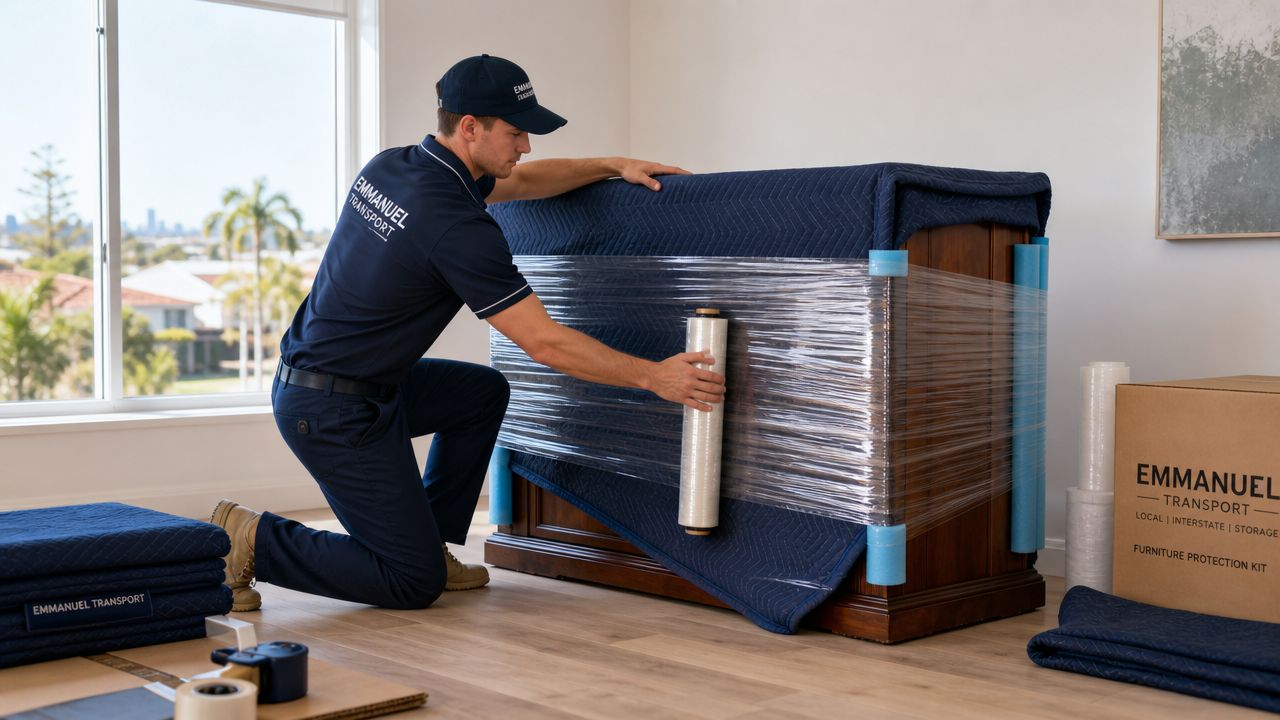
Moving day usually starts with good intentions. The sofa is clean, the dining table still looks great, and you tell yourself everyone will be careful. Then the difficulties of a Perth move surface. A narrow hallway, a hot driveway, a truck parked in direct sun, and one awkward turn through a gate is often all it takes for a timber edge to get rubbed, a lacquered surface to mark, or a chair leg to pick up a dent.
That’s why a proper furniture wrapping service matters. It isn’t about making furniture look tidy for transport. It’s about reducing the damage that happens during lifting, stacking, vibration in transit, and repeated handling at both ends of the move. In Perth, heat changes the risk again. Wrap that’s too tight, applied to the wrong surface, or left baking in the sun can create its own problems.
Good wrapping provides desired assurances on moving day. Less second-guessing. Less chance of avoidable damage. More confidence that the pieces you care about will arrive in the same condition they left.
Table of Contents
- Why Your Furniture Needs Protection During a Perth Move
- What Is a Professional Furniture Wrapping Service
- The Professional Toolkit Materials and Techniques
- When You Absolutely Need Furniture Wrapping
- Understanding the Process and Pricing
- Checklist Before You Hire a Wrapping Service in Perth
- Perth Furniture Wrapping FAQs
- Is wrapping really necessary for a local move across Perth?
- Can wrapping damage timber or lacquered furniture?
- What furniture usually benefits most from a wrapping service?
- Should I wrap furniture myself before the movers arrive?
- Is wrapping useful for storage as well as moving?
- Does every item need the same level of protection?
Why Your Furniture Needs Protection During a Perth Move
A typical home move has a few pieces that worry people more than the rest. The sofa that barely fits through the front room. The dining table with a finish that shows every mark. The bedhead that already needs careful handling because one hard knock will leave a visible chip. These are the items that tend to get damaged, not because anyone is reckless, but because moving creates friction, pressure, and contact at every stage.
That risk isn’t theoretical. The 2021 Census found that over a quarter of Australians had moved in the previous year, and Australia had 10.9 million households, which shows just how often people need practical protection for furniture during relocation (national mobility figures). In a city like Perth, with apartment moves, suburban family homes, and office relocations happening every week, wrapping is part of sensible preparation.
Where damage usually happens
Most furniture damage doesn’t happen in one dramatic incident. It happens in small moments:
- Doorway contact: A dresser clips a frame or brick edge while being turned.
- Truck vibration: A polished surface rubs against another item during transit.
- Dust and grit: Fine debris trapped against a surface acts like sandpaper.
- Sun exposure: Hot conditions make some finishes and wraps less forgiving.
A piece can leave the house looking fine and still arrive with rub marks from movement inside the truck.
Professional wrapping changes that equation by adding padding where furniture takes contact, then securing those layers so they stay in place.
If you want a practical breakdown of how to reduce those risks before moving day, this guide on protecting furniture when moving is a useful place to start. And once the furniture is delivered, many households also think about the handover condition of the property itself. If you’re coordinating interstate plans or helping family elsewhere, this resource for a sparkling San Antonio move covers the move-out cleaning side well.
What Is a Professional Furniture Wrapping Service
A professional furniture wrapping service is more than rolling plastic around a couch. This job has three parts. Assess the item, choose the right protection, and apply it in a way that protects the furniture without creating fresh damage.
A DIY attempt usually skips at least one of those steps. People often grab a hardware-store roll of plastic, wrap the outside, and assume the item is protected. The problem is that plastic alone doesn’t cushion impact, doesn’t reliably protect corners, and can trap grit against delicate finishes if the surface hasn’t been prepared properly.

What professionals do differently
The first step is assessment. A timber table, upholstered armchair, marble-topped console, and lacquered bedside each need a different approach. Professionals look at finish type, weak points, protruding legs, glass components, and how the item will travel through the property.
Then comes material choice. Some items need soft padding first. Others need blankets secured with stretch film. Delicate sections might need extra cushioning around corners, legs, or edges.
Skilled application is what holds it all together. Loose wrapping slips. Over-tight wrapping can print pressure into softer finishes or leave surfaces vulnerable in heat. Good wrapping sits firmly enough to stay put without stressing the item underneath.
Why this service sits closer to handling than packaging
This kind of work is part of protective transport, not decoration. That’s why it often overlaps with the same care standards people expect from a white glove delivery service, where the handling method matters as much as the final delivery.
Practical rule: If the wrap only looks neat but doesn’t control rubbing, pressure, and movement, it isn’t doing the real job.
For Perth households, that difference matters most with timber, veneer, glass-fronted pieces, and anything with a finish that marks easily.
The Professional Toolkit Materials and Techniques
A proper wrapping job uses layers because each material solves a different problem. One protects against impact. Another keeps padding from shifting. Another cushions fragile sections. When movers rely on one material alone, furniture usually pays for it somewhere along the route.

Professional movers use layered protection because a single layer is often not enough for high-contact points, and the combination of moving blankets, padding, and stretch wrap is designed to reduce abrasion, dust, and scuffs during loading, transit, and unloading (multi-layer protection workflow).
What each material is doing
Think of wrapping like dressing for the weather. You wouldn’t wear one thin layer and expect it to handle wind, heat, and impact. Furniture is the same.
| Material | Main job | Where it works best |
|---|---|---|
| Moving blankets | Cushion against bumps and rubbing | Timber tables, cabinets, bedheads |
| Stretch wrap | Hold protective layers in place and block dust | Over blankets and padding |
| Bubble wrap | Add soft cushioning to fragile points | Glass, corners, decorative details |
| Corner protection | Guard edges from knocks | Dining tables, cabinets, desks |
The sequence matters. Padding usually goes on first where the surface is vulnerable. Then blankets create the main protective shell. Stretch wrap secures that shell so it doesn’t slide during carrying and transport.
For more detail on when cushioning materials make sense, this guide to bubble wrap for moving is worth reading, especially for fragile components and mixed-material furniture.
Perth heat changes the technique
Perth conditions add a layer of judgement that generic guides often miss. A truck in direct sun gets hot quickly. So does a driveway load-up in summer. That matters because some finishes, especially lacquer, veneer, and polished timber, can react badly if film tension is wrong or the wrong material sits directly on the surface for too long.
Good practice starts with prep. Surfaces need to be clean and dry. Dust, grease, and leftover polish can make wraps shift under vibration, which increases rubbing instead of reducing it. On hot days, it also helps to avoid over-tight film on sensitive finishes and to keep wrapped pieces out of direct sun for longer than necessary.
In Perth summer, more wrap isn’t automatically safer. The safer method is the one that matches the surface and the heat exposure.
What works and what fails
A few methods are consistently reliable, and a few create trouble:
- Works well: Blanket first, secure wrap over the blanket, with extra padding on contact points.
- Works well: Careful edge protection on dining tables, buffets, and office desks.
- Fails often: Plastic film applied directly onto a heat-sensitive finish.
- Fails often: Wrapping over dusty furniture and expecting the layers to stay stable.
- Fails often: Tight film over corners with no cushioning underneath.
Experienced removalists make practical adjustments. A team like Emmanuel Transport can wrap on-site, dismantle where needed, and choose a protection method that suits both the item and the day’s conditions.
When You Absolutely Need Furniture Wrapping
Some moves can get by with basic handling. Others really shouldn’t. The difference usually comes down to access, surface sensitivity, storage time, and how much risk you’re willing to carry yourself.
Apartment moves and tight access
Apartment relocations are hard on furniture because the item gets handled more times before it even reaches the truck. Lifts, stairwells, tight corners, and shared corridors all increase the chance of side contact.
A sofa moved out of a Mount Hawthorn apartment or a dining setting coming down from an upper-floor Subiaco unit usually needs more than careful lifting. It needs surfaces protected before the first turn through the hallway.
Storage and short-term holding
Furniture going into storage needs a different mindset. You’re not only protecting it from knocks on moving day. You’re also shielding it from dust and surface contamination while it sits.
This is especially important for upholstered pieces, polished timber, and cabinets with exposed edges. A good wrap keeps the protective layers stable during transport and helps the item come out of storage in a cleaner condition.
If furniture will be moved, stored, and moved again, wrapping becomes part of preserving the finish between handling cycles.
Antiques and high-value pieces
Older furniture, custom pieces, and family heirlooms deserve slower handling and better material choices. Veneer can be less forgiving than people expect. Decorative trim catches easily. Older joints may still be solid, but they don’t love torsion, pressure, or abrupt bumps.
For these items, wrapping isn’t a general layer around the whole piece. It’s targeted protection around the parts most likely to suffer first.
Office relocations
Office moves often look simpler than house moves because the furniture is more uniform. In practice, desks, pedestals, meeting tables, reception counters, and storage cabinets still pick up plenty of damage if they’re rushed.
A scratch on a boardroom table or a dented front desk doesn’t stop the business operating, but it does create avoidable repair and replacement headaches. Wrapping makes sense when a business wants the furniture usable immediately on arrival, not marked up from the move.
Understanding the Process and Pricing
People usually feel more comfortable booking a wrapping service once they understand what happens on the day and why the cost is structured the way it is.

What the process usually looks like
A straightforward job tends to run in four parts:
-
Quote and scope
You identify what needs wrapping, what’s being moved, and whether there are any delicate or awkward items. -
On-site assessment
The team checks access, finish types, item size, and whether anything should be dismantled before wrapping. -
Protection and loading
Each item gets the materials that suit its surface and transport risk, then it’s loaded to minimise rubbing and movement. -
Delivery and placement
Furniture is unloaded, moved into position, and unwrapped as needed.
That structure matters because wrapping isn’t separate from the move. It affects carry paths, truck loading order, and how long vulnerable items sit in the heat.
Why the price varies
The cost of wrapping reflects materials and labour, not just the visible plastic on the outside. Independent industry guidance puts common inputs at around A$8 per moving blanket, A$10 to A$25 for plastic wrap, A$10 to A$25 for bubble wrap, and about A$50 to A$80 per mover per hour for professional packing labour (material and labour cost guidance).
That’s why a quote changes depending on the job. A simple mattress or standard cabinet is one thing. A glass-fronted display unit, dining setting with delicate edges, or office fit-out with multiple desks takes more materials, more handling time, and more care.
What usually affects your quote
| Factor | Why it changes cost |
|---|---|
| Item size | Larger pieces need more padding, more wrap, and more handling time |
| Surface type | Delicate finishes require gentler methods and extra care |
| Complexity | Glass, removable parts, and awkward shapes increase labour |
| Access | Stairs, tight halls, and long carries slow the process |
| Storage or repeat handling | Items may need more durable protection |
What you shouldn’t expect is a meaningful fixed price list for every item type. The same three-seater sofa can be easy in one home and difficult in another depending on access, finish, and whether it needs temporary storage.
What to ask for: A detailed quote that separates the scope of wrapping from the broader move, so you know what protection is being allowed for and why.
That’s also why transparent quoting matters. You’re paying for a bundled protection service, not a cosmetic extra.
Checklist Before You Hire a Wrapping Service in Perth
A wrapping provider doesn’t need fancy language. They need clear methods, suitable materials, and a quote that matches the actual job. If the answers sound vague, the result often is too.

Questions worth asking before you book
- What materials do you use on timber, veneer, and lacquered furniture? You want to hear about layered protection, not just plastic film.
- Do you wrap on-site? That’s important for large items that shouldn’t be moved unprotected through the property.
- How do you handle hot weather and direct sun exposure? In Perth, this is a real operational question, not a minor detail.
- What’s included in the quote? Ask whether wrapping materials, labour, dismantling, and reassembly are covered.
- Can you handle storage moves or office relocations as well as household items? Experience across different move types usually shows in the handling quality.
A useful comparison point is to look at providers that also offer broader moving and packing services, because wrapping is usually strongest when it’s integrated into the full handling process rather than treated as an afterthought.
One more practical check. Ask how they avoid direct tape contact with finished surfaces. If the answer is careless, keep looking.
Perth Furniture Wrapping FAQs
Is wrapping really necessary for a local move across Perth?
Often, yes. Short moves still involve loading, transport vibration, unloading, and contact with walls, doorways, and truck interiors. Distance isn’t the only risk. Handling is.
Can wrapping damage timber or lacquered furniture?
It can if the wrong material is used directly on the surface, if the item is wrapped while dusty, or if tight film is left in high heat. Good wrapping protects the finish. Poor wrapping can mark it.
What furniture usually benefits most from a wrapping service?
Dining tables, buffets, bedheads, office desks, antiques, polished timber pieces, upholstered furniture, and anything with glass, veneer, or delicate edges.
Should I wrap furniture myself before the movers arrive?
Only if you know the finish can handle the materials and the wrap won’t interfere with safe lifting. DIY wrapping often looks secure but slips during handling or traps grit against the surface.
Is wrapping useful for storage as well as moving?
Yes. It helps protect furniture from dust, scuffing, and repeated handling, especially if the item will be transported more than once.
Does every item need the same level of protection?
No. Good wrapping is selective. Some pieces need full layered protection. Others need targeted padding around corners, legs, tops, or fragile sections.
If you want a clear, no-obligation plan for your next move, Emmanuel Transport can help you work out what actually needs wrapping, what materials make sense for your furniture, and how to protect heat-sensitive finishes during a Perth move.
