
Moving a piano is about much more than just raw strength. It demands a specific set of tools, years of honed technique, and a genuine understanding of how these beautiful, delicate instruments are built. Getting it right comes down to meticulous planning, from clearing every inch of the pathway to safeguarding the thousands of moving parts inside and the polished wood outside.
Why Moving a Piano Is a Job for Experts
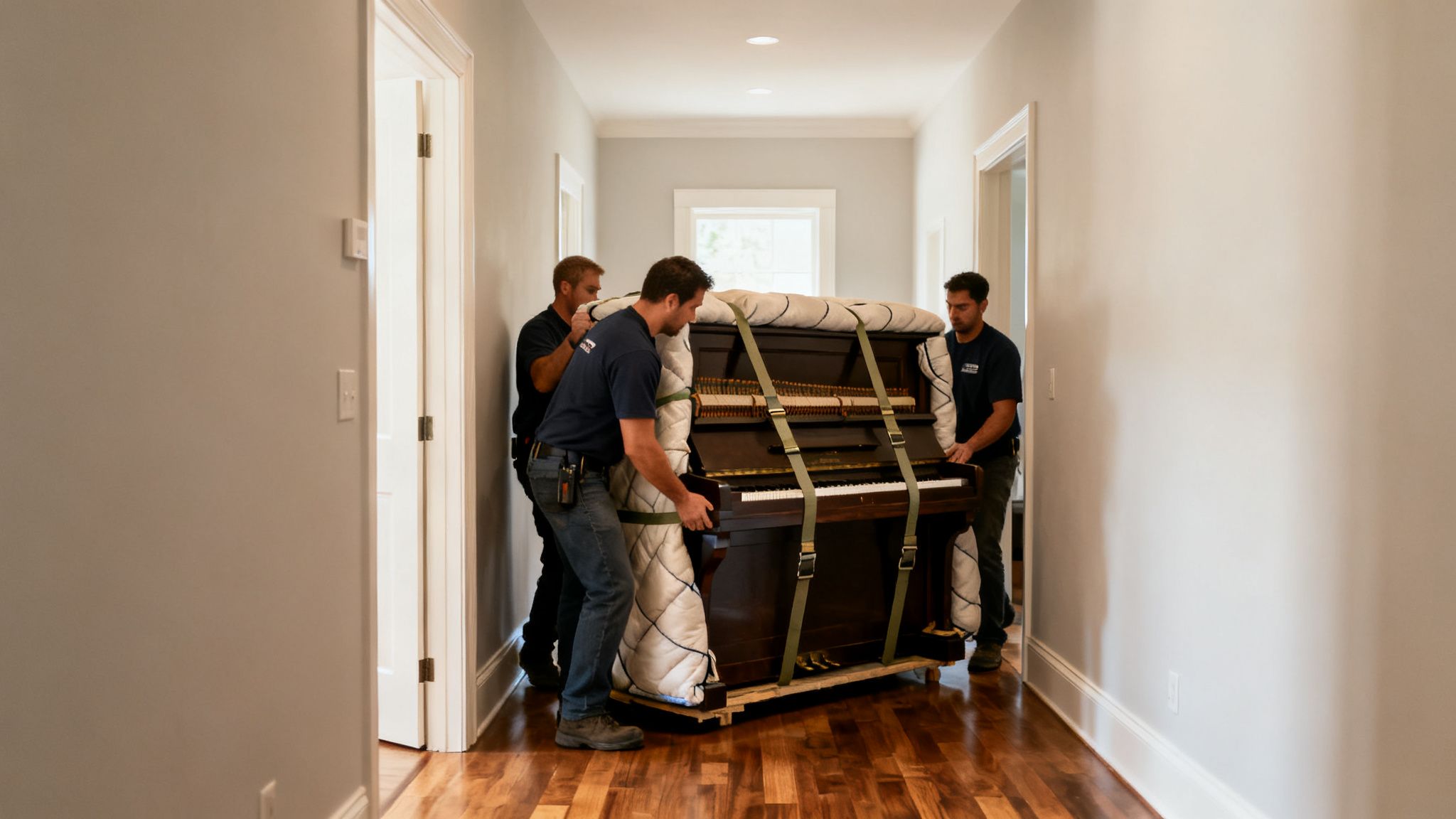
Before you start rounding up a few mates for a weekend move, it’s vital to grasp why shifting a piano is nothing like moving a heavy sofa or a wardrobe. A piano isn’t just a bulky piece of furniture; it’s an engineering marvel with an incredibly awkward, top-heavy design and countless fragile components.
The real risk in a DIY piano move isn’t just the catastrophic drop you might be picturing. It’s the less obvious damage that can happen in an instant. A single hard jolt can crack the cast-iron plate or the soundboard, landing you with a repair bill that dwarfs what professional movers would have charged. Even a small slip can leave a deep gouge in your timber floors or take a chunk out of the plaster.
The Hidden Risks of a DIY Piano Move
Picture this: you’re trying to manoeuvre a 250 kg upright piano around a tight corner at the bottom of a flight of stairs. Without proper technique and gear like a piano skid board, all that weight is concentrated on one or two tiny points. This is exactly how legs snap off, polished finishes get scratched beyond repair, and, worst of all, people get seriously hurt.
Professional removalists are trained to sidestep these dangers. They don’t just lift and hope for the best. They come equipped with specialised tools and, more importantly, the experience to map out the path, protect every vulnerable surface, and use equipment built for this one specific job.
When you hire the pros, you’re paying for:
- Specialised Equipment: They’ll arrive with heavy-duty dollies that won’t mark your floors, skid boards designed for stairs, and thick, padded moving blankets secured with proper straps.
- Correct Technique: They know how to balance the piano’s weight, tilt it without putting any stress on the legs, and navigate awkward spaces without causing a scratch.
- Full Insurance Coverage: Any reputable mover will be fully insured. If something does go wrong, your instrument and your home are covered. That’s a peace of mind a DIY move can never provide.
A piano is more than just furniture. For many families, it’s a treasured heirloom and a keeper of memories. Handing it over to people who respect its value is the only way to ensure it arrives safely, ready to bring music to your new home.
When Expertise Becomes Cost-Effective
Sure, the upfront quote from a professional mover might look steep compared to the “cost” of a case of beer for your friends. But once you start adding up the potential costs of damage, the choice becomes a lot clearer. Just like there are specific rules for moving fridge freezers safely, pianos have their own set of non-negotiable requirements. Before you book anyone, make sure you go through these essential questions to ask when hiring a removalist to confirm they have genuine piano-moving experience.
Ultimately, hiring professionals isn’t really an expense—it’s an investment in protecting a valuable and often sentimental asset. They make an incredibly difficult job look easy because they’ve spent years perfecting the process, ensuring your piano’s journey is smooth and secure from beginning to end.
Your Essential Pre-Move Preparation Checklist
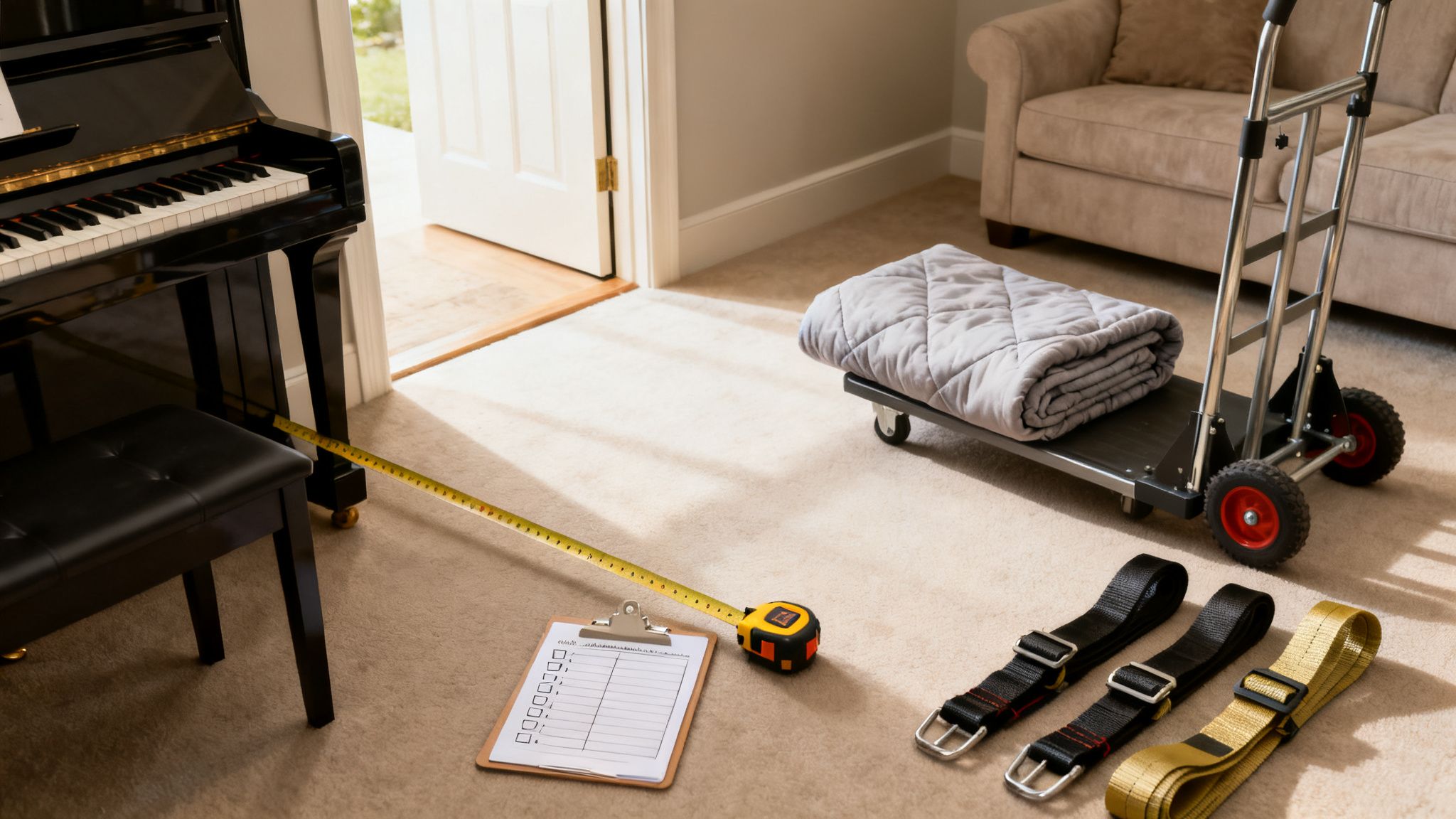
Success on moving day comes down to the work you do long before the truck even backs into the driveway. Whether you’ve called in the pros or you’re tackling this beast yourself, a solid plan is your best defence against last-minute chaos and potential damage to your beloved instrument.
The aim here is simple: create a completely clear, obstacle-free path from where the piano sits now, all the way to the moving vehicle. It all starts with a tape measure and a bit of careful observation.
Measure Everything Twice
Don’t just guess or “eyeball it.” You need exact measurements, and I mean exact. Understanding how to move a piano safely is fundamentally about understanding the space it needs to navigate.
First, measure the piano itself—height, width, and depth are crucial. For a grand, you’ll need that key measurement from the front of the keyboard straight back to the furthest point of the bow. Then, armed with those numbers, measure every single doorway, hallway, and staircase on its exit route. Be thorough and account for things like protruding door frames or handrails that can easily steal a few crucial centimetres of clearance.
- Doorways: Is the opening actually wide enough? Sometimes, taking a door clean off its hinges is the only way to gain that little bit of extra room you need.
- Hallways: Keep a sharp eye out for tight corners. I’ve seen many a move get stuck at a sharp 90-degree turn that seemed fine at first glance.
- Stairwells: This is where it gets tricky. You need the width, of course, but also the ceiling height on the incline and the clearance around any landings.
Taking the time to measure properly can prevent the nightmare scenario of getting a 300 kg instrument wedged in a doorway. Trust me, it happens.
Clear the Path and Spot the Hazards
With your measurements written down, walk the entire path from the piano’s current spot to where the truck will be parked. Your job is to make this route as barren as possible. This goes way beyond just shifting a sofa out of the way.
Think about the small things people always forget: area rugs that can slip, a stray floor lamp that could topple, or even toys lurking in a corner. Here in Perth, the path often leads outside, so you need to check for hazards there too. Look for uneven pavers, garden pots, or low-hanging tree branches that could get in the way. Every obstacle you remove is one less thing to worry about.
Planning the route is like choreographing a dance. Every step needs to be mapped out in advance to ensure a flawless performance and avoid a costly misstep that could damage your piano or your home.
Gather the Right Equipment
Trying to move a piano without the proper gear is, frankly, a terrible idea. That standard little dolly from Bunnings just isn’t going to cut it. The sheer weight and awkward balance of a piano demand specialised tools built for this exact job.
Before you start, you’ll need a few non-negotiable items. Having the right tools on hand isn’t just a suggestion; it’s essential for a safe move for both you and the piano.
Here’s a quick checklist of what you’ll absolutely need:
Essential Piano Moving Equipment Checklist
| Item | Purpose | Where to Get It |
|---|---|---|
| Piano Dolly/Skid Board | Designed to handle extreme weight and distribute it evenly. | Specialised moving supply stores or equipment hire shops. |
| Moving Blankets | Thick, padded blankets to shield the piano’s finish from scratches and bumps. | Moving supply stores or hire companies. |
| Heavy-Duty Straps | Wide, strong straps to secure the piano to the dolly and prevent it from shifting. | Professional moving suppliers or hardware stores. |
| Measuring Tape | For accurately measuring the piano, doorways, hallways, and stairs. | Any hardware store. |
| Work Gloves | To protect your hands and improve your grip. | Hardware or safety supply stores. |
Making sure you have this equipment ready to go means that when it’s time to do the heavy lifting, everything is in place for a secure, controlled, and successful move. It’s this groundwork that makes all the difference.
Mastering Techniques for Different Piano Types
Not all pianos are created equal, and the right way to move one changes dramatically depending on whether you’re dealing with an upright or a grand. A compact spinet is one thing, but relocating a concert grand is a whole different ball game. Knowing what you’re up against is the first step to a safe and successful move.
Upright pianos might be the most common type you’ll find in Aussie homes, but don’t let their simple shape fool you. They are notoriously top-heavy and unbalanced. With a high centre of gravity located towards the back, they can tip over in a heartbeat if you don’t know exactly what you’re doing.
Handling the Classic Upright Piano
Before you even think about lifting an upright, you need to prep it for the journey. Start by locking the keyboard lid. If it doesn’t have a lock, gently close it and tape it shut with painter’s tape—it’s strong enough to hold but won’t ruin the finish. Next, wrap the pedals and any other exposed wooden parts in thick moving blankets.
Once it’s all padded up, the piano needs to be carefully tilted back onto a proper piano dolly. This isn’t about raw strength; it’s a slow, controlled manoeuvre to keep the weight perfectly balanced. From there, you strap it tightly to the dolly so it becomes one solid, stable unit, ready to be rolled.
The real trick with an upright isn’t just the heavy lifting; it’s about constantly managing its awkward, unstable weight. A professional team makes it look easy, but that “easy” comes from hundreds of moves, perfecting the technique to prevent tipping and maintain absolute control.
Local specialists here in Western Australia report that upright pianos, which can weigh anywhere from 136 to 363 kg, account for roughly 70% of all piano relocations. Even for the pros, just getting an upright properly tilted, secured, and ready to roll can take a good 45 to 90 minutes.
The Art of Moving a Grand Piano
Grand pianos are a much more complex logistical puzzle. Their sheer size, awkward shape, and delicate build mean you can almost never move them in one piece. Instead, they have to be carefully disassembled—a job that should only ever be handled by seasoned professionals.
It’s a delicate operation that involves a few key steps:
- First, the pedal assembly (called the lyre) is carefully detached and wrapped up on its own.
- Next, with the piano resting on a specialised skid board for support, each leg is removed one by one and wrapped in protective blankets.
- Finally, the main lid is either taken off and wrapped separately or secured tightly before the whole body gets bundled up.
With the smaller parts safely packed, the main body of the grand piano is placed on its side on the skid board. It’s then meticulously wrapped in several layers of heavy-duty moving blankets, creating a thick cocoon to protect its polished finish. The level of detail is a lot like the care we take when moving antique furniture, where every single piece is treated like a priceless treasure. Only after all that is it finally ready for transport.
Navigating Stairs and Tight Corners Like a Pro
Let’s be honest, stairs and narrow hallways are where piano moves go from tricky to downright treacherous. This is the point where a DIY attempt often ends in disaster. Getting through these spots isn’t about muscle; it’s a delicate dance of physics, the right gear, and a team that moves as one. If you get it wrong, you’re looking at serious damage to your piano, your home, and potentially, yourself.
This is exactly why we professionals swear by a piano skid board, sometimes called a stairboard. It’s essentially a heavy-duty ramp that lets us slide the piano down a staircase in a completely controlled way. No jarring bumps, no sudden drops that could wreak havoc on the hundreds of delicate parts inside. We use heavy-duty straps to lash the piano to the board, effectively making them a single, solid unit that we can manage with precision.
This diagram breaks down the key differences in how we prep an upright piano versus a grand piano for these kinds of obstacles.
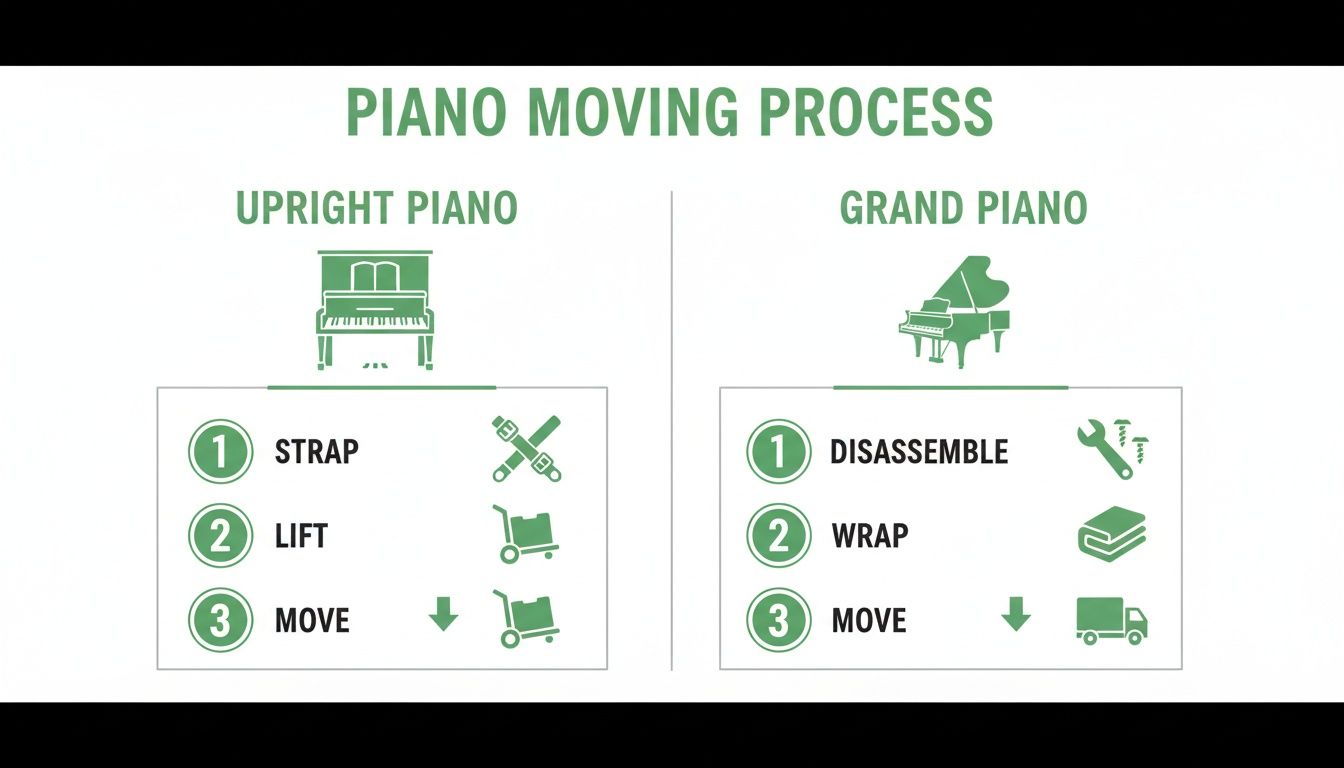
As you can see, while an upright needs careful securing, a grand piano is a different beast altogether. It requires significant disassembly before we can even think about tackling a tight spot.
Mastering the Pivot and Turn
Tight corners pose their own unique puzzle. Picture this: you’ve got a 250 kg instrument and you need to get it around a sharp 90-degree turn without taking out a chunk of the wall. This is where a professional technique we call the ‘tip and turn’ comes into play. We carefully tilt the piano onto its side while it’s on the dolly, which shrinks its footprint just enough to gently guide it around the corner.
This is never a one-person job. It takes at least two people—one to guide the turn and another to spot and stabilise. It’s a slow, deliberate movement where every single centimetre matters. Rushing is simply not an option.
Navigating stairs and tight corners safely is the true art of piano moving. It’s where experience and specialised gear transform a high-risk situation into a controlled, methodical, and successful operation, protecting your valuable instrument every step of the way.
The Reality of Perth’s Stairways
Here in Perth, especially with our hilly suburbs, stairs are just part of the landscape. They’re an incredibly common challenge on the job. In fact, we estimate that around 62% of relocations in the Perth metro area involve at least one flight of stairs. This single factor can turn a standard move into a complex operation.
For us, it means bringing out the piano boards and straps to safely manage loads that can be anywhere from 250-500 kg. As this industry analysis on moving costs explains, having the right professional equipment is crucial for avoiding the shockingly high injury rates you see with amateur attempts.
How to Choose the Right Piano Mover in Perth
Deciding to hire a professional is the smartest move you can make. But here’s the thing: not all removalists are created equal, and choosing the right one in Perth requires a bit of homework. A general moving company might be fantastic with your boxes and sofas, but a piano is in a different league entirely.
You need a specialist. A team that doesn’t just see a heavy piece of furniture but understands the intricate, delicate instrument inside.
Your search should focus on companies with proven, specific experience in piano relocations. When you call around for quotes, don’t just ask if they move pianos. Get specific. Ask how many they move in a typical month. An experienced team will answer this question confidently and can tell you about their specialised gear, like piano trolleys, skid boards, and protective wraps.
Critical Questions to Ask Potential Movers
Before you even think about booking, you need to vet the companies properly. A true professional will welcome your questions and have clear, reassuring answers. A mover who gets defensive or vague is a major red flag.
Have a list of questions ready when you call:
- What’s your experience with my specific type of piano? Moving a small upright is a world away from dismantling and relocating a baby grand. You need to know they’ve handled your model before.
- What specific equipment do you use for piano moves? Listen for keywords like piano dollies (not a standard furniture dolly), skid boards for stairs, thick moving blankets, and heavy-duty straps.
- Can you provide proof of insurance? This is non-negotiable. Ask to see their Goods in Transit insurance policy and make sure it covers the full replacement value of your piano.
- Is your quote all-inclusive? Get it in writing. Confirm if the price includes GST and any potential extra charges for stairs, tight corners, or tricky access points.
These questions are your best tool for filtering out the generalists from the true specialists. It’s about entrusting your instrument to the most capable hands.
Understanding the Quote and Local Costs
Getting a quote isn’t just about looking at the final number on the page. It should be a completely transparent breakdown of the costs involved. The price will naturally be influenced by the piano type (uprights are generally cheaper to move than grands), the distance of the move, and any access challenges like stairs or narrow hallways.
A professional mover doesn’t just see a heavy object; they see a valuable, delicate instrument. Their quote reflects the specialised care, equipment, and expertise required to protect your investment from start to finish.
In Perth, a mover’s local knowledge is a massive advantage. A team familiar with the city’s diverse architecture, from the tight laneways in Fremantle to the sprawling homes in the Hills, can anticipate challenges and give you a more accurate, fixed-price quote. To get a feel for how these costs are structured, you can explore our guide on Perth removalists hourly rate. This kind of insight helps you avoid nasty surprise fees on moving day.
For more general advice on vetting professional services, these tips for choosing a reliable contractor are a great read, as many of the core principles apply here too.
Ultimately, choosing the right mover comes down to finding that perfect balance of experience, proper equipment, and transparent pricing. Doing your due diligence now is the single best thing you can do to guarantee a smooth, stress-free move for your piano.
Common Piano Moving Questions Answered
Even with the best plan in place, you’re probably still mulling over a few details about moving your piano. It’s completely normal. To help put your mind at ease, I’ve pulled together the questions we get asked most often here in Perth, answered with the kind of insight you only get from years of being on the job.
These are the little things that can make a huge difference between a stressful day and a smooth, successful move for you and your instrument.
Does My Piano Need Tuning After a Move?
Yes, it’s a non-negotiable. No matter how gentle the journey, the vibrations from the truck and the shift in temperature and humidity between the old place and the new will throw its tuning out of whack. It’s just the nature of the beast.
The key is patience. We always advise clients to let the piano settle into its new environment for at least two to four weeks before calling in a tuner. This gives the wood, the felt, and the strings time to acclimatise, meaning your new tuning will actually hold and sound right for longer.
Is a DIY Move Really Cheaper?
It’s tempting to think you can save a few bucks by doing it yourself, but this is one of those times where the upfront saving is a massive gamble. Once you start adding up the real costs – hiring a truck with a hydraulic lift, renting a proper piano dolly and skid board, and buying all the necessary straps and blankets – you’ll find the gap between DIY and professional movers isn’t as big as you thought.
But the real kicker is the risk. A single slip can lead to a cracked soundboard, a snapped leg, or a nasty gouge in your floorboards. Repairs for that kind of damage can easily run into the thousands. Professional movers are insured for exactly these kinds of worst-case scenarios. That insurance isn’t just a piece of paper; it’s peace of mind.
The true cost of moving a piano isn’t what’s on the quote. It’s the potential cost if anything goes wrong. Hiring pros is an investment in making sure your instrument arrives in one piece, guaranteed.
How Long Does a Piano Move Take?
This really comes down to the specifics of the job. A simple move from a ground-floor house to another one just down the road? We could be in and out in as little as two hours.
On the other hand, the clock starts ticking when we run into challenges. The job can easily stretch to four hours or more if we’re dealing with:
- Hauling it up or down flights of stairs.
- Working with lifts and navigating tight apartment corridors.
- The meticulous process of disassembling and reassembling a grand piano.
Any good mover will give you a clear time estimate with their quote after they’ve asked about the access at both ends. That way, there are no surprises on moving day.
Can You Move a Piano in the Rain?
Absolutely. Here in Perth, you have to be ready for anything. A professional crew will always show up prepared with heavy-duty, waterproof covers to make sure your piano stays completely dry from door to door. We also take extra care to make sure our paths are clear and slip-free.
That said, our number one priority is always safety. If we’re talking about a serious downpour or dangerous, stormy conditions, we’ll be in touch to find a better, safer time to reschedule.
Ready to make your piano move simple and stress-free? The experienced team at Emmanuel Transport treats every instrument with the care it deserves. Get your free, no-obligation quote today!
