
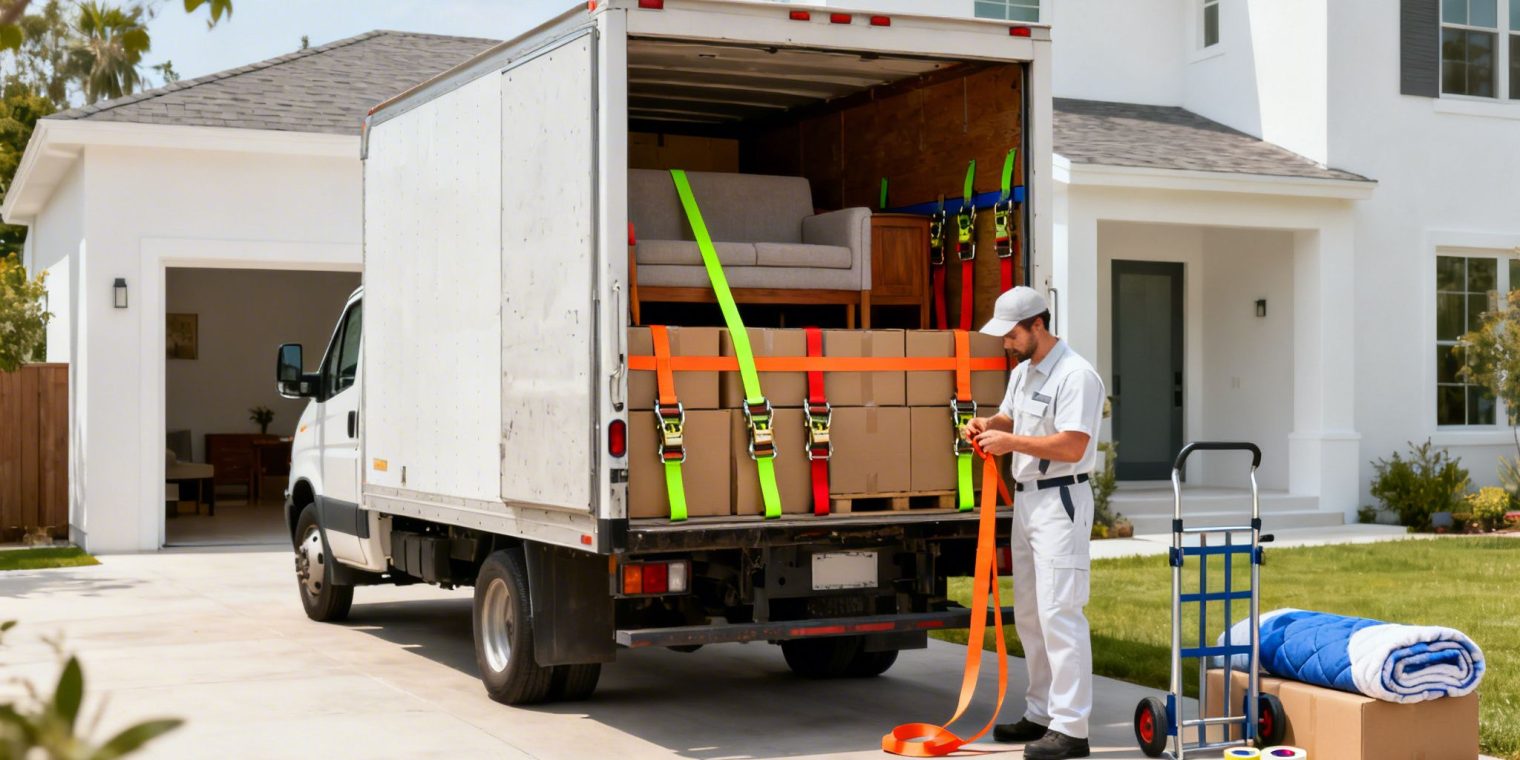
A successful move doesn't start when you lift the first box. It actually begins much earlier, with careful planning and preparation. Getting everything ready beforehand is the secret to a smooth, efficient loading day and, most importantly, ensuring your belongings arrive in one piece.
Your Game Plan for a Flawless Move

Let's be honest, moving day can be chaotic. But the difference between a stressful scramble and a well-oiled operation is having a solid game plan. Think of this prep phase as setting the stage—every bit of organisation you do now will pay off tenfold when the truck arrives.
First things first, you need the right tools for the job. And I’m not just talking about cardboard boxes. To do this properly, you’ll need a few key supplies.
-
Moving Blankets: You can never have too many. These are your first line of defence against scratches, scuffs, and dings on all your furniture.
-
A Sturdy Dolly: For heavy appliances like your fridge or washing machine, an appliance dolly with straps is a lifesaver. A standard hand truck is also brilliant for zipping stacks of boxes out to the truck.
-
Tie-Down Straps: Get some good ratchet straps. These are non-negotiable for locking everything down inside the truck and preventing items from shifting around corners.
-
Packing Tape and Stretch Wrap: You will use more tape than you ever thought possible. Stretch wrap is also incredibly useful for holding blankets in place or keeping drawers from flying open.
Dismantle Everything Possible
Once you have your supplies, it's time to start breaking down your large furniture. This isn't just a clever way to save space; it’s a crucial step for safety and maneuverability. Taking the legs off your dining table, disassembling bed frames, and removing shelves from bookcases makes them significantly lighter and far less awkward to carry.
Just be sure to keep all the hardware organised. Put all the screws, bolts, and brackets for each item into a labelled zip-lock bag and tape it securely to the largest piece it belongs to. Trust me, there’s nothing more frustrating than getting to your new place and realising you can’t find the bolts for your bed.
Pro Tip: I always recommend setting up a "staging area" near your front door. Pile up your dismantled furniture, wrapped items, and labelled boxes here. It creates a natural assembly line that makes loading the truck a systematic process and keeps pathways clear.
Create a Master Inventory List
This last step might feel a bit tedious, but creating an inventory list is a game-changer. Simply number each box and keep a list in a notebook or a spreadsheet detailing the contents and which room it belongs to (e.g., "Box 14 – Kitchen – Pots & Pans").
It’s a simple system that helps you keep track of everything, decide what to unpack first at the new house, and quickly check that all your belongings have made it. If you're looking for a great way to stay on top of it all, check out our complete moving planner for checklists and other resources. A little prep work now makes all the difference on moving day.
Choosing the Right Moving Truck for Your Home
Getting the truck size right is probably one of the most critical decisions you'll make for your move. I've seen it time and time again: the right truck means a smooth day, but the wrong one can turn your move into a nightmare of multiple trips, extra fuel costs, and a dangerously overloaded vehicle trying to navigate Perth's roads.
This isn’t a guessing game. The size of your home is the best indicator of the truck you’ll need. It all comes down to cubic metres and matching that to the standard rental sizes available.
Matching Truck Size to Your Home
The most common mistake people make is underestimating just how much space their belongings will fill. A good rule of thumb I've always used is to plan for about 5.5 cubic metres (roughly 200 cubic feet) of truck space for every furnished room in your house.
-
Studio or 1-Bedroom Unit: You can usually get away with a small 3-metre van or a 10-12 foot truck. These are perfect for getting in and out of tight city apartment complexes.
-
2-Bedroom Home: Now you're looking at a 15-17 foot truck. This gives you enough room for the usual furniture, appliances, and a decent stack of boxes without feeling like a professional truckie.
-
3-Bedroom House: This is where you’ll need to step up to a larger vehicle, usually a 20-26 foot (about 6-8 metre) truck. This is the go-to size for most Perth families moving a full household.
It’s easy to be tempted by a smaller, cheaper truck, but trust me, it’s a false economy. The money you "save" is quickly eaten up by extra trips and wasted time. To get a really accurate figure, it's worth taking a moment to use our handy truck size calculator and find the perfect fit for your move.
You might be surprised to learn that choosing the right truck size prevents 80% of common packing pitfalls. A 2026 analysis of WA metro areas found that undersized rentals led to 2.7 extra trips on average for Perth families, costing them over $250 in fuel and time. You can read the full analysis on loading strategies and their impact.
Booking and Safety Considerations
Keep the calendar in mind, too. Summer and the end of any month are the busiest times for moving, so truck availability can be scarce. My advice is to book your truck several weeks in advance to avoid missing out.
Ultimately, picking the right truck isn't just about making everything fit; it's about safety. An overloaded or poorly balanced truck is a real hazard—it's harder to control, takes longer to brake, and is a pain to manoeuvre. If you’ve got a large home, valuable antiques, or just aren't confident, leaving it to the professionals is the smartest move. A team like Emmanuel Transport takes the guesswork out of it completely. We know exactly what size vehicle is needed to get the job done in a single, safe, and efficient trip.
Right, let's talk about the most critical part of the entire move: loading the truck. This is where the real game of Tetris begins, and how you start will determine whether your belongings arrive in one piece.
We always, always start with the heaviest and bulkiest items. It's not just a tradition; it’s basic physics. By placing your heaviest gear at the very front of the truck, right up against the cab, you create a stable, low centre of gravity. This single step makes the truck far less likely to sway on the road and gives you a solid foundation to build upon.
Think of it as laying the cornerstone for a house. If that first piece isn't secure, everything you stack on top is at risk.
Creating a Solid Foundation with Appliances and Heavy Furniture
Your big-ticket items are first up the ramp. We’re talking about:
-
Refrigerators
-
Washing machines and dryers
-
Solid timber dressers
-
Large, heavy cabinets
Grab your dolly and carefully guide these pieces up the ramp, pushing them flush against the front wall.
The key here is to balance the load. Don't just shove everything to one side. If you place a heavy fridge on the left, try to put the washing machine or a heavy chest of drawers on the right to counterbalance it. This side-to-side balance is just as important as front-to-back for keeping the truck stable during transit.
Choosing the right size truck is half the battle, giving you enough floor space to distribute weight properly.

Getting this part wrong is the number one cause of moving day heartbreak. In Perth alone, where over 12,000 households move locally each year, poor loading is a constant headache. A recent survey even found that a staggering 68% of DIY movers in WA reported broken items because of an unbalanced load. You can dig deeper into research on professional moving techniques to see just how much of a difference it makes.
The "I" Formation: A Pro Technique for a Secure Base
Once your appliances are in, it’s time for the rest of your large, boxy furniture—things like bookshelves and chests. A brilliant technique the pros use is called the 'I' formation.
Imagine placing a large item flat against the front wall. Now, place two similar-sized items on either side of it, but turned perpendicular so they run along the truck's side walls. You’ve just created a capital 'I'. This locks your furniture together and creates perfect, contained nooks for stacking boxes into later on.
Pro Tip: Always load dressers with the drawers facing the truck wall. It’s a simple trick that stops them from flying open on the road, even if you forgot to tape or wrap them shut.
After you’ve built this first row of heavy items, stop and secure it. Use your ratchet straps to create a tight 'X' pattern across the front of the items, hooking them into the E-tracks or wooden slats along the truck walls. This base layer needs to be rock-solid before you even think about adding the next tier.
Honestly, this part can be a lot to handle, especially with expensive or awkwardly shaped furniture. If you’re feeling a bit out of your depth or worried about damaging your most valuable items, it’s often smarter to call in the professionals. The team at Emmanuel Transport has this down to a fine art and can build a perfectly balanced load without breaking a sweat.
Alright, with the big, heavy furniture locked in place, you've got a solid foundation. Now it’s time to build upwards with your boxes. This is where you can really make or break a move – it’s all about creating tight, secure walls of boxes that won’t shift, topple, or crush each other on the road.
There’s one rule that’s absolutely non-negotiable: heavy boxes on the bottom, medium in the middle, and light ones on top. I’ve seen countless moves go wrong because someone ignored this. It’s the single biggest reason items get broken, and it’s completely avoidable.
The Heaviest-to-Lightest Stacking Method
Think of the first layer of boxes as an extension of your furniture base. Right on the floor of the truck and on top of sturdy items like chests of drawers, you'll place your heaviest boxes. We’re talking about the ones packed with books, tools, canned food, or your cast-iron cookware. These boxes need to be strong and taped securely, as they’ll be supporting everything above them.
Once that foundation is set, you can start on the next tier with your medium-weight boxes. This is where you’ll put things like kitchen dishes, small appliances, and folded clothing. Stack them directly on top of the heavier boxes, aiming to create stable, straight columns.
The very top layer, reaching towards the truck’s ceiling, is exclusively for your lightest boxes and soft items. This is the spot for boxes of linen, pillows, kids' toys, and any duffle bags. You can even use rolled-up rugs, duvets, and cushions to cram into any gaps at the top, which helps lock the whole stack in place.
We see the consequences of poor stacking all the time. In fact, following a 15% surge in local house moves in Perth back in 2026, a report found that a staggering 73% of damage claims in the metro area were due to crushed lightweight boxes. It's no joke. You can see more on how proper stacking prevents damage at move.org.
Creating Stable Columns and Filling Gaps
As you stack, you need to think like a bricklayer. The goal is to build dense, interlocking walls of boxes that run from the floor to the ceiling. Avoid leaving big, empty channels between your box columns—that’s just an invitation for things to fall over the second the truck hits a bump.
-
Build in walls: Work methodically from one side of the truck to the other. Build a complete floor-to-ceiling wall before starting the next section.
-
Stagger the seams: If your boxes are a uniform size, try to stagger them like bricks in a wall. This simple trick adds a surprising amount of stability.
-
Fill every gap: Use your soft items—cushions, blankets, stuffed animals—to fill any and all voids. This stops the minor vibrations and shifts that can cause scratches and breaks over a long drive.
Before you move on, give the wall of boxes you just built a firm push. Does it wobble? If so, you need to either re-stack for a better fit or cram more soft fillers in until it’s rock solid. Getting an accurate box count beforehand really helps with planning; you can get a good idea of what you're working with by using our comprehensive packing calculator.
Don't forget your labels, either. Make sure every box is clearly marked on the top and at least two sides with its contents and the room it belongs to. This isn't just for easy unloading—it’s crucial during loading so you can instantly tell a heavy box from a light one at a glance.
Protecting Fragile Items and Securing the Load

You're on the home stretch. Now it's all about locking everything down and giving your fragile items the five-star treatment they deserve. A perfectly loaded truck has zero empty space for a very good reason: movement is the enemy.
The best way to stop things from shifting around is to use high-quality ratchet straps. Don't just run a single strap horizontally across a tier of boxes. To really lock it all in, create a large 'X' pattern across each vertical section you've built. This pulls everything inwards and downwards, pinning the load securely against the truck walls and the items behind it.
Handling Special and Fragile Items
Some of your most prized possessions won't fit neatly into a standard box. I’m talking about those awkward, delicate items like mirrors, paintings, and that big-screen TV you love.
-
Mirrors and Artwork: These need to be wrapped in several layers of thick furniture blankets or bubble wrap. They must always be loaded on their edge, standing vertically—never lay them flat. The safest spot is wedged securely between two soft, flat surfaces, like your mattress and the side of a sofa.
-
Flatscreen TVs: If you were wise enough to keep the original box, now's the time to use it. If not, a specialty TV moving box from a packing supply store is money well spent. Just like mirrors, always keep them upright and find a spot where they’re cushioned and can't be crushed by a shifting load.
These fragile pieces belong somewhere in the middle of the truck. This protects them from the heavy vibrations at the rear and keeps them shielded by the surrounding furniture. If you're dealing with irreplaceable art or antiques, getting a professional quote for Perth removals and storage can give you some much-needed peace of mind.
The Art of Filling Every Gap
Your final task is to make your load one solid, unmovable mass. Every little pocket of air is a chance for something to vibrate, shift, and break. This is where all your soft, squishy items become your secret weapon.
The 'Mum's attic'—that little shelf above the truck's cab—is the perfect home for your most delicate items or your 'first night' bag. The ride is much smoother up there, making it ideal for electronics, small valuables, and anything you'll need as soon as you arrive.
Use your duvets, pillows, and rolled-up rugs to plug any gaps you see between furniture and boxes. Specialised clothing storage bags are great for protecting your clothes while also creating soft, stuffable bundles to fill larger voids.
Before you shut that roller door, give the last wall of items a firm push. Does anything wobble? If so, find another pillow or bag and cram it in there. When you’re done, the entire load should feel as solid as a rock.
When a DIY Move Isn't the Right Call
Learning to pack a moving truck like a pro is a great skill to have, and it can save you a fair bit of money. But let's be honest, it's not the right move for everyone, every time. Sometimes, tackling it all yourself goes from being a satisfying challenge to a genuinely bad idea—one that puts your belongings, and even your back, at risk.
Knowing when to step back and call in the professionals is about being realistic about your specific situation.
Red Flags for the DIY Mover
Some moves have "call for help" written all over them. If you’re looking at moving a grand piano, that antique wardrobe you inherited from your grandmother, or a collection of valuable art, the risk of damage is just too high. These aren't just 'heavy things'; they often need specialised wrapping, custom crates, and specific lifting gear that you won’t find at your local hardware shop.
The layout of your home is another massive factor. Are you on the third floor of an apartment block with no lift? Trying to pivot a heavy sofa down a narrow, winding staircase is a nightmare scenario. It's not just exhausting; it's a perfect recipe for gouged walls, splintered furniture, and a trip to the emergency room.
Time pressures can also turn a manageable DIY move into a disaster. If your lease is up or you have a tight settlement date, the rush can lead to sloppy packing and careless loading. Professional removalists bring an efficiency honed over thousands of moves. They can clear a house in hours, a task that might take you an entire weekend while juggling work and family.
Consider This: We often underestimate the sheer physical effort a move requires. If you have any pre-existing health issues, or simply aren't conditioned for hours of heavy lifting and carrying, going it alone can be a serious health risk.
At the end of the day, it's a judgement call. Take a hard look at the complexity of your move, the value of your items, and the physical toll it will take. For many people across Perth, from families in Joondalup to businesses shifting offices in the CBD, hiring a trusted local team isn't giving up—it's a smart, strategic decision.
When Expert Help Is a Smart Investment
Think about what a professional team really brings to the table. It's more than just muscle. It’s the expertise to load a truck for maximum stability, the experience to handle fragile items with care, and the local knowledge to navigate Perth’s suburbs without a hitch. That peace of mind is often worth every penny.
If your move involves any of those red flags—precious items, tricky access, a tight deadline, or physical limitations—it's time to seriously consider getting the pros in. Letting experts handle the heavy lifting ensures your belongings arrive safely and efficiently, leaving you with the energy to actually focus on starting your new chapter.
When the job is too big or too delicate for a DIY approach, the expert moving company team at Emmanuel Transport is ready to help. Get a free, transparent quote for your Perth move and let us make your next chapter a seamless one. Find out more at https://emmanueltransport.net.au.