
Moving house is often cited as one of life's most stressful events, but with a structured plan, it can be a surprisingly smooth transition. The key to a seamless relocation lies not in brute force, but in methodical preparation. A well-organised approach transforms an overwhelming marathon of tasks into a series of manageable, bite-sized steps, preventing last-minute panic and ensuring nothing critical is overlooked. This detailed moving house checklist is your blueprint for achieving exactly that.
We've designed this guide to serve as your central command for the entire relocation process. It organises the journey into a clear, timeline-based sequence, covering everything from crucial pre-move planning weeks in advance to the final tasks on moving day and the essential follow-ups after you’ve settled in. Forget generic advice; this listicle is packed with specific, actionable insights and practical examples to guide you. You will learn precisely how to research and book the right moving company, declutter your home effectively, and pack your belongings with a professional, strategic system.
Furthermore, we'll cover the critical administrative tasks, such as officially changing your address and organising the transfer of utilities, to avoid any service disruptions. We also provide guidance on preparing children and pets for the change, handling sensitive documents, and conducting a thorough final walkthrough of your old property. Whether you're moving a large family home across the state or a small apartment locally, this checklist provides the structure needed to execute your move with precision and minimal stress. It's your complete roadmap from your current front door to your new one, designed to keep you in control every step of the way.
1. Create and Notify Change of Address
One of the most critical administrative tasks in any moving house checklist is systematically updating your address. Failing to do this can lead to missed bills, lost personal documents, and disruptions to essential services. This process involves notifying a wide range of organisations, from government agencies to subscription services, ensuring a smooth transition of your mail and accounts to your new home. It’s a task that requires careful planning and organisation, ideally beginning 4 to 6 weeks before your moving day.
Organising Your Address Change Notifications
The key to a successful address update process is creating a master list. A simple spreadsheet is perfect for this. List every organisation you need to contact, including columns for the date notified, the method used (online, phone, mail), and a confirmation reference. This creates a clear record and helps you track your progress.
Start with the most critical entities first:
- Government Agencies: Prioritise updating your details with the Australian Taxation Office (ATO), the Australian Electoral Commission (AEC), and Medicare to ensure you continue to receive important official correspondence.
- Financial Institutions: Contact your banks (like CommBank or ANZ, which offer easy online portals), superannuation funds, and any loan providers. For highly sensitive accounts, consider sending a formal letter via registered post for added security.
- Utilities and Services: Notify your electricity, gas, water, and internet providers. Most have a structured process for transferring services to a new address, which can often be initiated online.
Timing Your Notifications
The following timeline visualises the ideal schedule for notifying different types of organisations to ensure a seamless transition.
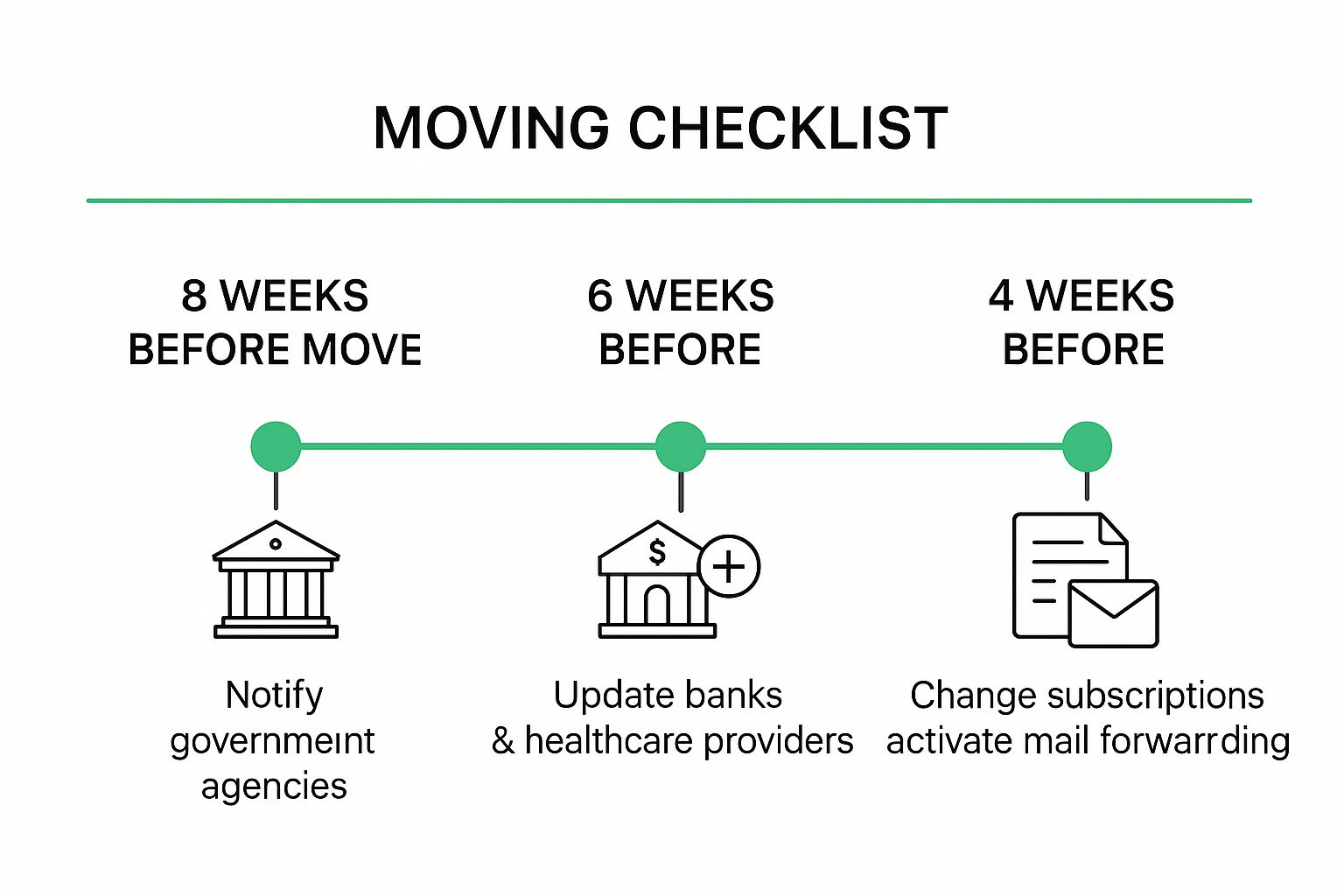
This structured timeline ensures that high-priority government and financial updates are handled well in advance, preventing any service interruptions.
Key Insight: Don’t underestimate the time this takes. Always capture a screenshot of online confirmation pages or note down reference numbers. For an extra layer of protection, use Australia Post’s mail redirection service for at least 6 months. This acts as a safety net, catching any mail from organisations you may have forgotten to notify. To simplify sending out physical change-of-address notices to friends and family, consider ordering a batch of pre-printed return address labels with your new details.
2. Research and Book Moving Company
Selecting the right moving company is a cornerstone of a successful moving house checklist, directly impacting the safety and security of your belongings. This step involves more than just finding the cheapest option; it requires thorough vetting, comparing multiple quotes, and understanding contract terms to ensure your possessions are handled by reputable, insured professionals. Making an informed choice prevents potential disasters like damaged goods, hidden fees, or even scams, and it should be a priority task initiated 6 to 8 weeks before your move date.
Vetting and Comparing Moving Services
A systematic approach is essential when choosing a removalist. Begin by creating a shortlist of potential companies, drawing from online searches, recommendations from friends, and real estate agent suggestions. Your goal is to gather at least three comprehensive, in-home or video-call-based written estimates. This allows for an accurate comparison of costs, services included, and proposed timelines.
Look for companies with a strong track record and clear credentials:
- Established National Networks: Companies like Two Men and a Truck offer extensive reach and standardised service levels across numerous locations, providing reliability for interstate moves.
- Specialised Local Expertise: For moves within a specific area, local professionals often provide tailored services. If you're relocating within Perth's northern suburbs, for example, researching specialist Joondalup removalists can connect you with experts familiar with the region.
- Industry Accreditation: Check if the company is a member of the Australian Furniture Removers Association (AFRA). AFRA members are held to high standards, including having the right equipment and insurance coverage.
Key Considerations When Booking
When you have your quotes, scrutinise the details. A low price might be tempting, but it could signify a lack of proper insurance or inexperienced staff. Confirm that any quote includes transit insurance to protect your items while they are on the truck. Also, clarify the policy on potential damages and the claims process before signing any agreement. Avoid companies that demand a large cash deposit upfront or provide a vague, non-binding estimate over the phone.
Key Insight: Never rely solely on a company's own testimonials. Perform your own due diligence by checking recent, independent reviews on platforms like Google, ProductReview.com.au, and social media. Before the movers arrive, take photos of your high-value items to document their pre-move condition. This creates an objective record that can be crucial if you need to make an insurance claim later.
3. Declutter and Organise Belongings
A crucial step in any successful moving house checklist is systematically decluttering your possessions. This process involves deciding what to keep, donate, sell, or discard before you even think about packing. Not only does this reduce the volume of items to be moved, saving you money on removalist fees and packing supplies, but it also allows you to start fresh in your new home without unnecessary clutter. It’s a task that should begin at least 6 to 8 weeks before your moving day to avoid a last-minute rush.
A Systematic Approach to Decluttering
To avoid feeling overwhelmed, adopt a structured method. A room-by-room approach is often the most manageable. Focus on one room at a time, creating four distinct zones or using labelled boxes: Keep, Donate, Sell, and Discard. This categorisation prevents you from simply moving items from one pile to another.
Consider popular decluttering philosophies for inspiration:
- The KonMari Method: Popularised by Marie Kondo, this method encourages you to handle each item and ask if it "sparks joy". If it doesn't, you thank the item for its service and let it go. This is particularly effective for sentimental items.
- Swedish Death Cleaning (Döstädning): This practical approach, from Margareta Magnusson, involves getting rid of superfluous items to make life easier for yourself and those you leave behind. It’s a pragmatic way to assess the true value of your belongings.
- The One-Year Rule: A simple and effective rule of thumb. If you haven't used an item in the past year, it’s a strong candidate for donation or sale.
Executing Your Decluttering Plan
Once you've sorted your items, act quickly to clear the space. For items you plan to sell, use platforms like Facebook Marketplace or Gumtree for local sales; price them for a quick sale rather than maximum profit. For donations, research local charities like Salvos or Vinnies, and check their websites for what items they accept and if they offer a pickup service for larger furniture. Remember to get receipts for donations, as they can sometimes be used for tax purposes.
Key Insight: Decluttering can be an emotionally and physically draining process. Start small with a single drawer or cupboard to build momentum. If you find you have numerous items you want to keep but won't have space for in your new home, consider a temporary solution. Exploring options for secure and affordable self-storage can be a lifesaver, allowing you to move with less stress and make decisions about those items later.
4. Transfer Utilities and Services
A seamless transition between homes relies on the coordinated transfer of essential utilities. This part of your moving house checklist involves disconnecting services like electricity, gas, water, and internet at your old address and activating them at your new one. Proper scheduling is paramount to avoid being left without power or internet on moving day, and it also prevents you from paying for services at two properties simultaneously. This task should be initiated 2 to 3 weeks before you move to allow providers enough time to process your request.
Organising Your Utility Transfers
To manage this process efficiently, add a dedicated section for utilities to your master moving spreadsheet. List each provider (e.g., AGL for electricity, Telstra for internet), your account numbers, and columns to track the disconnection and connection dates. This creates a clear overview and ensures no service is overlooked.
Begin by identifying your current providers and then research which companies service your new address. This is a great opportunity to compare rates and potentially find a better deal.
- Energy Providers: Contact your electricity and gas companies. Many, like Origin Energy or AGL, have online moving portals that simplify the process of transferring your account or setting up a new one.
- Water Services: Notify your local water corporation. These organisations, such as Sydney Water or Melbourne Water, typically require at least 48 to 72 hours' notice to arrange a final meter reading and establish service at the new property.
- Internet and Phone: Get in touch with your telecommunications provider (e.g., Telstra, Optus). Internet connections, especially for NBN, can take time to activate, so scheduling this well in advance is crucial to ensure you’re connected when you arrive.
Timing Your Utility Switch
Plan the timing of your connections and disconnections carefully. Arrange for utilities at your new home to be connected the business day before you move in. This ensures everything is working when you arrive with the first box. Schedule the disconnection at your old home for the business day after you have completely moved out, giving you a buffer for any final cleaning or inspections.
Key Insight: On your last day at the old property, take clear photos of the final readings on your electricity, gas, and water meters. This provides irrefutable proof of your usage up to the disconnection date, protecting you from potential billing disputes. Keep a folder with all provider contact details and confirmation numbers easily accessible in your essentials box, so you can quickly resolve any issues that may arise on moving day.
5. Pack Strategically and Label Everything
A systematic approach to packing is a cornerstone of any successful moving house checklist, transforming a potentially chaotic process into a manageable task. Strategic packing involves more than just putting items in boxes; it’s about using appropriate materials, proven techniques, and a clear labelling system to ensure everything arrives safely and can be unpacked efficiently. This method minimises stress on moving day and significantly speeds up the process of settling into your new home, making it an indispensable part of your plan.
This process should begin at least 3-4 weeks before your move, starting with rooms and items you use least often, like guest rooms or seasonal decorations.
A Systematic Approach to Packing
The key to effective packing is a disciplined, room-by-room strategy. This prevents you from feeling overwhelmed and ensures items from the same room stay together. A digital inventory app like Sortly can be invaluable for tracking valuable items, allowing you to photograph and log everything before it's packed.
Start by gathering all necessary supplies:
- Quality Boxes: Use sturdy, new boxes in various sizes. Reusing old supermarket boxes can be risky as they may have hidden weaknesses or pests.
- Protective Materials: Stock up on bubble wrap, packing paper, and even old linens or towels to cushion fragile items.
- Labelling System: Use permanent markers and consider colour-coded labels (e.g., blue for kitchen, red for master bedroom) for at-a-glance identification.
Packing and Labelling Techniques
Proper technique is crucial for protecting your belongings. The following video demonstrates professional packing methods that you can easily adopt.
Always label boxes on the top and at least two sides with the destination room and a brief summary of contents (e.g., "KITCHEN – Mugs & Glasses"). Mark boxes containing breakables as "FRAGILE".
Key Insight: Create an "Open First" box for each family member and for the house itself. This box should contain essentials for the first 24 hours: toiletries, a change of clothes, medications, phone chargers, basic tools, toilet paper, and coffee-making supplies. This saves you from desperately searching through dozens of boxes for a toothbrush on your first night. If the task feels too daunting, engaging professional packing services can be a worthwhile investment. Discover the benefits of professional packing services in Perth to save time and ensure your items are handled with expert care.
6. Handle Important Documents and Records
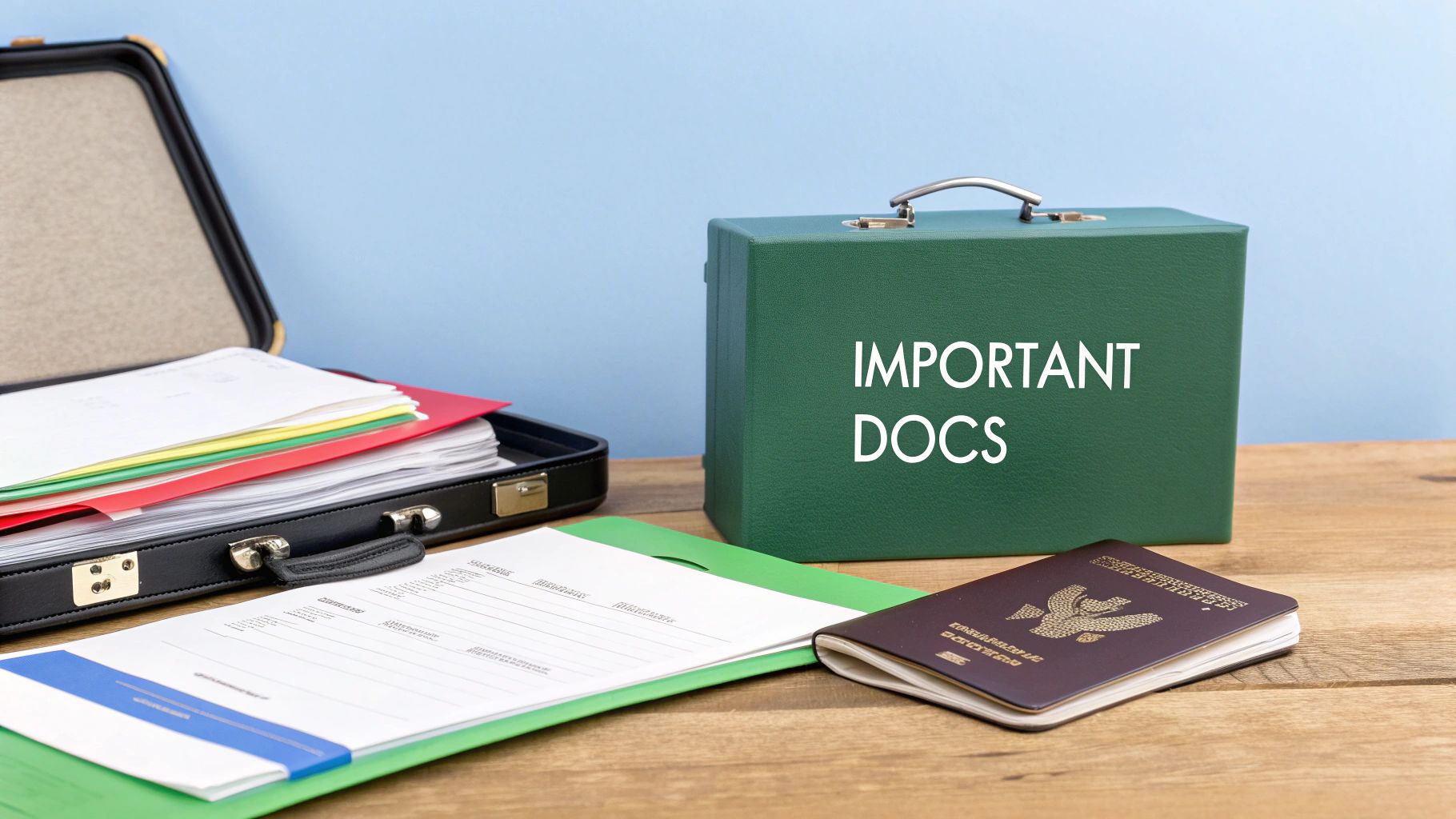
One of the most overlooked yet critical tasks in any moving house checklist is the secure management of your essential personal documents. Amidst the chaos of packing boxes and organising logistics, vital papers like birth certificates, passports, and financial statements can easily be misplaced or damaged. Properly handling these documents ensures continuity of services, protects you from identity theft, and guarantees you have everything you need during the transitional period. This process should be started 3 to 4 weeks before your move to allow ample time for requests and organisation.
Organising Your Vital Records
The first step is to create a centralised, portable file system for all your irreplaceable documents. A dedicated file box or accordion folder labelled “DO NOT MOVE” is ideal. This ensures these items are transported by you personally, not packed away with the movers. Begin by gathering and sorting all critical paperwork.
Start by categorising your documents for clarity:
- Personal Identification: Passports, birth certificates, citizenship papers, and marriage certificates.
- Financial and Legal: Wills, deeds, car titles, bank statements, tax records, and superannuation details. If your move involves buying or selling a property, ensuring meticulous management of all real estate-related documents is paramount. You can find more expert tips on real estate document management to streamline this complex process.
- Medical and Educational: Medical histories, vaccination records, and school transcripts. If you're moving to a new area, contact your current doctor and schools to request record transfers to your new providers, a process that can take several weeks.
Creating Digital Backups
For an added layer of security, create digital copies of every important document. Use a high-quality scanner or a smartphone app to capture clear images of each page. Store these digital files in a secure, encrypted cloud service like Dropbox or Google Drive, protected with a strong, unique password and two-factor authentication. This provides a crucial backup in case the physical copies are lost or destroyed.
Key Insight: Never pack your essential documents in a moving box that goes on the truck. Keep this "essentials file" with you at all times during the move. For maximum protection, consider keeping a set of digital copies on an encrypted USB drive stored separately from your primary file box, perhaps with a trusted friend or family member. This redundancy is your best defence against unforeseen circumstances.
7. Prepare Children and Pets for the Move
Moving can be an emotionally taxing experience, especially for children and pets who thrive on routine and familiarity. A key part of any comprehensive moving house checklist is managing their transition with care and empathy. Addressing their anxieties and practical needs proactively can prevent behavioural issues and make the adjustment to a new home a positive experience for the entire family. This process involves clear communication, maintaining stability, and creating positive associations with the move, starting several weeks before the big day.
Supporting Children Through the Transition
The key to helping children adapt is to involve them in the process in an age-appropriate way. Open communication helps demystify the move and gives them a sense of control. For younger children, books like 'The Berenstain Bears' Moving Day' can be excellent tools for explaining what will happen.
Start by focusing on the practical and emotional preparations:
- School and Community: If changing schools, arrange a visit to the new school and neighbourhood beforehand. Contact the school counsellor to discuss transition support. Research local parks, libraries, and clubs to highlight exciting new opportunities.
- Involvement and Ownership: Allow children to pack a special box of their favourite toys and essentials. Let them help choose their new room’s paint colour or layout. A visual countdown calendar can also make the timeline feel more manageable and exciting.
- Maintain Routines: As much as possible, stick to regular schedules for meals, playtime, and bedtime. This consistency provides a crucial sense of security amidst the chaos of packing.
Ensuring a Smooth Move for Pets
Pets are highly sensitive to changes in their environment, and the disruption of a move can be a major source of stress. Your preparation should focus on minimising this stress and ensuring their safety and comfort throughout the process.
Follow a structured plan to manage their needs:
- Veterinary Preparations: Schedule a check-up before you move. This is the time to update vaccinations, get copies of their medical records, and discuss travel anxiety solutions, such as prescribed calming medications if necessary.
- Create a Safe Haven: On moving day, confine your pet to a quiet, secure room with their food, water, litter box, and familiar toys. This prevents them from escaping or getting underfoot.
- Familiarity is Key: Pack your pet’s essentials, like their bed, favourite blanket, and toys, last. Unpack these items first in the new home to create a familiar-smelling, comforting space for them immediately upon arrival. For long-distance relocations, specialised pet relocation services can manage the logistics safely and professionally.
Key Insight: The emotional well-being of children and pets is as important as any logistical task. Their comfort items, whether a favourite teddy bear or a well-worn cat bed, should be treated as high-priority items. Pack these in a clearly labelled “Open First” box that travels with you in the car, not the moving van. This ensures they have immediate access to sources of comfort and familiarity as soon as you arrive at your new home.
8. Conduct Final Walkthrough and Inspection
A final walkthrough is an essential step in any moving house checklist, serving as your last opportunity to verify the condition of both your old and new properties. This systematic inspection protects your bond or security deposit at the old residence by documenting its condition upon departure. At the new home, it ensures all agreed-upon repairs have been completed and identifies any new issues before you take legal possession. This formal process, involving detailed checklists and photographic evidence, prevents disputes and unexpected costs.
Organising Your Final Inspections
The key to a thorough walkthrough is a methodical approach. Use a dedicated checklist for each property, either a digital one using an app like RentSpree or a detailed paper version. This ensures you don't miss anything critical during the inspection. It's best to schedule these walkthroughs during daylight hours for optimal visibility.
Systematically check each room and document its condition:
- For the Old Property: Your goal is to prove you are leaving it in the condition required by your lease or sales agreement. Take photos and videos with timestamps to document that it's clean, empty, and undamaged. This evidence is invaluable if any disputes over your bond arise later.
- For the New Property: This is your chance to confirm everything is as it should be. Check that all inclusions from the sale or lease are present, test all appliances, and verify that any negotiated repairs have been finished to a satisfactory standard. According to real estate closing procedures, this is the final point to raise concerns before settlement.
- Utilities and Fixtures: In both properties, test all electrical outlets, light switches, and fixtures. Run water in every sink and shower, flush all toilets to check for leaks or pressure issues, and open and close all windows and doors to ensure they function correctly.
Timing and Documentation
The final walkthrough of your old property should occur after all your belongings have been removed and it has been professionally cleaned. For your new home, the inspection is typically scheduled 24 to 48 hours before the final closing or key handover. This timing is crucial as it ensures the property is in the exact condition you will be receiving it. Document every detail meticulously, no matter how minor it may seem at the time.
Key Insight: Never conduct a walkthrough alone. Bring your real estate agent, property manager, or a trusted friend to act as a witness. A second pair of eyes can spot things you might miss. Use your phone to take extensive, date-stamped photos and videos of every room, appliance, and any areas of concern. This digital record serves as indisputable proof of the property's condition at the time of inspection, protecting you from future liability.
Moving House Checklist: 8 Key Task Comparison
| Item | Implementation Complexity 🔄 | Resource Requirements ⚡ | Expected Outcomes 📊 | Ideal Use Cases 💡 | Key Advantages ⭐ |
|---|---|---|---|---|---|
| Create and Notify Change of Address | Moderate – requires detailed tracking & follow-up | Medium – time, records, mail forwarding service | High – prevents mail loss, identity theft, ensures service continuity | Moving households needing official and private updates | Prevents disruptions, maintains financial & voting status |
| Research and Book Moving Company | Moderate to High – verification, quotes, contracts | High – time for research, cost of service | High – safe, insured moving, less physical strain | Moves requiring professional transport and insurance | Professional handling, insurance, saves time |
| Declutter and Organize Belongings | Moderate – multiple sorting sessions | Low to Medium – time, donation drop-offs | Medium to High – lowers costs, simplifies packing | Moves aiming to reduce volume, selling, donating items | Cost savings, stress reduction, tax deductions |
| Transfer Utilities and Services | Moderate – coordination & scheduling | Medium – deposits, appointment scheduling | High – uninterrupted utilities, avoids double billing | Moves requiring timely utility switchovers | Ensures active services, avoids extra charges |
| Pack Strategically and Label Everything | High – systematic packing & labeling | Medium to High – packing materials, time | High – damage reduction, efficient unpacking | Moves requiring organized packing and damage prevention | Faster unpacking, damage protection, stress relief |
| Handle Important Documents and Records | Moderate – secure gathering & backups | Low to Medium – organizing, digital tools | High – prevents loss, identity theft, ensures continuity | Moves involving critical personal/legal records | Secure access, theft protection, continuity |
| Prepare Children and Pets for the Move | Moderate – emotional & practical preparations | Medium – time, vet/school coordination | Medium – reduced anxiety, maintained routines | Families with children and pets | Emotional stability, education & health continuity |
| Conduct Final Walkthrough and Inspection | Moderate to High – detailed inspection process | Low to Medium – time, documentation tools | High – protects deposits, identifies issues | Rental/end of lease or home purchase moves | Legal protection, issue identification |
Unlocking Your New Chapter with Confidence
Moving house is far more than a logistical challenge; it's a significant life transition, marking the end of one chapter and the beginning of another. The journey from your old front door to your new one can feel overwhelming, but it doesn't have to be a source of stress and chaos. As this comprehensive moving house checklist has demonstrated, the key to a smooth and successful relocation lies in structured, methodical preparation. By breaking down the monumental task of moving into a series of manageable, timeline-based actions, you reclaim control and transform potential anxiety into proactive confidence.
The true power of this checklist isn't just in the individual tasks it outlines. Its value is in the framework it provides, turning a vague idea of "moving" into a concrete project plan. From the crucial early steps of researching professional removalists and decluttering your life, to the meticulous details of labelling boxes and transferring utilities, each item is a vital building block. Overlooking even one of these pillars, such as failing to notify institutions of your change of address or neglecting to prepare your children for the change, can create significant, and entirely avoidable, complications down the line.
From Checklist to Confidence: Key Takeaways
The most successful moves are not a matter of luck; they are the result of deliberate and thoughtful organisation. As you reflect on the journey ahead, keep these core principles at the forefront of your planning:
- Proactive Planning is Paramount: Your greatest asset is time. Starting the process eight weeks out, as we've outlined, allows you to tackle tasks methodically without last-minute panic. This prevents rushed decisions that often lead to higher costs and increased stress.
- Declutter with Purpose: Moving is the ultimate opportunity to simplify. Every item you decide not to take is one less thing to pack, move, and unpack. Be ruthless in your decluttering. This not only lightens your physical load but also your mental load, allowing you to start fresh in your new home without the baggage of the old.
- Details Define the Experience: The small things truly matter. Proper labelling saves hours of frustration when you're unpacking. Creating an "essentials box" with daily necessities ensures your first night is comfortable. Conducting a final, thorough walkthrough guarantees you haven't left anything important behind, from personal items to your peace of mind.
Your First Steps in Your New Home
Once the last box is inside, your journey isn't quite over. The post-move phase is critical for settling in and establishing your new sanctuary. This is the time to focus on making the space truly yours and, most importantly, secure. As you unpack and organise, one of the first and most vital security measures you should take is ensuring you are the only one with keys to your property. For ultimate assurance, a crucial next step is rekeying your new home's locks, which is often simpler and more cost-effective than replacing them entirely.
Key Insight: A moving house checklist doesn't end when the truck drives away. It extends into the first few weeks in your new home, encompassing tasks like unpacking systematically, registering with local services, and securing your new environment.
By embracing this structured approach, you're not just moving possessions; you are orchestrating a seamless transition for yourself and your family. You are laying the foundation for a positive start in a new environment, free from the lingering chaos that so often accompanies a poorly planned move. With your checklist as your guide, you can confidently close the door on your old home and step eagerly into the exciting possibilities that await in your new chapter.
Ready to turn your checklist into action? For a seamless and professional moving experience in Perth, trust the experts at Emmanuel Transport to handle your belongings with the care they deserve. Book your move with Emmanuel Transport today and take the most important step towards a stress-free relocation.