
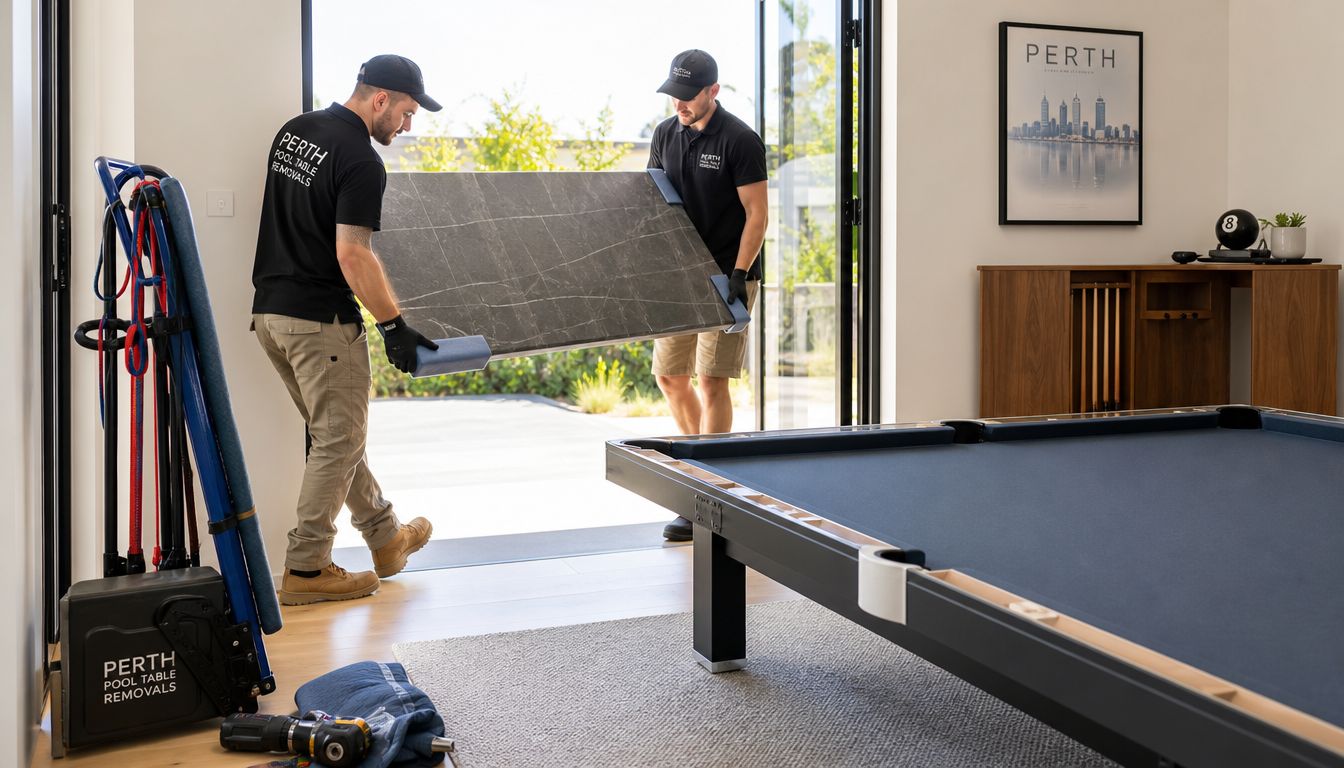
You’re usually not thinking about your pool table until moving day gets real. The truck is booked, the boxes are stacked, and then someone looks at the games room and realises the heaviest, most delicate item in the house is still sitting there like it owns the place.
That’s the moment pool table removal stops looking like “just another furniture job”. A proper billiard table isn’t a bookshelf you can muscle through a doorway with two mates and a trolley. It’s a precision-built piece of equipment made from timber, bolts, rails, stretched felt and, critically, slate that can crack, shift, or go back together badly if the move is rushed. If the table matters to you, the move plan matters too.
Table of Contents
- The 400kg Problem in Your Games Room
- DIY vs Professional Pool Table Removal
- Your Pre-Move Preparation Checklist
- How to Safely Disassemble a Pool Table
- Reassembly and Precision Levelling
- Why Perth Trusts Emmanuel Transport
- Pool Table Removal FAQs
The 400kg Problem in Your Games Room
A lot of homeowners hit the same wall. The table looked perfect when it was installed. It fit the room, it never needed to move, and it became part of the house. Then a sale settles, a renovation starts, or the table needs to go upstairs, downstairs, or across Perth. Suddenly, the centrepiece becomes a removal problem.
What catches people out is that a pool table is heavy in the wrong way. It’s not just overall weight. It’s awkward weight, concentrated weight, and fragile weight. The frame might look solid, but the table’s performance depends on parts staying square, labelled, protected, and reassembled with care.
Why it’s not just furniture
Most tables have rails, pockets, felt, and multiple slate sections underneath. Those components work together as a playing surface. If one slate piece shifts, if the felt stretches, or if the frame twists during transport, you can end up with a table that looks fine but plays badly.
That’s why Perth has a specialist market for this work. Find A Mover’s pool table removal guide notes that over 535 trusted pool table removalists are available in Perth, and approximately 90% of these removals require professional dismantling because DIY attempts can lead to cracked slate, torn felt, or misalignment.
Practical rule: If you’re asking whether the table can stay in one piece, the answer is usually no.
The homeowners who protect their table best usually make one decision early. They stop treating the table like a bulky item and start treating it like a precision asset. That’s the right mindset whether the table is a family favourite, part of a renovated games room, or one of the statement pieces you’d expect to see in well-designed entertainment spaces. If you’re refining the room around it, this advice for luxury homeowners gives useful context on how the table fits into the broader design and value of the space.
The real decision
Most guides jump straight into bolts, tools, and disassembly. Fair enough. But the first question isn’t how to remove a pool table. It’s whether the table, the access, and the destination make DIY sensible at all.
If you’ve got a straight run, wide access, and a table you can afford to risk, that’s one conversation. If you’ve got polished floors, tight corners, stairs, or a table you want playing properly on the other side of the move, that’s a very different job.
DIY vs Professional Pool Table Removal
If you’re deciding between doing it yourself and hiring specialists, compare four things. Cost, time, risk, and equipment tell the story better than confidence does.
What the numbers say about cost and weight
In Australia, Airtasker’s pool table removals page puts typical local pool table moves at $112 to $500, with Perth-specific rates often higher at $300 to $800. The same source notes that these tables commonly weigh 295 to 454 kg, with some slate pieces reaching up to 250 kg.
That range matters. DIY looks cheaper until you add the hidden costs of extra labour, tool hire, protective materials, possible vehicle limitations, and the risk of damaging either the table or the house. Professional removal costs more upfront, but that price often includes the part that ruins DIY jobs. Controlled handling.
Side by side comparison
| Factor | DIY Approach | Professional Service (e.g., Emmanuel Transport) |
|---|---|---|
| Cost | Lower upfront if you already have tools, help, and transport. Can climb fast if you need extra hands or repairs after the move. | Higher upfront, but clearer as a single service cost. In Perth, pricing often reflects dismantling, access issues, and heavy handling. |
| Time | Usually slower. Stops and starts are common when bolts seize, access is tighter than expected, or helpers aren’t confident with slate. | More structured. The team arrives with a process, allocates roles, and handles loading with fewer delays. |
| Risk | Highest risk sits with slate, felt, rails, floors, walls, and back injuries. Mistakes often show up later during play. | Lower handling risk because the team uses proven lifting methods, packing routines, and transport setup. |
| Equipment | You need the right sockets, staple remover, blankets, straps, trolley options, and enough safe lifting capacity. | Specialists bring the gear and know when standard moving tools aren’t enough. |
When DIY makes sense
DIY can work, but only under controlled conditions. The best-case DIY move usually has:
- Simple access: Ground floor, wide doorways, no tight turns, and no stairs.
- A capable team: Not just strong friends, but people who’ll listen, lift together, and stop when something feels wrong.
- A lower-stakes table: A table that doesn’t carry major financial or sentimental value.
Even then, there’s a difference between taking a table apart and putting it back into proper playing condition.
A pool table move fails most often after transport, not during it. The table arrives, gets reassembled, and never rolls true again.
When a professional is the better call
Professional pool table removal is the smarter option when the table is slate, the access is awkward, or the finish of the home matters. It also makes sense when your move already has enough variables and you don’t want one item consuming the entire day.
If you’re already comparing specialist movers for heavy and delicate work, this page on expert removalists in Perth gives a useful benchmark for what organised, careful handling should look like.
A simple test helps. If replacing the table, repairing the slate, or living with a poor roll would annoy you more than paying for a proper move, don’t DIY it.
Your Pre-Move Preparation Checklist
A smooth pool table removal starts before anyone touches a socket wrench. Most trouble comes from poor prep. Not from bad intentions.
Measure the route before the first bolt comes out
Start with the path out of the current room and the path into the new one. Measure doorways, hallway widths, stair landings, ceiling clearance, and any corner where the frame or slate will need to turn. Don’t guess. Don’t eyeball it.
Check the destination room as carefully as the pickup site. A table can leave one house cleanly and still become a problem at the other end if the floor is uneven, the access is tighter, or the room layout forces an awkward carry.
Get the right tools and staging area ready
Lay out a dedicated area for hardware and labelled parts. That alone prevents a lot of reassembly headaches.
Use a checklist like this:
- Socket wrench set: Needed for rail bolts and frame fasteners.
- Staple remover: Useful if the felt or pocket liners are stapled rather than glued.
- Power drill: Speeds up work, but use it carefully on older timber and threaded hardware.
- Zip bags and labels: Keep bolts, screws, washers, and brackets grouped by section.
- Furniture blankets: Protect rails, timber edges, and polished home surfaces.
- Heavy-duty straps and trolley support: Only if they suit the actual load and access conditions.
- Spirit level: Helpful for planning and checking, even if final levelling needs more precision.
Clear the house like a work zone
The route should be wide, dry, and free of rugs, toys, lamp stands, side tables, and anything that catches a boot or trolley wheel. Protect vulnerable points such as corners, stair balustrades, and freshly painted walls.
On-site check: The safest carry path is rarely the shortest one. It’s the one with the fewest stops, turns, and changes in height.
If you’re planning the broader move at the same time, a structured moving planner helps keep timing, room access, and item priority organised so the pool table doesn’t become a last-minute problem.
Decide the order of work
Don’t start dismantling until transport, labour, and room access are confirmed. A half-disassembled table sitting in a garage for days is more exposed to moisture, lost hardware, and accidental damage.
The best sequence is simple. Prepare the route, prepare the destination, prepare the tools, then dismantle. That order saves time and reduces mistakes.
How to Safely Disassemble a Pool Table
Disassembly is where enthusiasm gets people into trouble. A pool table comes apart in stages for a reason. Each stage protects the next one.
Start with pockets and rails
Remove the pockets first. Depending on the build, they may be fixed with screws, staples, or brackets. Work slowly and keep hardware sorted by section, not in one mixed container.
Then move to the rails. Use the correct socket or wrench, support the rail as the final bolts come free, and place each rail on a protected surface. Rails can chip, twist, or scuff if they’re stacked carelessly.

Handle the felt like a finishing material
The felt isn’t just a cover. It affects speed, roll, and appearance. If it’s glued or stapled, peel it back carefully and evenly. Don’t yank from one corner and don’t fold it roughly.
If the felt is old, brittle, or already lifting, removal becomes more delicate. In those cases, the smartest move is to assume it may need replacing rather than forcing a salvage attempt that tears it.
Slate is the point where most DIY jobs should stop
Perth-specific guidance on Airtasker’s pool table removals page describes the standard professional method clearly. Remove pockets and rails, peel the felt, then unscrew slate fasteners in a diagonal pattern. The same source notes that individual slates typically weigh 45 to 70 kg each and require at least two to three people to lift safely, and that professionals often use specialised pool table trolleys to reduce cracking and frame damage.
That diagonal pattern matters because it releases tension evenly. Pulling one side free too quickly can stress the slate or rack the frame.
Use this order:
-
Locate every slate fastener
Check under filler, lining material, or finish caps if needed. Missing one fastener and trying to lift anyway is a classic mistake. -
Label each slate section
Mark position and orientation so reassembly follows the original layout. -
Lift as a team
One person calls the movement. Everyone lifts together. No twisting, no dragging, no resting one end on a table leg. -
Crate or pad immediately
Once free, the slate should go straight onto a protected support, not lean against a wall.
Never let one person “just hold this side for a second” with slate. That’s how corners chip and backs go.
Finish with the frame
Once the slate is off, the remaining frame becomes much easier to dismantle. Even so, take photos as you go, keep leg hardware matched to its original position, and wrap visible timber components before loading.
The right way to dismantle a table is calm and methodical. Rushed disassembly saves almost no time and creates most of the expensive problems.
Reassembly and Precision Levelling
Moving the table is only half the job. Reassembly decides whether the table still plays like a pool table or turns into an oversized piece of décor.

Why levelling is where DIY often falls apart
A table can survive transport and still fail at the final stage. The frame goes back together, the slate is set, the felt looks acceptable, and then the first ball drifts off line. That result is more common than is often thought.
According to this Perth pool table removal guide, 68% of Australian pool table owners report playing surface misalignment after DIY or unverified moves, while only 12% of local service listings explicitly guarantee post-move levelling certification. That gap tells you where the major risk is. Not in getting the table into the room, but in restoring accurate play.
What proper reassembly involves
Reassembly needs patience and sequence control:
- Frame first: The base must sit correctly before any slate goes back on.
- Slate positioning: Each labelled piece returns to its original orientation.
- Seam treatment: Installers typically fill or seal joins so the playing surface runs smoothly.
- Felt refit: The cloth must be tensioned evenly, without ripples or stretch marks.
- Rail alignment: Rails need to sit cleanly and consistently for rebound quality.
A small error at any one of those points can show up later as dead rails, drift, bounce variation, or visible seams under the cloth.
Floors change everything
Even a perfectly reassembled table can play badly if the room itself isn’t level. That’s why floor assessment matters. Timber floors can flex. Tiles can vary. Older homes often have subtle movement from one side of the room to the other.
The broader principle is the same one trades use whenever they need to ensure container stability. The base has to be properly supported before the structure above can perform as intended. Pool tables are no different. If the support below is off, the finished result above will be off too.
A quick visual helps if you want to see the sort of fitting and tuning work involved at the final stage.
Good levelling is made of tiny adjustments. Bad levelling comes from trying to fix a major roll issue at the legs after the whole table is already under tension.
What a real guarantee should cover
If you’re paying for professional pool table removal, ask direct questions. Does the service include reassembly? Is levelling part of the job or an add-on? What happens if the table rolls poorly after installation?
The strongest services don’t just move the table. They leave it playable. That’s the standard worth paying for.
Why Perth Trusts Emmanuel Transport
When a move includes a pool table, the job demands more than general lifting capacity. It needs planning, careful handling, and enough experience to know where the risks are before the table is touched. That’s why many Perth homeowners look for a local team that already works with delicate, awkward, high-consequence items across the metro area.
Emmanuel Transport fits that brief because the business is built around practical removal work, not generic promises. The team handles residential and commercial moves, dismantling and reassembling furniture, wrapping delicate items, and navigating the kinds of access problems that usually complicate heavy-item jobs. That local knowledge matters when you’re moving between older character homes, apartment blocks, or tight suburban layouts.
What people want from a specialist move
Most customers aren’t just buying transport. They want a crew that shows up on time, communicates clearly, protects the property, and doesn’t treat specialist items like standard freight.
That’s where Emmanuel Transport stands out:
- Transparent quoting: Clear pricing matters when access, handling, and timing affect the job.
- Careful handling: Delicate and heavy items need method, not speed for its own sake.
- Local familiarity: A Perth-based team understands suburb access, traffic patterns, and typical residential constraints.
- Flexible scheduling: Weekend and after-hours availability can take pressure off a packed moving plan.

Why trust is earned locally
A removal company earns trust one move at a time. People remember whether the team protected the floor, whether the quote matched the invoice, and whether the job felt organised from the first call to the final placement.
If you want to see how customers describe that experience in their own words, the client testimonials for Emmanuel Transport are the best place to start.
Perth customers tend to value the same things. Straight answers. Reliable arrival times. No hidden fees. Respect for the home and the item being moved. For pool tables, that standard matters more than ever.
Pool Table Removal FAQs
Can a pool table be moved without taking it apart?
Sometimes a small non-slate table can be shifted short distances without full disassembly, but most quality tables shouldn’t be moved that way. If the table has slate, tight access, or any meaningful value, dismantling is usually the safer route.
What part of the move is most likely to go wrong?
Reassembly and levelling. A table can arrive without visible damage and still play poorly if the slate, seams, cloth, or base aren’t set correctly.
Should I keep the old felt?
Only if it comes off cleanly and is still in good condition. Older felt often tears, stretches, or shows wear once removed, so it’s worth being realistic before planning to reuse it.
What should I do before the movers arrive?
Clear access, measure doorways and corners, empty the room around the table, and confirm exactly where the table will sit at the destination. Good prep makes the move safer for both the house and the table.
If you’d rather avoid the risk of cracked slate, damaged felt, or a table that never rolls true again, Emmanuel Transport is a smart local choice for Perth moves. Their team handles difficult items with care, offers transparent quotes, and brings the kind of practical removal experience that makes a specialist job feel straightforward.
