
You usually don’t start looking for storage because life is calm and perfectly organised. It’s more often the opposite. Settlement dates don’t line up. A renovation starts before the spare room is cleared. A business stockroom spills into the garage. A family member moves in, and suddenly the house feels half the size it did last month.
That’s where self storage in Narre Warren becomes useful, not as a random extra cost, but as part of a smarter moving plan. From a removalist’s point of view, storage works best when it’s treated as an extension of the move itself. The people who have the easiest relocations are rarely the ones doing everything in one frantic day. They’re the ones who create breathing room, stage the job properly, and store the right items for the right amount of time.
Table of Contents
- Why You Might Need Self Storage in Narre Warren
- What to Look for in a Narre Warren Storage Facility
- How to Choose the Right Storage Unit Size
- Decoding Self Storage Pricing and Contracts in 2026
- Packing and Moving Tips for a Stress-Free Experience
- Finding and Vetting Storage Facilities in Narre Warren
- Common Questions About Self Storage in Narre Warren
Why You Might Need Self Storage in Narre Warren
A common scenario goes like this. You’ve sold one place, the new home isn’t ready, and half your furniture has nowhere sensible to go. Trying to cram everything into a relative’s garage sounds workable for about a day, then the access becomes awkward, the stacking gets messy, and nobody can find the bed frame bolts when it’s time to move again.

Self storage in Narre Warren also makes sense for jobs that aren’t full house moves. Renovations are a big one. If painters, floor sanders, cabinet installers, or tilers need space to work, keeping furniture inside the home often slows the whole job down. The same goes for downsizing. People hang on to quality furniture, family keepsakes, business records, or seasonal gear because they’re useful, but not useful every day.
Small business owners use storage differently. Tradies need room for tools, spare materials, signage, and archive boxes. Online sellers need overflow space that’s cleaner and easier to access than a packed spare bedroom. Families use it during separations, deceased estate clear-outs, interstate moves, and long holidays.
Practical rule: If your move has more than one date, more than one property, or more than one decision-maker, storage usually reduces stress.
The biggest mistake is treating storage as a last-minute add-on. That usually leads to the wrong unit size, poor packing, and wasted trips. Treated properly, storage gives you control. It buys time, protects belongings, and lets the actual move happen in stages instead of chaos.
What to Look for in a Narre Warren Storage Facility
Not all storage facilities are equal. Some are clean, easy to access, and well run. Others look fine online and become a headache the minute you arrive with a truck full of furniture.

A quick comparison checklist helps. If you’re weighing up options, this guide to convenient storage for your move is useful for understanding how storage fits into the broader moving process, not just the unit itself.
Security
Security starts before your lock goes on the door. Look at the front gate, the perimeter fencing, lighting, entry controls, and whether the site layout lets staff observe what’s happening. CCTV matters, but cameras alone don’t fix poor site management.
Ask direct questions:
- Gate access: Is entry controlled individually, or does everyone come and go through a basic shared gate?
- Unit protection: Are there individual alarms, or only general site surveillance?
- Lighting quality: Can you clearly see your lock, the aisle, and the path to your vehicle after dark?
- Staff presence: Is someone regularly on site, or is the facility mostly unattended?
A cheap unit stops being cheap if your belongings are exposed to theft risk or careless access conditions.
Access Hours
Access is where many renters get caught. A facility can advertise itself as available seven days a week and still be frustrating if the practical access window doesn’t match your schedule.
Independent industry data notes that many facilities are marketed as 7-day available, but independent operators in Australian regions often provide more flexible and personalised service hours than larger chains. That’s why renters working standard hours need to confirm the exact weekend and after-hours access windows before signing, as outlined by industry commentary on access flexibility for independent operators.
This matters more than people think. If you can only visit during business hours, your “convenient” unit may be useless when you need to retrieve boxes, swap stock, or unload after work.
Ask for the real access window, not the marketing version.
Climate Control
Not everything needs climate control. A sofa, a dining table, or sealed tubs of household goods may store perfectly well in a standard unit if they’re packed properly. But some items are less forgiving.
Climate control is worth considering for:
- Electronics: TVs, speakers, computers, and older hi-fi equipment
- Timber furniture: Especially antique or solid wood pieces that can react poorly to moisture swings
- Documents and photos: Paper records, archives, artwork, and sentimental albums
- Musical instruments: Anything sensitive to heat and humidity
If you’re only storing garden tools, plastic tubs, and basic furniture, paying extra for climate control may not be necessary. If you’re storing irreplaceable items, it can be money well spent.
Insurance
Many renters assume the facility automatically insures the contents. Sometimes that assumption is wrong. Sometimes cover is partial, conditional, or your own home and contents policy won’t extend to a storage unit.
Before move-in, clarify:
- Whether insurance is included in the agreement.
- Whether insurance is optional or compulsory.
- What proof of value you’d need if you made a claim.
- Whether excluded items apply, especially for jewellery, cash, collectibles, or business goods.
If staff can’t explain the cover clearly, don’t guess. Get the wording in writing.
Cleanliness
Cleanliness tells you a lot about the facility’s habits. Dusty corridors, stained concrete, rubbish near doors, cobwebs on roller tracks, or signs of damp usually point to broader maintenance problems.
Check the unit itself, not just the office. Open the door. Smell the air. Look at the ceiling, corners, and floor. A clean storage unit should feel dry, maintained, and ready to use that day.
How to Choose the Right Storage Unit Size
Unit size confuses first-time renters because dimensions sound clear on paper and vague in real life. A unit that looks roomy when empty can fill up fast once you add a fridge, mattress, dining chairs, and a wall of moving boxes.
Think in rooms, not square metres
The simplest way to choose is to think in household zones. Don’t start with measurements. Start with what’s going in.
A narrow unit can hold a surprising number of boxes if you stack properly. A wider unit becomes necessary when you have bulky items that can’t be safely stood upright or squeezed around each other. Lounges, whitegoods, entertainment units, workshop gear, and business shelving change the calculation quickly.
Consider listing your large items first:
- Bedroom items: Mattress, base, tallboy, bedside tables
- Living room items: Sofa, coffee table, TV unit, armchairs
- Appliances: Fridge, washing machine, dryer
- Box count: Book boxes, kitchen cartons, archive boxes, plastic tubs
Then add the awkward pieces. Bikes, mirrors, lamps, artwork, outdoor furniture, and disassembled frames are what often tip a unit from “probably enough” to “too tight”.
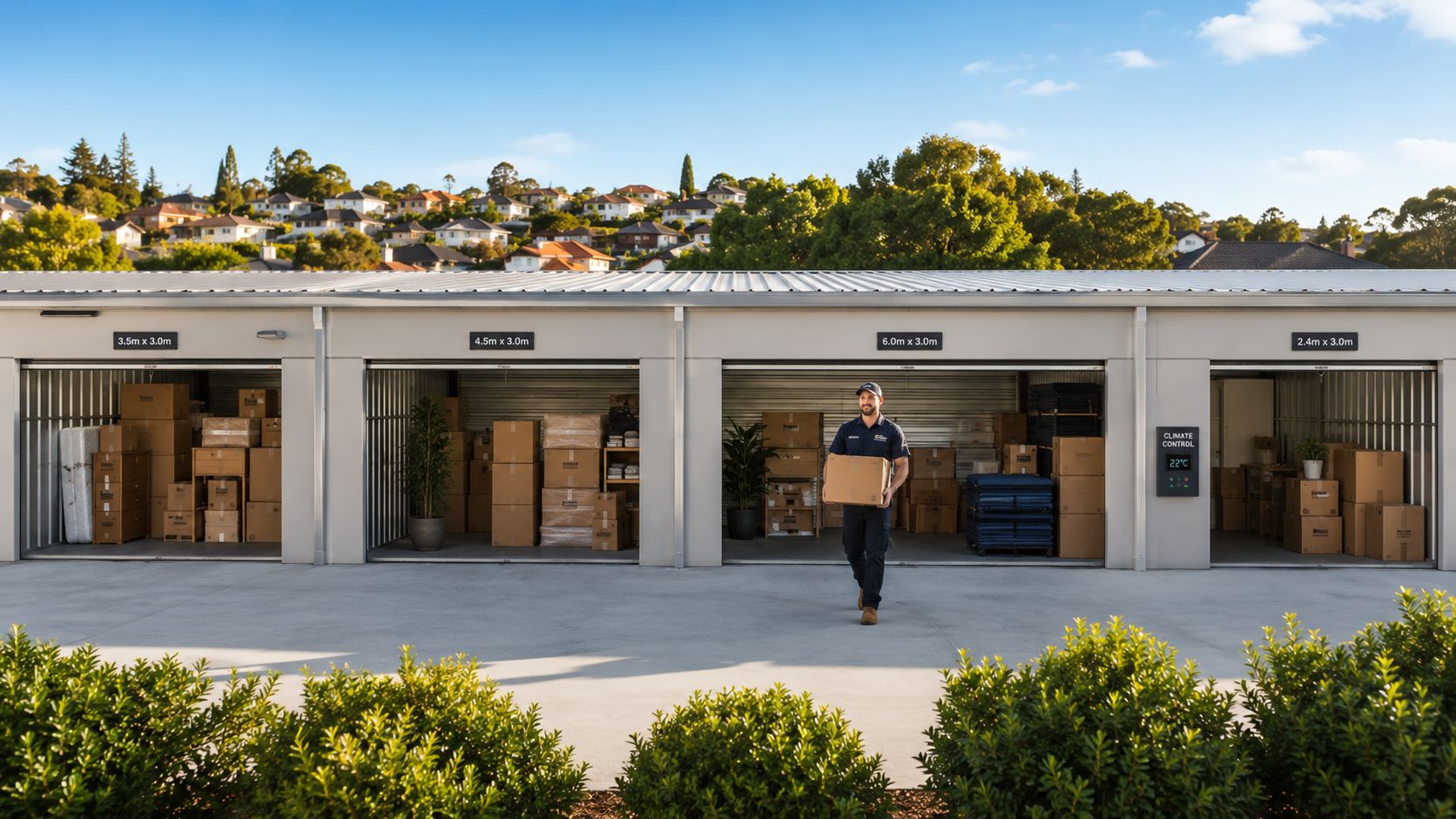
Common Self Storage Unit Sizes and What They Fit
| Unit Size (Metres) | Equivalent To | What It Typically Holds |
|---|---|---|
| 1.5 x 1.5 | A large hall cupboard | Archive boxes, suitcases, small shelves, a few small furniture pieces |
| 1.5 x 3 | A walk-in wardrobe | Boxes, bedside tables, a bicycle, occasional chairs, compact household overflow |
| 3 x 3 | A small single garage bay | Contents from a modest one-bedroom flat, including mattress, sofa, whitegoods, and stacked cartons |
| 3 x 4.5 | Half a standard garage | Furniture from a larger one or two-bedroom home, plus appliances and multiple box stacks |
| 3 x 6 | A single garage | Typical contents of a two to three-bedroom home, depending on packing method |
| 6 x 6 | A double garage | Large home contents, business stock, bulky furniture, workshop gear, or combined household storage |
These are practical guides, not promises. How well you pack matters almost as much as the unit size itself. Disassembled furniture, uniform cartons, and upright storage can save a lot of space. Loose bags, half-filled boxes, and badly wrapped furniture waste it.
A quick way to avoid renting the wrong size
If you’re uncertain, don’t estimate from memory while standing at the counter. Walk room by room and make a written inventory. Better again, group items into three categories: must store, maybe store, and can donate or dispose of.
An online packing calculator for household volume planning can help you turn that rough list into something more realistic before you book. It won’t replace a site recommendation, but it does stop the classic mistake of hiring too little space and paying with extra trips, re-stacking, and frustration.
Rent for the space your packed items need, not the space they take up while still scattered around your home.
If you’ll need regular access, don’t choose the smallest possible unit just because everything technically fits. A tightly packed unit is efficient for long-term storage and annoying for short-term use. If you expect to retrieve boxes, rotate business stock, or access seasonal items, leave workable space inside.
Decoding Self Storage Pricing and Contracts in 2026
Storage prices are rarely as simple as the number on the website. The advertised rate is only useful if you know what it includes, when it changes, and what extra costs show up after move-in.
Use a benchmark, then inspect the fine print
While Narre Warren-specific data is limited, metropolitan Australian averages in 2023 showed monthly rental costs for a standard 10×10 ft unit, roughly 3x3m, ranging from $140 to $190 AUD, according to Australian self-storage pricing benchmarks. That gives you a sensible reference point when you compare local quotes. It doesn’t tell you what a Narre Warren facility should charge, but it does help you spot rates that seem unusually high or suspiciously low.
A low headline rate can still be poor value if it comes with awkward access, weak security, or a contract that becomes expensive after the first billing cycle. A higher rate can be justified if loading access is easy, the site is cleaner, and the unit is practical to use.
For extra context on the kinds of charges renters often compare, this breakdown of how much self storage costs is worth reading alongside any local quote.
Contract terms that matter more than the headline rate
Read the agreement with the same care you’d use for a removalist quote. Focus on the parts that affect your exit, not just your entry.
Look for these points:
- Notice periods: How much notice do you need to give before vacating?
- Price changes: Can the operator increase the rent during your stay, and how are you told?
- Billing cycle: Are you charged monthly only, or is there flexibility?
- Lock requirements: Must you buy their lock, or can you use your own approved one?
- Restricted goods: What items are prohibited?
- Default clauses: What happens if a payment is late?
Some facilities also raise issues that renters don’t think to ask about. Local listings often skip detailed answers on environmental or zoning concerns, even though industry commentary has identified “environmental headaches” and “phantom occupancy” as major deal-killers in storage transactions, discussed in this industry analysis on storage due diligence and environmental risk. As a renter, you don’t need to overcomplicate this. You do need to ask whether there are any known site restrictions, flooding issues, or access limitations that could affect your use of the unit.
Packing and Moving Tips for a Stress-Free Experience
Packing for storage isn’t the same as packing for a same-day move. A moving truck only needs your items protected for transport. A storage unit needs them protected for time, stacking pressure, and repeated handling.

Pack for stacking, not just transport
Use sturdy cartons in repeat sizes where possible. Tea-chest style boxes, book cartons, archive cartons, and heavy-duty plastic tubs are easier to stack safely than a random mix of supermarket boxes and soft bags. Uniformity matters because unstable stacks lean, crush, and topple.
Label every box on at least two sides and the top. Include the room, broad contents, and whether the box is fragile or needed early. If the move is complex, add a simple code such as K1 for kitchen essentials or BR2 for second bedroom storage.
A proper professional packing service for moving and storage usually follows one rule consistently. Fragile wrapping protects the item, but disciplined carton choice protects the whole stack.
Store like you’ll need to find one box in a hurry six weeks from now.
Furniture needs a different approach. Use moving blankets, corrugated cardboard sheets, mattress protectors, and stretch wrap carefully. Stretch wrap is useful for holding pads in place, but it shouldn’t be the only layer between a timber surface and dust or rubbing contact. Electronics should go in original cartons if you still have them. If not, use double-walled boxes and cushion the voids so the item doesn’t shift.
Set the unit up like a mini warehouse
The way you load the unit changes everything later. Good storage isn’t just about fitting items in. It’s about getting them back out without dismantling your own work.
Use this order:
- Create a back wall with long-term items such as archived boxes, seasonal goods, or furniture you won’t need soon.
- Stand mattresses and lounges correctly if the manufacturer allows it and the item is fully protected.
- Build stable box columns with heavier cartons at the bottom and lighter ones above.
- Keep access items near the front such as tools, documents, stock, or children’s equipment.
- Leave a narrow aisle if you’ll need to enter the unit again.
This quick visual guide shows many of the same practical techniques in action:
A master inventory helps more than people expect. It can be a notes app list, a spreadsheet, or numbered cartons with a matching checklist. The point isn’t perfection. The point is avoiding the expensive habit of re-opening and re-handling everything because nobody remembers where the kettle, tax files, or cot hardware went.
What should never go into storage
Some items create risk for you, the facility, or nearby renters. Avoid storing:
- Perishables: Food, pantry items, anything that can rot or attract pests
- Hazardous goods: Fuel, paint, gas bottles, chemicals, and flammables
- Living things: Plants, pets, anything biological
- Unsealed wet items: Damp furniture, wet rugs, or recently used outdoor gear
- Irreplaceables without proper planning: Loose cash, passports, critical legal originals, or valuables better kept in a more controlled location
If an item is damp when packed, it can affect everything around it. Storage preserves condition when items go in clean, dry, wrapped, and organised.
Finding and Vetting Storage Facilities in Narre Warren
A local search gets easier when you stop trying to find the “best” facility immediately and start by eliminating weak options fast.
Start online, then narrow the field fast
Use map results first. That shows which facilities are practical from your home, worksite, or new address. Convenience matters because every extra minute of driving gets repeated on move day, on retrieval day, and on every visit in between.
From there, shortlist a few candidates and study the reviews for patterns, not isolated complaints. One angry comment doesn’t mean much. Repeated comments about billing confusion, poor staff response, access delays, dirty units, or pest problems do.
If your move includes both transport and storage, it also helps to look at how the two fit together operationally. This guide on removals and storage planning is useful for understanding what makes the handover between moving truck and unit smooth rather than messy.
What to ask before you drive over
Phone calls save wasted inspections. Keep the questions short and specific.
Ask things like:
- What access hours apply to my unit type
- Whether I can bring my own lock
- Whether insurance is included or separate
- How move-out notice works
- Whether there are trolleys, lifts, or drive-up access
- What unit size they’d suggest for your inventory list
The quality of the answers matters almost as much as the answers themselves. Clear, direct responses usually point to a better-run site.
What to inspect on site
Visit in person before committing if you can. Look past the reception area. That part is designed to look presentable. The critical elements are the driveway, loading area, corridors, lift access, and the actual unit you may rent.
Check these details carefully:
- Surface condition: Clean, dry floors and no obvious water staining
- Door operation: Roller door or swing door opens smoothly and closes properly
- Access layout: Enough room to manoeuvre with a trolley or small truck
- General upkeep: Lighting works, signage is clear, and common areas aren’t neglected
A tidy office proves very little. A tidy loading bay tells you the facility is maintained where customers actually work.
Common Questions About Self Storage in Narre Warren
A few practical questions come up repeatedly once people get past the initial search.
Can I bring my own lock
Often, yes, but don’t assume. Some facilities allow customer-supplied locks if they meet the site’s requirements. Others want you to buy a specific lock type. Ask before move-in so you’re not stuck paying for the wrong hardware on the day.
What items are usually forbidden
Most facilities prohibit flammable goods, hazardous chemicals, explosives, perishables, and anything illegal. Wet items are also a bad idea, even if they aren’t explicitly banned. They can lead to mould, odour, and damage to your own contents.
Can I receive mail at a storage unit
Usually, a self-storage unit isn’t a normal mailing address for personal post. Some business-oriented facilities may have separate arrangements, but that’s a different service. If you need mail handling, ask directly and get the terms in writing.
How much notice do I need before moving out
That depends on the agreement. Some operators want notice before the next billing cycle. Others are more flexible. The safest move is to ask this before signing, then set yourself a reminder well before your intended vacate date.
Should I choose the cheapest unit available
Only if it’s also secure, accessible, clean, and realistically sized for your needs. Cheap storage that causes double-handling, poor access, or damaged furniture usually costs more in the end.
If your move involves packing, timing gaps, furniture protection, or coordinating storage as part of a bigger relocation, Emmanuel Transport can help take the pressure off. Their team handles moves with the same practical thinking that makes storage work properly in the first place. Clear planning, careful handling, and a smoother path from one property to the next.
