
When you're planning a move, one of the first questions you'll have is, "How big are these taxi boxes, really?" Getting a handle on the exact dimensions is your first step towards a smooth, stress-free move. A standard taxi box isn't just a container; it's a precisely designed space that can make all the difference.
Let's get straight to the numbers. The typical taxi box you'll find for hire measures 2.4m deep, 1.5m wide, and 2.2m high. In practical terms, that gives you enough room to pack up the contents of a studio apartment or about 1 to 1.5 standard rooms of furniture and belongings.
What Are the Standard Taxi Box Dimensions?
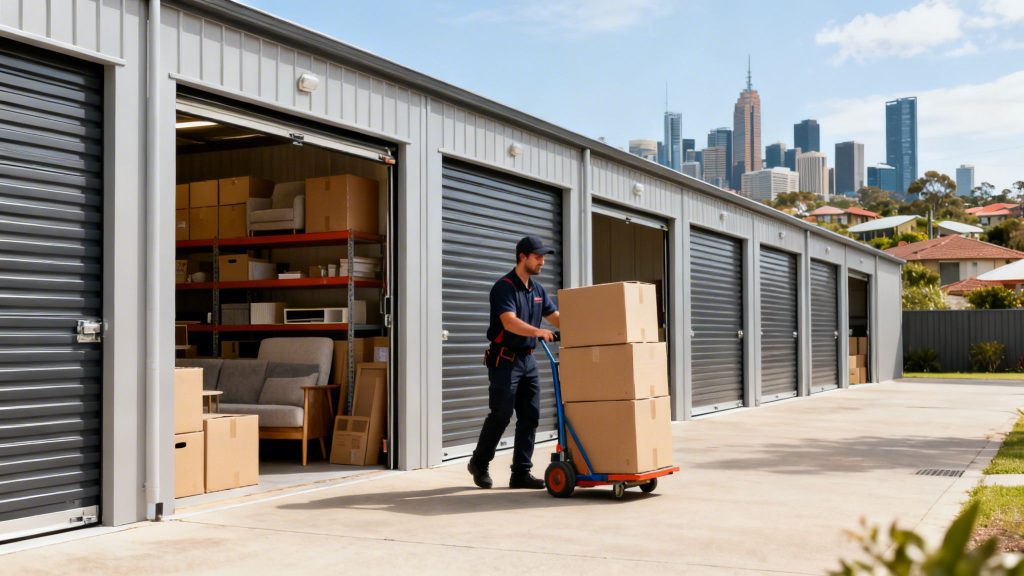
First things first, let's clear up a common misconception. When we talk about a "taxi box," we’re not referring to the boot of a yellow cab. Think of it more like a personal, portable storage unit or a mini-removalist van that gets delivered right to your door. You pack it on your own schedule, and then it’s whisked away to your new home or a secure storage facility.
The specific measurements are what really matter for planning your move and figuring out how many you'll need. To give you a real-world example, a well-known provider like TAXIBOX uses containers with these exact industry-standard dimensions.
For a quick reference, here’s a breakdown of what you're working with:
To help you visualise just how much you can fit, this chart lays out all the key specifications at a glance.

Here's a handy table summarising the key stats for a single taxi box.
Standard Taxi Box Specifications at a Glance
This table breaks down the essential numbers for a standard mobile storage box, providing both metric and imperial units for easy planning.
| Specification | Metric Value | Imperial Value |
|---|---|---|
| External Depth | 2.4 m | 7.87 ft |
| External Width | 1.5 m | 4.92 ft |
| External Height | 2.2 m | 7.22 ft |
| Cubic Volume | 7.9 m³ | 279 ft³ |
| Weight Limit | 1,000 kg | 2,204 lbs |
As you can see, the numbers are impressive. A generous volume of nearly 8 cubic metres combined with a robust 1-tonne weight limit means these boxes are built tough. They can easily handle bulky but light items like couches and mattresses, as well as incredibly dense things like full cartons of books or your home gym weights.
Of course, the box itself is only half the story. You'll also need the right supplies to pack everything safely. For a complete rundown of what you’ll need and where to find it, check out our guide on where to buy moving boxes in Perth.
What Actually Fits Inside a Taxi Box?

It’s one thing to read the dimensions, but another thing entirely to visualise your belongings packed neatly inside. The standard 7.9 cubic metre capacity is surprisingly generous—it’s specifically designed to hold the contents of a typical one-bedroom or studio apartment.
This doesn't just mean a few odds and ends. With some smart packing, you can easily fit your larger furniture right alongside dozens of standard moving boxes.
Example Load for a Standard Taxi Box
To help you get a real-world picture of the space, here’s a practical list of what we often see fitting comfortably into a single, well-packed taxi box. Think of this as the inventory of an average one-bedroom apartment.
- Large Furniture: A queen-sized mattress and its dismantled bed frame, a small two-seater sofa or a large armchair, and a small dining table with its chairs (disassembled, of course).
- Appliances and Electronics: A flatscreen TV up to 55 inches, a microwave, and your other small kitchen appliances like a kettle and toaster.
- Boxes and Personal Items: Around 20-30 medium-sized moving boxes holding everything from clothes and books to kitchenware and personal belongings.
A common mistake we see is underestimating the vertical space. By taking furniture apart and stacking your boxes high, you can make full use of the 2.2m internal height. What looks like a compact box suddenly becomes a highly efficient moving solution.
Visualising Your Move
The biggest hurdle for many is trying to guess if their specific items will fit. That three-seater sofa, for example, might be too long to lay flat on the floor, but it could slide in perfectly if stood on its end.
This is where a tape measure becomes your best friend. Always measure your largest items and check them against the internal taxi box dimensions: 2.4m deep x 1.5m wide x 2.2m high. A few minutes of planning can save you from ordering too many (or too few) boxes, which saves you both money and stress.
If you’re still scratching your head, try our free online packing calculator. It’s a great tool designed to turn your list of household goods into a reliable taxi box estimate.
Comparing Taxi Box Capacity with Removalist Trucks

Knowing the dimensions of a taxi box is a great start, but the real question is: how does that stack up against a full-scale move? Let's break down how a taxi box compares to professional removalist trucks so you can pick the right strategy for your relocation.
A single taxi box gives you about 8 cubic metres of usable space. From our experience, that’s generally enough to handle the contents of a studio or a one-bedroom apartment. But once you move into a larger home, you'll need to decide whether multiple taxi boxes or a dedicated removalist truck makes more sense.
Vehicle Volume Comparison
To give you a clearer picture, here’s a direct comparison between one standard taxi box and the common vehicles we use at Emmanuel Transport. This should help you visualise the scale of your move.
- Small Van (approx. 10-12 m³): These vans, perfect for smaller apartment jobs, can hold slightly more than one taxi box. Think of it as being ideal for a single large piece of furniture plus a decent stack of moving boxes.
- 4-Tonne Truck (approx. 20 m³): This is our go-to for most 2-bedroom homes. A 4-tonne truck gives you the capacity of roughly 2.5 taxi boxes.
- 6-Tonne Truck (approx. 30 m³): Moving from a standard 3-bedroom house? This truck is usually the right fit, holding the equivalent of nearly four taxi boxes.
Sometimes, the best move isn't an "either/or" choice. A hybrid approach often works wonders. You could use a taxi box for items heading into storage while hiring our professional movers for the main relocation. This kind of flexibility is a huge plus.
This volume comparison is a fantastic starting point for planning. If you’re looking at a larger move and want to get a more precise figure, our detailed truck size calculator is the perfect tool. It will help you figure out if a full-service move is the best option for your situation.
Why a Taxi Box Is Not a Standard Taxi
The name "taxi box" can be a bit misleading, and we see the mix-up all the time. Let’s clear this up right away: a taxi box has nothing to do with the cab you’d hail for a ride to the airport. Getting this wrong can stop your move in its tracks before you’ve even packed a single item.
A taxi box is a purpose-built mobile storage container designed for moving house. A standard taxi, on the other hand, is built for one thing only: transporting people. Confusing the two is like trying to use a sports car to haul furniture—it just won’t work.
The Limits of a Standard Taxi Boot
When you're thinking about taxi box dimensions, it’s a completely different ball game compared to the boot of a standard taxi. A cab’s boot is only meant for a couple of suitcases or shopping bags, not the contents of your home. The space is surprisingly small and is actually governed by strict regulations to ensure passenger safety and comfort.
In Australia, taxi standards—especially in major states like NSW and Victoria, which set the precedent for Western Australia—are very clear. Regulations prevent drivers from carrying any luggage that "cannot be accommodated without inconvenience," which basically means keeping the passenger cabin free of clutter.
The average Perth taxi offers a boot capacity of only 1.2 to 1.5 cubic metres. It’s simply not designed to handle heavy or awkwardly shaped items. Compare that to a standard taxi box, which gives you a massive 7.9 cubic metres of usable space. That’s more than five times the volume, highlighting just how impractical a cab is for anything beyond personal luggage.
It's a fact of the industry: trying to use a regular taxi for even the smallest of moves is a recipe for frustration. Statistics even show that around 25% of taxi trips involving luggage run into problems, pushing more people to call in professionals like Emmanuel Transport. These vehicles are strictly limited to small, light loads, typically under 50kg.
Knowing your taxi box capacity is just one part of the puzzle. It's also incredibly helpful to know how to choose the right moving boxes to keep your belongings safe. A taxi box is engineered to handle the stress of moving—it can easily hold furniture, whitegoods, and dozens of boxes, making it the obvious choice for a smooth, hassle-free relocation.
Packing Tips to Maximise Taxi Box Space
Knowing the dimensions of a taxi box is one thing, but packing it well is what really makes for a smooth move. The secret is to start by building a solid foundation at the very back of the container. Your heaviest, most solid items—think washing machines, chests of drawers, and already-packed bookshelves—should go on the floor first to create a stable base.
This approach does two things: it stops your belongings from shifting around in transit and helps you keep the load balanced. Staying under the 1-tonne weight limit is much easier when the weight is distributed evenly. Think of it like a game of Tetris; your first goal is to build a solid, flat wall of heavy items.
Strategic Stacking and Dismantling
Once your base is in place, it’s time to look at your larger furniture. You'd be surprised how much space you can reclaim by simply dismantling things. Take the legs off tables and pull apart bed frames—these newly flattened pieces can be slotted into narrow gaps or stood upright against the container walls.
For the most efficient stack, try to use moving boxes of a similar size. This makes stacking them safely and securely all the way to the 2.2-metre high ceiling much simpler.
Here's a straightforward packing order that the pros use:
- Heaviest Boxes First: Any boxes packed with books, tools, or kitchenware should sit directly on top of your heavy furniture base.
- Lighter Boxes Higher: Stack boxes with lighter contents, like clothing, bedding, and cushions, toward the top. This prevents anything fragile from being crushed under the weight.
- Fill Every Gap: Use soft items like pillows, doonas, and blankets to plug any empty spaces. This not only stops items from moving but also adds extra padding.
A professional packer’s real secret is to leave no empty space. Every gap is a missed opportunity for both stability and protection. It's a skill that comes with experience, and it's something our team at Emmanuel Transport has mastered over countless moves.
Finally, make use of the internal tie-down points along the walls to secure everything. Ratchet straps are brilliant for holding taller items like mattresses or dismantled wardrobes firmly in place. For a complete rundown, check out our expert guide on how to pack for movers.
How Professional Movers Simplify Your Relocation

Knowing the exact taxi box dimensions and having a solid packing plan is a fantastic start. But let's be honest, the gap between having a plan and actually executing it can feel enormous. This is where getting the professionals involved can turn a mountain of stress into a manageable task. At Emmanuel Transport, we’ve seen it all, and our experience is your biggest asset for a smooth move.
We can jump in to help you figure out exactly how much storage you’ll need, making sure you don’t waste money on unused space. Or, if you’d rather not lift a finger, we can give you a clear, comprehensive quote for our full-service option where we take care of everything from start to finish.
Your Relocation Partner in Perth
We’re a local Perth team, through and through. Our crews have handled moves of every shape and size, from apartments in Joondalup right down to big family houses in Rockingham. We believe in being upfront and efficient, shaping our service around what you actually need.
Some people enjoy the DIY packing process and just need our muscle, while others want a completely hands-off experience. Either way, our main goal is to give you peace of mind. While we handle the heavy lifting, it's also worth thinking about other services that can make life easier. For example, many of our clients find that booking professional move-in/move-out cleaning services is a massive help, freeing them up to focus on settling in.
At Emmanuel Transport, we treat your belongings as if they were our own. Our friendly, punctual service is designed to get you settled into your next chapter safely and without stress.
Ready to make your next move the easiest one you’ve ever had? If you want a team of professionals to manage the entire packing process for you, you can learn more about our dedicated packing services for moving. Get in touch today, and we'll work out a personalised quote for you.
Your Top Questions About Taxi Box Dimensions, Answered
Once you get your head around the standard taxi box dimensions, a few practical questions almost always come up. It's one thing to know the numbers, but another to picture how your life will actually fit inside. Let's tackle some of the most common queries we hear from our customers.
How Many Taxi Boxes Will I Need?
This is probably the number one question we get asked! A good starting point is to plan for one taxi box for every 1 to 1.5 rooms in your home. Each box gives you about 8 cubic metres of packing space.
So, for a standard 2-bedroom apartment, you'd likely be looking at 2 to 3 boxes. Of course, this can change depending on how much stuff you have. The best way to get a precise number is to use an online volume calculator or, even better, have a professional moving team give you a free assessment.
Are There Weight Limits for a Taxi Box?
Yes, and this is a really important one for safety. Every standard taxi box has a strict maximum weight capacity of 1,000 kg (or 1 tonne). It’s absolutely vital you stick to this limit.
When you're packing, try to spread the weight evenly across the floor. This means placing heavy things like boxes of books, records, or gym equipment across the base, rather than piling them all in one corner.
Heads up: Overloading a container is a serious safety risk. We can't transport a box that exceeds the weight limit, which could cause major delays for your move. Always pack with this limit in mind.
Can a 3-Seater Sofa Fit in a Standard Taxi Box?
It often can, but you absolutely have to measure it first to be sure. A taxi box has an internal length of 2.4m and a height of 2.2m. Most 3-seater sofas are shorter than 2.4m, so they usually fit if you stand them on their end or side.
The crucial measurement is the door opening, which is 1.5m wide. You need to measure your sofa's depth and height to make sure you can actually manoeuvre it through the doorway.
Planning your move and need a hand figuring it all out? The team at Emmanuel Transport is here to help. We can provide a free, transparent quote to accurately estimate your needs and ensure your relocation is as stress-free as possible. Visit us at https://emmanueltransport.net.au to learn more.