

Moving quotes confuse almost everyone the first time. You get a number from a removalist, assume it’s the final price, and then face a much larger bill on moving day. Understanding what a moving quote actually is, and more importantly what type of quote you’re looking at, is the difference between a smooth relocation and a costly surprise. This guide covers how quotes are calculated, the legal protections available to you, and how to compare estimates confidently so you can plan your Perth move or interstate relocation with clear eyes.
Key takeaways
| Point | Details |
|---|---|
| A quote is not always fixed | Moving quotes range from binding fixed prices to flexible estimates that can change based on actual weight or services. |
| Survey quality determines accuracy | An in-home or video survey produces far more reliable quotes than phone or online estimates alone. |
| Quote type is the biggest variable | Whether your quote is binding, non-binding, or binding not-to-exceed determines how much your final bill can shift. |
| Access details drive add-on charges | Stairs, lifts, long carries, and parking restrictions are common sources of extra charges not captured in basic quotes. |
| Compare at least three written quotes | Using the same inventory list across multiple movers helps you spot low-ball bids and missing services quickly. |
What is a moving quote and how is it calculated?
A moving quote, also called a moving estimate in the industry, is a written price provided by a removalist company after assessing your shipment details and required services. The moving estimate definition in formal terms is the documented cost projection a mover produces based on what needs to be transported, where it’s going, and what additional services are required.
The calculation is not guesswork. Removalists consider several specific factors:
- Volume and weight of your belongings, which is assessed room by room during a survey
- Distance between your origin and destination, including whether it’s a local, interstate, or long-distance move
- Additional services such as packing and unpacking, temporary storage, furniture disassembly, or special handling for fragile or oversized items
- Access conditions at both properties, including stairs, narrow corridors, lift availability, and parking distance from the front door
- Timing of your move, since weekend or end-of-month dates often carry a premium
The most reliable quotes come from in-home or video surveys where the removalist physically or visually inventories your belongings and notes any logistical challenges. A survey conducted over the phone or through a basic online form produces a rough projection at best. Without observing the actual access logistics at both ends of your move, estimators are filling in blanks with averages, which increases the chance of a discrepancy between what you’re quoted and what you’re charged.
Pro Tip: Before your survey, walk through every room and note items you plan to take. Include items in the garage, attic, and garden shed. Estimators can only price what they see or are told about.

This process is why two quotes for the same move can look very different. One removalist may have conducted a thorough video survey while another based their number on a brief phone call. The one who saw your three-bedroom home with a narrow staircase will give you a more realistic price, even if it’s higher upfront.
Types of moving quotes and what they mean for your bill
Not all quotes are created equal, and this is where many people get caught off-guard. There are three main types of moving estimates you’ll encounter, and the estimate type is the single biggest factor in whether your final bill matches what you were originally shown.
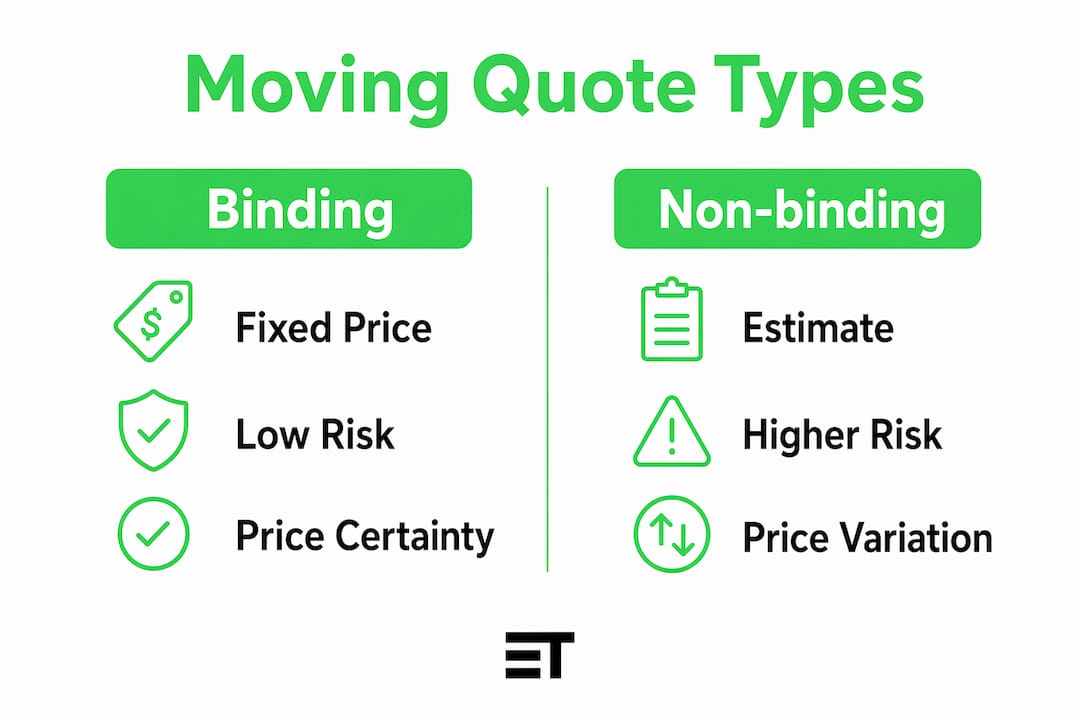
| Quote type | Price certainty | Risk level | Who benefits |
|---|---|---|---|
| Binding | Fixed, won’t change if inventory and services stay the same | Low for the customer | Anyone wanting cost certainty |
| Non-binding | Estimate only, final price based on actual weight and services | Higher for the customer | Movers (shifts risk to client) |
| Binding not-to-exceed | Capped at quoted price but can drop if shipment is lighter | Very low for the customer | Budget-conscious movers |
Binding quotes
A binding quote locks the price at the agreed amount, provided the inventory and services don’t change between quoting and moving day. If you told the removalist you had 80 boxes and a piano, and that’s what they move, you pay exactly what was quoted. No surprises.
The caveat is that if you add items or request extra services on the day, the mover is entitled to charge for those additions. Keeping your inventory accurate and current is what keeps a binding quote truly binding.
Non-binding quotes
Non-binding quotes are estimates based on projected weight and services. The final price is calculated after the move, once the shipment has been weighed and all services accounted for. Many movers default to non-binding because it shifts the financial risk to the customer rather than the company.
For interstate moves covered by federal regulations, there is a consumer protection worth knowing. Non-binding interstate costs are capped at 110% of the written estimate on delivery day. This means you cannot be forced to pay more than that 110% threshold upfront. Any amount above it can be billed later, but you retain access to your belongings. This protection exists to prevent movers from holding shipments hostage until a much larger bill is paid.
Binding not-to-exceed quotes
This is the least commonly offered type, but arguably the most consumer-friendly. A binding not-to-exceed estimate sets a price ceiling. If your shipment weighs less than estimated, you pay the lower amount. If it weighs more, you still pay the capped price. You get cost certainty plus the possibility of paying less. The catch is that most removalists won’t offer this option unless you specifically ask for it.
Pro Tip: When requesting quotes, ask each mover directly: “Is this a binding or non-binding estimate?” Most will not volunteer this information. Knowing the answer before you sign anything is non-negotiable.
What can change your moving costs after a quote
Even a carefully prepared quote can shift if certain details weren’t captured during the initial assessment. Understanding where these gaps typically appear will help you avoid them.
The most common culprits are access-related. Missing details like stairs, long carries, or lifts often generate additional charges on moving day because they require more time and labour than the original estimate accounted for. A removalist who was told “ground floor apartment” but arrives to find a third-floor walk-up without a lift will add a stair carry fee. That fee isn’t unreasonable. It just wasn’t in your quote.
Other common sources of variation include:
- Specialty item handling: Pianos, pool tables, large safes, and artwork often carry separate fees that standard quotes may not include unless you specifically mention them
- Packing materials and services: If packing wasn’t part of your original agreement and you ask for it on the day, expect an additional charge
- Long carry fees: If the truck cannot park close to the property, and removalists need to carry items over a certain distance, this often triggers an extra fee
- Last-minute inventory additions: Deciding to take the outdoor furniture set that wasn’t included in the survey will almost certainly add cost
- Storage: If your new property isn’t ready on moving day and you need temporary storage, this is rarely included in a standard quote unless agreed upon in advance
Pro Tip: When you receive a quote, ask the mover to spell out every condition under which the price could change. Get the answer in writing. Verbal promises about pricing are worth very little on moving day.
The simplest way to protect yourself is to make your initial survey as thorough as possible. A detailed survey that observes actual access logistics at both properties dramatically reduces the chance of surprise charges. Walk the estimator through every room, point out anything awkward or heavy, and mention the parking situation at both ends of the move.
Accepting a quote without any form of survey is a risk not worth taking. Without an accurate survey, a non-binding quote is essentially a rough phone projection, and the final bill can be significantly higher than anticipated.
How to compare and use moving quotes effectively
Getting multiple quotes is basic advice. Getting them correctly is where most people fall short. Here’s how to approach quote comparison in a way that actually protects you.
- Use the same inventory list for every quote. Create a detailed written list of everything you’re moving before you contact any removalist. Share this exact list with each company. Comparing quotes based on different assumptions is meaningless.
- Get everything in writing. A verbal quote is not a quote. A written estimate, specifying whether it’s binding or non-binding, what services are included, and what conditions could change the price, is the only document that protects you.
- Be suspicious of the lowest bid. Low bids often omit services or add charges later. If one quote is significantly cheaper than the others, ask which services were excluded. The difference is usually found in packing, insurance, fuel levies, or stair fees that the other companies included transparently.
- Request at least three written quotes. Comparing at least three estimates based on the same inventory gives you a realistic price range and helps you identify outliers, both suspiciously low and unreasonably high.
- Ask about the quote type before signing. Confirm whether the estimate is binding or non-binding. If the mover cannot tell you clearly, or if nothing is specified in the written document, treat it as non-binding.
- Negotiate for a binding or binding not-to-exceed quote. Once you’ve identified your preferred mover, it’s worth asking whether they can lock the price. Many will agree, particularly if your inventory is well-documented and the survey was thorough.
- Review what happens if your move date changes. Some quotes are valid for a set period. If your settlement is delayed or your lease start is pushed back, confirm whether the quoted price still applies or whether rates could change.
For Perth moves, using a moving cost calculator beforehand gives you a ballpark figure before you even contact a removalist. It won’t replace a proper survey, but it helps you walk into conversations with a realistic expectation of costs.
Tools and technology for getting accurate quotes
The way removalists generate quotes has changed considerably. You no longer need to schedule an in-home visit weeks in advance to get a useful estimate.
Video surveys are now widely offered and can match the accuracy of an in-home survey when done properly. You walk the estimator through your property via a video call, showing items, access points, and any potential challenges. Technology like video surveys improves quote accuracy and convenience without requiring either party to travel.
Online moving quote calculators give you instant ballpark figures based on inputs like home size, distance, and rough item counts. They’re useful for initial budgeting and for understanding average moving quote costs before you contact companies. The limitation is that calculators cannot account for access conditions, specialty items, or the specific logistics of your move. Treat calculator outputs as a starting point, not a final price.
Other things to consider when using digital quoting tools:
- Always verify that any online quote leads to a formal written estimate after a proper survey
- Check whether the platform is comparing quotes from insured, licensed removalists or simply aggregating any available provider
- Confirm what the quoted price actually includes before comparing numbers across different platforms
The technology reduces the friction of getting quotes but doesn’t eliminate the need for a thorough assessment. A video or in-home survey remains the most reliable way to reduce quote surprises on moving day.
My honest take on moving quotes
I’ve worked with enough people going through relocations to know that the biggest source of stress is not the physical move. It’s the gap between what someone expected to pay and what they actually paid.
The uncomfortable truth about the moving industry is that non-binding quotes are the norm because they protect the mover, not the customer. When you sign a non-binding estimate, you’re essentially agreeing to pay whatever the actual weight and services add up to, subject to that 110% cap on delivery day. That cap helps, but it doesn’t eliminate the risk. The balance above 110% can still be billed afterward.
What I’ve found actually works is insisting on a written binding quote after a proper video or in-home survey. Most reputable removalists will offer this without a fight. If a company resists or cannot explain what type of estimate they’re providing, that resistance tells you something important about how they operate.
I also think people underestimate how much their own preparation matters. A removalist who walks through a well-organised, fully inventoried home gives a far more accurate quote than one who is guessing at items behind closed cupboard doors. The ten minutes you spend making a detailed list before your survey is probably the highest-value ten minutes of your entire move.
One more thing: resist the temptation of the cheapest quote. I’ve seen it go wrong consistently. The company that quotes 30% below everyone else almost always finds reasons to charge more on moving day, often in the form of access fees, packing charges, or fuel levies that were buried in the fine print. Comparing quotes carefully and choosing a mover who is transparent from the start is worth every extra dollar.
— Emmanuel
Get an accurate quote for your Perth move

If you’re planning a residential move in Perth and want a quote you can actually rely on, Emmanuel Transport makes the process straightforward. As a Perth-based removalist with experience across house removals, apartment moves, office relocations, and same-day services, Emmanuel Transport provides free, no-obligation quotes based on a proper assessment of your move. No guesswork, no hidden fees added on the day. You can start by using the Perth moving cost calculator to get a feel for pricing, then contact the team for a written estimate tailored to your situation. For families and businesses alike, residential removalist services in Perth are available with fully insured vehicles and transparent pricing from the first conversation.
FAQ
What is the difference between a moving estimate and a quote?
The terms are often used interchangeably, but in formal usage a moving estimate is the broader term covering both binding and non-binding projections, while a quote typically implies a fixed price. Always confirm in writing which type you’ve received.
How do I get moving quotes that are accurate?
The most reliable way to get accurate moving quotes is to request an in-home or video survey with a detailed inventory list. A thorough survey that covers access conditions at both properties produces far more precise pricing than phone or online estimates alone.
What should a moving quote include?
A moving quote should detail the inventory being moved, services included (packing, disassembly, storage), the type of estimate (binding or non-binding), distance and travel charges, any potential add-on fees, and the validity period of the quoted price.
What is the average cost of a moving quote in Perth?
Average moving quote costs in Perth vary significantly based on home size, distance, and services required. A local move for a two-bedroom home typically ranges from $400 to $1,200, while larger or interstate moves can cost several thousand dollars. Use a cost calculator for a personalised estimate.
Can a binding moving quote change?
Yes, but only under specific conditions. A binding quote can change if you add items that weren’t included in the original inventory or request additional services on moving day. Keeping your inventory accurate and informing your mover of any changes before the move date protects the agreed price.
Recommended
- Why compare moving quotes: save money, avoid surprises
- The Real Moving House Price in Perth for 2026 | Emmanuel Transport Removalists Perth
- The Real Moving House Price in Perth for 2026 | Emmanuel Transport Removalists Perth
- How Much Do Movers Cost in Australia? A Price Guide | Emmanuel Transport Removalists Perth
