

Moving across state lines feels straightforward on the surface. You pack your things, hire a truck, and head to your new home. But what is an interstate move, really? The reality is considerably more involved than most people expect. There are regulations, consumer protections, insurance considerations, and logistical layers that a local move simply does not carry. This guide breaks down everything you need to know about the interstate relocation process, from the legal definition and planning timelines to the real cost of interstate moving and how to protect yourself from scams.
Table of Contents
- Key takeaways
- What is an interstate move, exactly?
- How to plan an interstate move
- Understanding the cost of interstate moving
- Practical tips for a smooth interstate move
- My honest take on what makes interstate moves succeed
- Ready to plan your interstate move?
- FAQ
Key takeaways
| Point | Details |
|---|---|
| Interstate vs local moves | Crossing a state border changes your legal protections, required paperwork, and the way movers operate. |
| Plan well ahead | Book movers months in advance, especially for peak season, to avoid higher costs and limited availability. |
| Budget beyond the truck | Factor in packing supplies, travel costs, and insurance, not just the mover’s fee. |
| Use a detailed checklist | An interstate move checklist covering utilities, insurance, and address changes reduces costly oversights. |
| Verify your removalist | Check credentials, reviews, and registrations before signing anything to avoid scams and liability gaps. |
What is an interstate move, exactly?
The interstate moving definition is straightforward on paper: any move that crosses a state or territory border. In Australia, that means relocating from Perth to Melbourne, Brisbane to Sydney, or Adelaide to Darwin all qualify. What makes them different from local moves is not just the distance. It is the entire framework surrounding how the move is managed, regulated, and protected.
Interstate moves involve specific protections and required documentation that simply do not apply when you move down the street or even across town. A local move is generally governed by a single state’s consumer law. Cross a border, and the move now involves regulations from two states, and in some cases, federal oversight. That changes what your removalist is obliged to provide, what documents you should expect, and how disputes are handled.
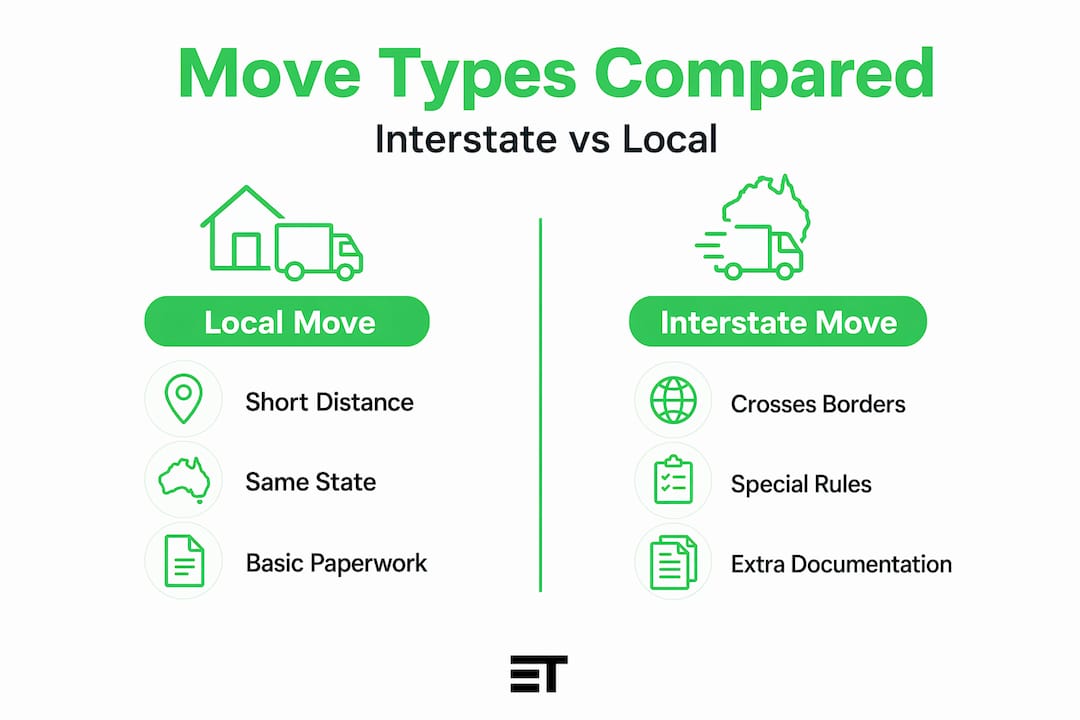
Interstate vs local moves: a quick comparison
Understanding the distinction helps you set the right expectations before you even request a quote. Here is how the two compare across the areas that matter most.
| Feature | Local move | Interstate move |
|---|---|---|
| Distance | Within one state or territory | Crosses a state or territory border |
| Regulatory framework | State-based consumer law | Multiple state laws, federal considerations |
| Required documents | Basic contract or receipt | Bill of lading, liability declarations, consumer rights documentation |
| Cost drivers | Hours and labour | Distance, volume, fuel, tolls, transit time |
| Transit time | Same day | One to several days depending on route |
| Insurance complexity | Standard coverage | Often requires additional valuation agreements |
The bill of lading is a document worth understanding before your move day. It functions as both a receipt and a contract between you and the removalist. Reading your moving documents carefully before signing is one of the most important things you can do. Signing without understanding the liability limits and valuation options can leave you financially exposed if something goes wrong in transit.
Pro Tip: Ask your removalist to explain the difference between released value protection and full value protection before you sign the bill of lading. The cheapest option may cost you significantly more if items are damaged.
Movers vs brokers: know who you are dealing with
One distinction that catches many families off guard is the difference between a removalist company and a moving broker. A removalist company owns its vehicles and employs its crew. A broker, on the other hand, acts as a middleman, taking your booking and then outsourcing the actual work to another company. Verifying that you are dealing with a legitimate mover and not an unregistered broker is a critical step that too many people skip in the excitement of organising a move.
How to plan an interstate move
Good planning is what separates a smooth interstate move from a stressful one. The single most effective thing you can do is start earlier than you think you need to. Moving companies book up months ahead during peak seasons, particularly over summer and around school holidays. If you are hoping to move in January and you start calling in December, you may find your preferred dates are already gone.

A realistic planning timeline
The following steps give you a structured way to approach the process from start to finish.
- 12 weeks out: Confirm your moving date and start requesting quotes from at least three removalists. Research their credentials, read reviews, and ask specifically about their interstate experience.
- 10 weeks out: Accept a quote, sign the contract, and pay any deposit required. Book any temporary accommodation if there is a gap between leaving your old home and settling into your new one.
- 8 weeks out: Begin decluttering room by room. The less you move, the less you pay. Donate, sell, or dispose of anything you would not deliberately buy again.
- 6 weeks out: Notify your employer, bank, Medicare, and the Australian Tax Office of your upcoming address change. Contact your health fund, car insurer, and home insurer to update your coverage for your new location.
- 4 weeks out: Begin packing non-essentials. Start packing 2 to 4 weeks early with items you rarely use, such as books, seasonal clothing, and decorative objects.
- 2 weeks out: Arrange disconnection of utilities at your current property and connection at your new address. Confirm all details with your removalist, including arrival windows and access arrangements.
- Moving week: Pack your essentials bag, do a final walkthrough, and confirm the removalist’s arrival time. Keep important documents, medications, and valuables with you rather than on the truck.
Your interstate move checklist essentials
Beyond the timeline, a solid interstate move checklist covers the categories that are easy to forget under pressure.
- Redirect your mail through Australia Post
- Notify your children’s schools and arrange enrolment at the new location
- Transfer your vehicle registration to the new state within the required timeframe (usually 90 days)
- Update your driver’s licence to reflect your new address
- Inform your superannuation fund of your address change
- Arrange pet transport if applicable, including vet records and any interstate biosecurity requirements
- Take photos of all furniture and valuables before loading for insurance purposes
Pro Tip: Build at least two to three buffer days into your plan on both ends of the move. Delays happen. Traffic, weather, and access issues at the new property are all common. Having breathing room means one hiccup does not derail your entire schedule.
Understanding the cost of interstate moving
The cost of interstate moving is one of the first things people search for, and also one of the most misunderstood. Most people focus on the removalist’s quote and forget that it represents only part of the total expense. Moving costs include mover fees, transport, packing supplies, and travel expenses, all of which add up faster than expected.
What drives the price?
Distance is the most obvious factor. A move from Perth to Adelaide is priced differently from a move from Melbourne to Sydney, even if the volume of goods is identical. But distance is only the starting point. Volume and weight of your belongings, the time of year, whether you need packing services, and how accessible your pickup and delivery addresses are all influence the final figure.
Here is a rough guide to typical interstate moving costs in Australia. These are indicative ranges only, as actual pricing varies based on the factors above.
| Route | Approximate cost range (2BR home) |
|---|---|
| Melbourne to Sydney | $2,500 to $5,000 |
| Sydney to Brisbane | $2,000 to $4,500 |
| Perth to Adelaide | $3,500 to $7,000 |
| Brisbane to Melbourne | $3,000 to $6,000 |
| Adelaide to Sydney | $2,500 to $5,500 |
For a more detailed breakdown tailored to Australian conditions, the interstate moving costs guide from Emmanuel Transport walks through each pricing factor in plain language.
Cost-saving strategies that actually work
- Get at least three written quotes and compare them line by line, not just the total
- Move mid-week and outside of school holiday periods to access lower rates
- Reduce your volume before moving day by selling or donating furniture you were going to replace anyway
- Do your own packing where possible, but ask the removalist how they want items prepared to avoid transit damage
- Ask whether a shared load or backloading option is available on your route. This means your belongings share truck space with another customer’s goods, which cuts costs considerably on popular routes
Pro Tip: When comparing quotes, watch for price gaps that seem too large. A quote that is substantially lower than all others often signals that the company is a broker, is uninsured, or plans to add charges later. The affordable interstate movers guide explains what legitimate pricing looks like so you know what to expect.
Practical tips for a smooth interstate move
Even with the best planning, interstate moves carry risks that local moves simply do not. Knowing where those risks sit gives you the best chance of avoiding them.
Protect yourself from scams and rogue operators
Many fraudulent companies operate as internet-only brokers without proper registrations. They take your deposit, pass your job to a subcontractor, and disappear when things go wrong. Before you book, verify that your removalist has a physical address, a landline number, an ABN, and a real track record of completed interstate jobs.
Key steps to protect yourself:
- Check Google reviews and look for patterns in complaints, not just the star rating
- Ask for the removalist’s public liability insurance certificate before signing
- Confirm that the quote is binding, not an estimate that can change on the day
- Never pay the full amount upfront. A reasonable deposit is standard; full payment before your goods are delivered is a red flag
Insuring and protecting your belongings
Understanding your insurance options is just as important as finding a good removalist. Reading all moving documents and understanding your liability limits before signing protects you from unexpected losses. Most removalists offer basic liability coverage, but this rarely reflects the replacement value of your goods. Transit insurance taken out through your removalist or a third-party insurer will cost more, but it covers the full replacement cost of damaged or lost items.
For larger or more fragile pieces, investing in professional furniture protection services makes a real difference. Proper wrapping, blankets, and tie-down techniques dramatically reduce the risk of damage on long hauls.
“The families who have the smoothest interstate moves are almost always the ones who spent the most time on their checklist, not necessarily the ones who spent the most on their removalist.”
Pro Tip: Before moving day, photograph every item of furniture and any existing scratches or damage. Date-stamp the photos by sending them to yourself via email. If a dispute arises later, this evidence is invaluable.
My honest take on what makes interstate moves succeed
I’ve watched hundreds of families move interstate, and the pattern is clear. The moves that go wrong almost always share one of two problems. Either the planning started too late, or the removalist was chosen on price alone without proper vetting.
What I’ve found is that most people underestimate how much the choice of removalist shapes the entire experience. A legitimate, experienced interstate mover will flag access issues at your new property before the truck arrives. They will confirm the job details days in advance. They will have the right equipment for your goods and the right insurance if something goes wrong. That kind of competence is worth paying a fair price for.
The other thing I’ve learned is that the paperwork deserves far more attention than it gets. Most people scan the contract, sign it, and move on. But the liability clause in that document is what determines whether you are compensated properly if your television arrives cracked or your dining table comes back with a leg snapped off. Take twenty minutes to read it. Ask questions if anything is unclear. A removalist who gets defensive about explaining their liability terms is a removalist worth reconsidering.
One more observation: the weeks immediately before an interstate move are not the time to cut corners. People get tired, stressed, and start making decisions based on saving a few hours of effort. That is when things get left behind, boxes get packed carelessly, and important documents end up in the wrong box. The buffer days I mentioned earlier are not a luxury. They are what keep a manageable situation from becoming a genuinely difficult one.
Interstate moving is one of the most significant logistical events most families will ever undertake. It deserves the same level of planning you would give any major financial or life decision.
— Emmanuel
Ready to plan your interstate move?
If you are getting serious about your upcoming interstate relocation, Emmanuel Transport has put together practical resources to help you move with confidence rather than anxiety. Whether you need a step-by-step moving house checklist to stay organised, a clear breakdown of what interstate moves cost in Australia, or guidance on protecting your furniture during transit, the resources are all there in one place.

Emmanuel Transport is a Perth-based removalist team with real interstate experience and fully insured vehicles. Getting a free quote takes minutes, and it gives you a concrete starting point for your budget. Reach out through the website to find out how the team can make your interstate move far simpler than you might expect.
FAQ
What is the interstate moving definition in Australia?
An interstate move is any residential or commercial relocation that crosses a state or territory border. It differs from a local move in its regulatory requirements, documentation, and the complexity of logistics involved.
How far in advance should I plan an interstate move?
Start planning at least eight to twelve weeks before your move date. Moving companies book months ahead during peak seasons, so earlier is always better, particularly if you are moving over summer or around school holidays.
What does an interstate move checklist need to include?
Your checklist should cover utility transfers, address updates with Medicare, the ATO, and your bank, vehicle registration transfer, mail redirection, insurance updates across states, and school enrolment for children. Tick off each item at least two weeks before moving day.
What factors affect the cost of interstate moving?
The main cost drivers are the distance between locations, the volume and weight of your goods, the time of year, and whether you need packing or unpacking services included. Comparing at least three detailed written quotes is the most reliable way to understand what a fair price looks like for your specific move.
How do I verify that an interstate removalist is legitimate?
Check that the company has a registered ABN, a physical address, public liability insurance, and verifiable customer reviews. Fraudulent operators often act as brokers without proper registration, so confirm the company performing the move is the same one you are paying.
Recommended
- Find Affordable Interstate Moving Companies: Expert Tips for a Budget Move | Emmanuel Transport Removalists Perth
- Interstate Moving Costs in Australia | Emmanuel Transport Perth
- Moving into New House Checklist: Your Complete Relocation Guide | Emmanuel Transport Removalists Perth
- Moving Checklist 2026: Emmanuel Transport’s Moving Guide
