
Moving house is one of life’s genuinely stressful events, and most people underestimate how much time and effort packing actually takes. A packing service is a professional offering where trained movers handle the wrapping, boxing, organising, and labelling of your belongings before a move. It goes far beyond chucking things into cardboard boxes. Understanding what a packing service actually involves, what it costs, and when it makes sense to use one can save you considerable time, money, and headaches on moving day.
| Point | Details |
|---|---|
| Packing is an optional add-on | Professional packing is not automatically included in a moving quote — you need to request and confirm it. |
| Two main service tiers exist | Full packing covers your entire home; partial packing targets fragile or high-priority items only. |
| Costs vary by home size | A 3-bedroom home typically costs between $600 and $1,000 for a full professional pack. |
| Professionals reduce damage risk | Expert packers use quality materials and proven techniques that protect belongings better than DIY methods. |
| Preparation improves results | Decluttering and communicating priorities to your packers before the day leads to better outcomes. |
A packing service, in the context of moving, is when a professional team comes to your home and prepares your belongings for transport. Packing is usually an optional add-on to a moving service, not something automatically included when you book a removalist. Many families book a truck and crew and assume packing is part of the deal. It is not, unless you specifically request it.
What separates professional packing from simply throwing things in boxes is the systematic approach. Trained packers conduct a pre-move walkthrough to assess your home, plan the order of work, and identify anything requiring special attention. From there, they apply a room-by-room strategy that keeps like items together, protects vulnerable belongings, and labels every box clearly so unpacking at the other end is far less chaotic.
Here is what a typical packing service covers:
One thing worth understanding is that professional packers bring all materials with them: sturdy boxes in various sizes, tape, bubble wrap, packing paper, and protective padding. You do not need to source or buy materials yourself, which is a practical convenience that many people do not factor into the cost comparison with DIY packing.
The packing strategy professionals use is systematic rather than haphazard. Heavier items go in smaller boxes. Fragile items are individually wrapped, nested in cushioning, and never stacked without protection. Boxes are filled to capacity to prevent collapse but not overpacked to the point of breaking. It sounds straightforward, but the reality is that most people packing their own homes skip these fundamentals under time pressure, which leads to broken items and disorganised deliveries.
Not all packing services are created equal, and understanding the different options helps you match the service to your actual needs and budget.
| Service type | What it covers | Best for |
|---|---|---|
| Full packing | Every room, every item, all materials included | Busy households, large homes, long-distance moves |
| Partial packing | Selected rooms or items only, client handles the rest | Budget-conscious movers, simpler relocations |
| Fragile-only packing | Breakables, antiques, artwork, electronics | Those comfortable packing general items themselves |
| Custom crating | High-value or unusually shaped items requiring timber crates | Art collectors, businesses, heritage pieces |
| Same-day packing | Packing and moving completed within a single day | Last-minute moves, smaller homes |
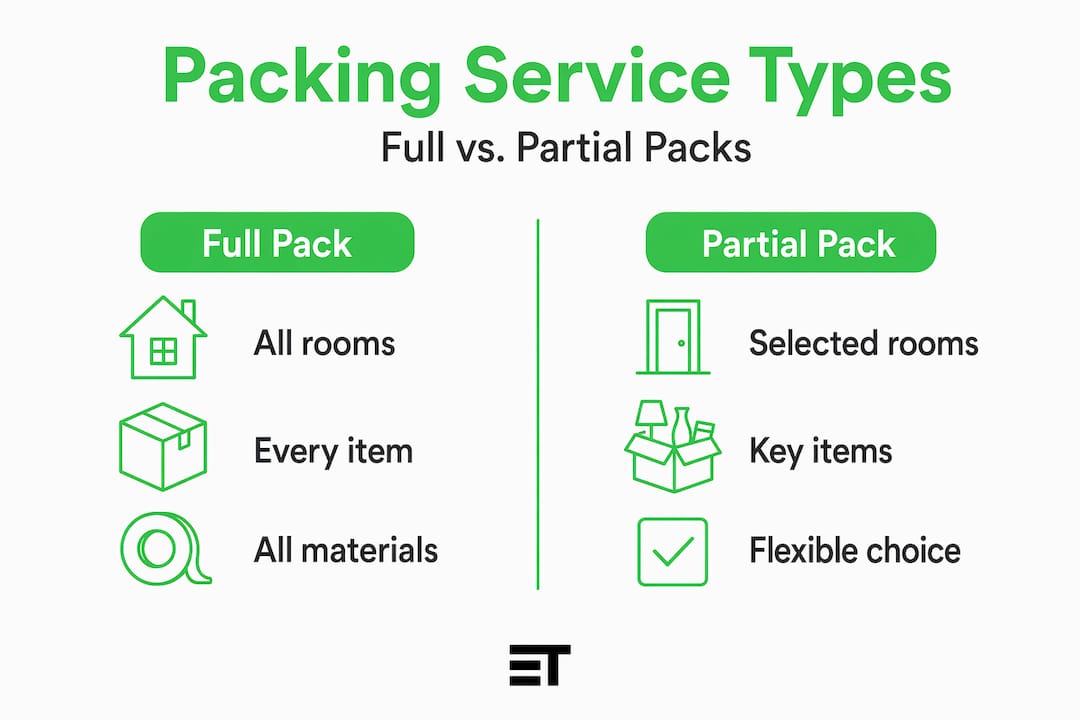
Full packing means the crew arrives and handles everything from the kitchen to the garden shed. You do not lift a finger beyond telling them your priorities. This is the highest cost option but also the one that compresses the most labour into the least amount of your time.
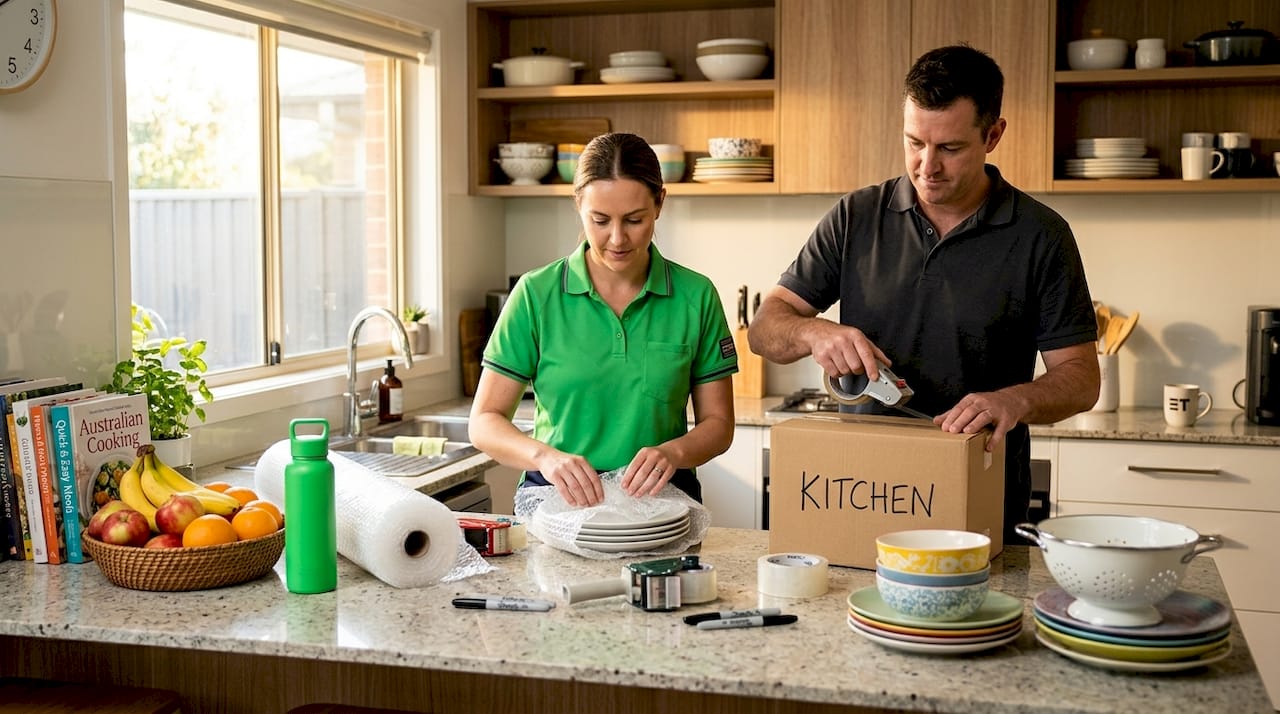
Partial packing is one of the most practical choices for families trying to balance cost and protection. Many families select which rooms or items professionals pack while handling general, lower-risk belongings themselves. You might ask the packers to handle the kitchen, china cabinet, and home office while you manage clothing, linen, and books on your own. The result is professional handling where it counts most, and savings on the overall bill.
Fragile-only packing is ideal if you are confident in your own packing ability but know that your grandmother’s dinner set or the 75-inch television is beyond your skill set to protect safely.
Pro Tip: Ask your packing service provider for a pre-move consultation. Walking through your home together before the packing day allows the crew to bring the right quantity of materials, plan the work efficiently, and flag anything that needs special treatment. It takes 20 minutes and avoids surprises on the day.
Same-day packing is worth knowing about for urgent situations. A number of Perth removalists, including Emmanuel Transport, offer packing and moving within a single booking, which is a genuine solution when life does not give you the luxury of a planned lead time.
Cost is the factor most people want to understand before deciding whether to engage a packing service. The short answer is that pricing depends on how much you need packed, where you live, and which provider you choose.
Professional packing typically costs between $280 and $2,200, with the wide range reflecting differences in home size, scope, and materials. Hourly rates per packer generally sit between $25 and $100. For most families, the job is priced either by the hour per person or as a flat rate based on the volume of work involved.
| Home size | Estimated packing cost |
|---|---|
| 1-bedroom unit | $280 to $450 |
| 2-bedroom home | $450 to $700 |
| 3-bedroom home | $600 to $1,000 |
| 4+ bedroom home | $1,000 to $2,200+ |
These figures cover packing labour and materials in most cases, though it is worth confirming with your provider whether materials are included or charged separately. Some companies bill for boxes and protective supplies on top of the labour rate, which can add a few hundred dollars to the final figure for a fully packed home.
Costs are influenced by several key factors: the overall volume of belongings, the proportion of fragile or high-value items, the timing of your move (peak periods like school holidays and end of month typically command higher rates), and whether you opt for unpacking at the destination as well.
The cost-versus-time equation is worth thinking through carefully. If you earn a reasonable hourly rate and a full pack for your home would take you three full weekends, the financial case for outsourcing starts to look compelling. Time saved and damage avoided frequently outweigh packing costs for busy families or complex moves. One broken television or damaged antique can easily exceed what professional packing would have cost.
Pro Tip: When requesting a quote, walk the provider through your home room by room rather than giving a bedroom count. The contents of a single study or shed can triple the labour hours compared to a sparsely furnished room. A detailed walkthrough produces a far more accurate quote.
The practical benefits of engaging a packing service go well beyond convenience. They compound across the entire moving experience.
Time savings are significant. Expert packers compress weeks of work into days through efficient teamwork and proven methods. A team of two can pack a three-bedroom home in a single day. Most individuals, working evenings and weekends around a full-time job and family, take two to four weeks to achieve the same result. That time difference is material.
Damage reduction is the other major practical benefit. Professional packers use higher-quality materials and know exactly how to protect different item types. Expert packers use superior materials and methods not readily available to most individuals. The combination of proper box selection, cushioning, and packing technique dramatically reduces the chance of breakage in transit.
Beyond time and damage, professional packing produces a far more organised result. Detailed labelling and room-by-room systems mean that when you arrive at your new home, you are not opening ten boxes looking for the kettle. Boxes go to the right rooms, fragile items are clearly marked, and the whole unpacking process moves faster.
Who benefits most from professional packing?
You can explore tips for packing fragile items yourself if you are considering a hybrid approach, where you handle general items and leave the delicate work to professionals.
Pro Tip: If you are undecided, start by listing every item in your home that would genuinely upset you if it were damaged. If that list is long, the case for professional packing is strong. If it is short, partial packing for those specific items is likely the right call.
Selecting the right packing service provider requires a bit of groundwork, but the process is not complicated. Follow these steps to make a confident choice.
Check credentials and insurance. Confirm that the company is licensed, holds public liability insurance, and can provide proof that your belongings are covered during packing. Never assume this is in place without asking.
Read recent reviews. Look for reviews that specifically mention packing quality, not just the general moving experience. You want evidence that packed items arrived undamaged and that the crew was organised and communicative.
Ask what materials are included. Confirm whether boxes, bubble wrap, and packing paper are included in the quoted price or billed as extras. This affects your true cost significantly.
Clarify service scope in writing. Specify exactly which rooms and items are included, whether unpacking is part of the service, and how fragile or high-value items will be handled.
Coordinate packing and moving dates carefully. Ideally, packing happens the day before the move or early on moving day. Confirm that the packing crew and the removalist crew are coordinated, especially if you are using the same company for both.
Declutter before the packers arrive. Packing services charge based on volume. Every item you donate, sell, or throw away before the packing day reduces your cost and the chaos at the other end.
Communicate your priorities clearly. Walk the lead packer through your home before they begin. Point out items that are fragile, sentimental, or need special treatment. Write a list if it helps. Clear communication up front avoids misunderstandings mid-job.
If you want a broader view of moving preparation, the moving and packing tips guide at Emmanuel Transport covers the full planning process in practical detail.
I have seen hundreds of moves at Emmanuel Transport, and the pattern is consistent. The families who struggle most are almost always the ones who underestimated packing. They spend three exhausted weekends filling boxes, arrive on moving day already worn out, and then discover on the other end that half their fragile items did not survive the trip.
The myth I hear most often is that professional packing is a luxury for people with more money than sense. In my experience, that framing has it backwards. The cost of replacing a broken television, a damaged dining set, or an irreplaceable piece of art will exceed most professional packing bills. And that is before you account for the value of your own time and the stress of doing it yourself while also managing the thousand other details of a move.
What I find most overlooked is partial packing as a genuinely smart strategy. People often think it is all or nothing. It is not. Handing your kitchen, your study, and your display cabinet to professionals while you pack your own wardrobe and linen cupboard is a perfectly reasonable, cost-effective approach. You get expert handling where it matters and keep the bill manageable.
The one thing that makes the biggest difference in quality of outcome is communication. Packers work from what they can see and what you tell them. If you walk them through your priorities before they start, the result is far better than if you leave them to make their own judgements about what is fragile or important. That five-minute conversation at the start of the day is worth more than any upgrade in materials.
— Emmanuel

When you are planning a move in Perth, having one team handle both packing and removalist services makes the whole process significantly more organised. At Emmanuel Transport, our professional packing services are tailored to your home and timeline, whether you need a full pack, partial packing for fragile items, or same-day packing and moving combined. We bring all materials, work to a room-by-room plan, and label everything clearly so your destination feels manageable from day one.
Our team is fully insured, experienced with all property types across Perth and surrounding suburbs, and committed to transparent pricing with no surprises on the day. To get started, our complete relocation checklist gives you a clear picture of every step in the moving process. You can also request a free quote directly through our website to get a personalised cost estimate based on your actual home, not a rough guess.
A packing service typically includes wrapping, boxing, labelling, and organising your belongings for transport, along with supply of all packing materials. Many providers also offer optional unpacking at the destination and specialised handling for fragile or high-value items.
No. Packing is usually an optional add-on and is not automatically included in a standard removalist booking. You need to request and confirm packing services separately when booking.
For a 3-bedroom home, professional packing costs typically range from $600 to $1,000, depending on the volume of belongings, fragility of items, and whether materials are included in the quoted price.
Full packing means the professional team packs every item in your home. Partial packing means you select specific rooms or item types for the professionals to handle while you pack the rest yourself, which reduces cost while still protecting your most important belongings.
Professional packing is worth considering when you have a large or complex home, fragile or high-value items, a tight timeline, or limited time available for self-packing. The decision often comes down to your time availability, the complexity of your belongings, and your tolerance for the stress of doing it yourself.