
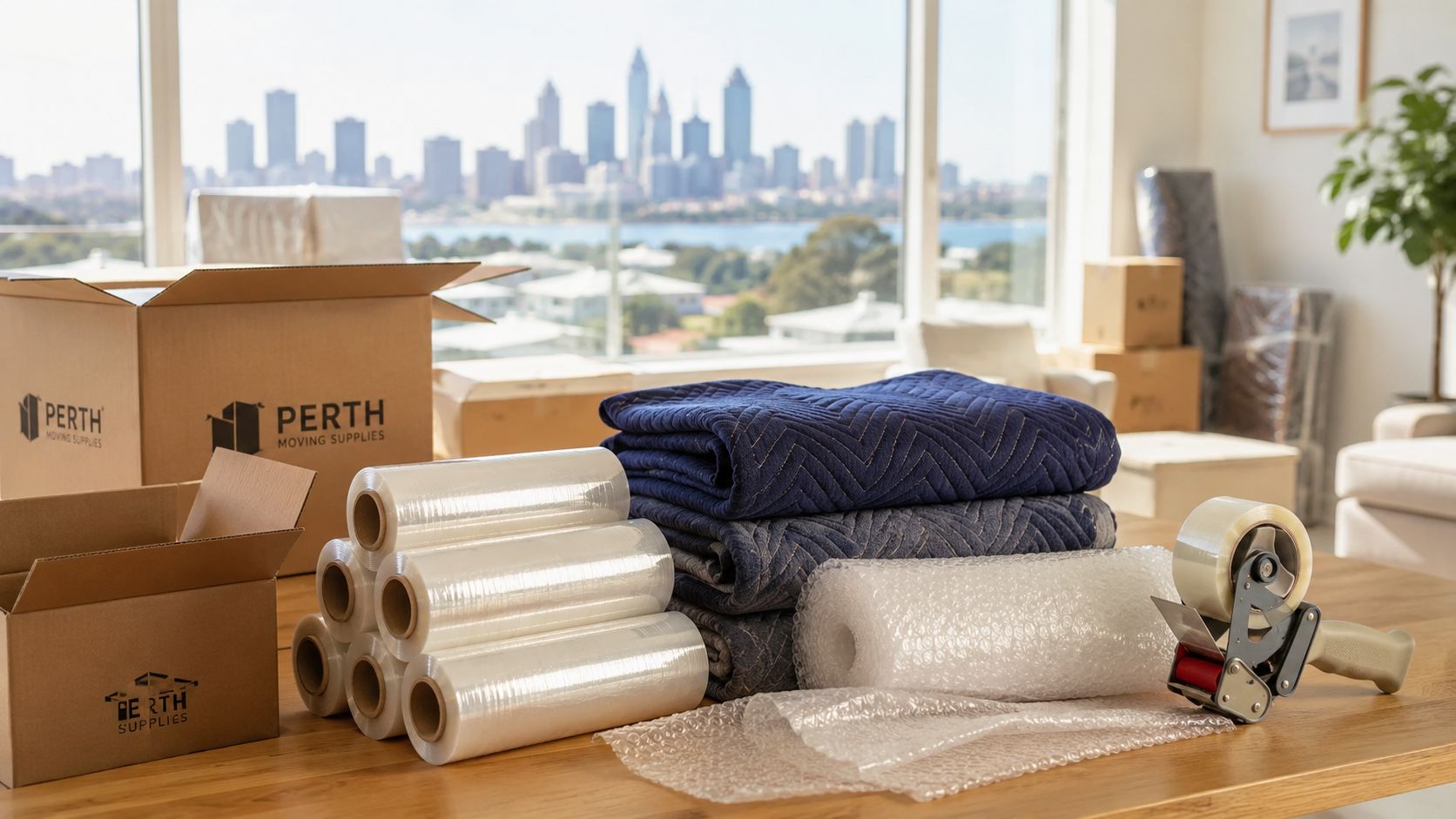
Your lounge is half boxed, the tape gun has vanished again, and the items making you nervous aren’t the easy ones. It’s the TV leaning against the wall, the timber dining table that already marks if you look at it the wrong way, and the framed print you don’t trust in the back of a truck. That’s usually the moment people search for packing wrap near me.
Fair call. Wrap is one of those moving supplies people leave too late, then either buy the wrong type or use the right type the wrong way. Both mistakes cost money. In Perth, they also cost time because a quick “I’ll duck out and grab some” can turn into two or three supply runs if you haven’t planned properly.
A local move has its own pressures. Coastal humidity can affect timber finishes. Stop-start suburban driving can shake poorly packed items harder than people expect. And if you’re moving from an apartment with lifts, loading bays, and tight corners, surface protection matters just as much as cushioning.
Table of Contents
- Your Search for Packing Wrap Ends Here
- Choosing Your Armour Types of Packing Wrap Explained
- Where to Find Packing Wrap Near You in Perth
- Estimating Quantity and Cost for Your Perth Move
- Mastering the Wrap Pro Tips for Damage-Free Moving
- When to Skip the DIY and Call the Professionals
Your Search for Packing Wrap Ends Here
Saturday morning in Perth, the truck is booked, keys are due back by noon, and the first problem is smaller than it sounds. You need packing wrap, and you need the right kind before a timber table gets marked, a fridge door swings open, or a mattress picks up dirt on the driveway.
That decision affects more than packing speed. In Perth, moves often involve long suburban runs, hot afternoons, and plenty of loading over rougher surfaces than people expect. A short trip from Victoria Park to Baldivis can still mean vibration in the truck, dust at the curb, and furniture shifting at every brake point. Good wrap reduces that risk. Bad wrap, or the wrong wrap, usually shows up later as scuffed legs, chipped corners, or a cracked lamp base.
Local demand is steady too. The Australian Bureau of Statistics reported strong population growth in Western Australia in recent years, including migration gains that keep pressure on rental turnover and house moves (ABS National, state and territory population). For anyone trying to buy supplies on a Friday afternoon or end of month weekend, that matters. Stock runs thin fast at the cheaper outlets.
Practical rule: Buy wrap for the item, not for the room. A kitchen often needs more cushioning than film. A bedroom often needs more film than cushioning.
I see the same mistake every month. People buy one big roll of bubble wrap and expect it to do every job. Then they use too much on low-risk items, too little on fragile pieces, and still need to re-pack half the load. The cheaper move is usually the more targeted one.
Perth conditions make that even more important. Heat can soften adhesives. Humidity shifts can affect timber finishes. Longer metro runs from the hills to the coast, or from outer suburbs into apartment complexes, give furniture more chances to rub, bounce, and collect dust.
The fix is simple. Match the material to the risk, buy enough to finish the job in one go, and avoid paying twice for rushed top-up runs.
Choosing Your Armour Types of Packing Wrap Explained
Packing materials work like armour. The mistake is expecting one layer to do every job. It won’t. Good wrapping uses the right material for the right threat, whether that’s scratches, vibration, pressure, or dirt.

Stretch wrap for control and surface protection
Stretch wrap is the clear film you see around lounges, drawers, table legs, and mattress corners. Its real job isn’t cushioning. Its job is to hold things in place, keep dust off, and stop surfaces rubbing against each other.
In the Australian removalist industry, HDPE stretch film at 20–25 microns is the technical standard for furniture wrapping, with a 300% elongation rate and 12–15 N/cm² compressive force to prevent inter-item abrasion during transit, according to Pacific Packaging’s Perth packaging guidance. That matters in Perth because humidity shifts can affect timber movement and increase friction where surfaces rub.
What works:
- Holding drawers and doors shut on buffets, bedside tables, and filing cabinets
- Bundling loose parts like bed slats, bolts in labelled bags, and dismantled chair legs
- Wrapping over blankets or foam so the soft layer stays exactly where you put it
- Protecting upholstered items from dust and grubby handling
What doesn’t:
- Wrapping bare timber directly if the finish is delicate
- Expecting thin film to protect against impact
- Using bargain film that tears the moment it catches a corner
If I’m wrapping a polished timber table, I want a soft layer first. Film goes on the outside to secure it, not directly against the most sensitive finish.
Bubble wrap and foam for fragile items
Bubble wrap cushions. Foam wrap separates and softens contact points. They’re not interchangeable, even though people often treat them that way.
Bubble wrap is best for:
- Glassware
- Lamps
- Ceramics
- Framed prints
- Electronics with vulnerable corners
Foam wrap is better for:
- Gloss furniture
- Timber surfaces
- Items with polished or painted finishes
- Pieces where you want a non-abrasive first layer
Put bubbles outward when you need a smoother inner contact layer against delicate surfaces. Put cushioning where the impact will land.
For delicate household goods, the safest approach is usually layered. Foam first if the finish marks easily, then bubble wrap, then carton packing with enough fill to stop movement. A wrapped item that still slides inside the box is only half protected.
Furniture blankets for bulk and impact protection
Furniture blankets do the heavy lifting for large items. They absorb bumps during carrying, loading, and stacking. They also protect edges when a fridge, couch, or chest of drawers brushes a doorway, lift wall, or truck side.
Blankets are the right choice for:
- Sofas and armchairs
- Dining tables
- Bed heads
- Fridges and washing machines
- Timber cabinets
- Large mirrors when paired with corner protection
They’re a poor substitute for close-contact cushioning on fragile items. A blanket around a wine glass box does almost nothing useful if the contents aren’t packed properly inside.
A good rule is simple:
- Surface-sensitive item gets foam first.
- Fragile item gets bubble wrap or structured cushioning.
- Large furniture gets a blanket.
- Everything that needs to stay put gets stretch wrap over the protective layer.
That sequence saves more furniture than fancy gadgets ever will.
Where to Find Packing Wrap Near You in Perth
If you need packing wrap nearby in Perth, the best place depends on what you’re moving and how fast you need it. Convenience, quality, and stock consistency rarely come together in one shop, so it helps to choose based on the job instead of grabbing everything from the nearest shelf.

Big retail chains for speed
Hardware chains are the quickest answer when you’ve run short mid-pack. They’re useful for basic bubble wrap, tape, packing paper, utility knives, and light-duty stretch film. If you’re moving a small flat or topping up supplies for a few remaining items, that’s often enough.
The downside is consistency. Retail film can be too light for larger furniture, and blanket options are often limited or absent. You’ll also pay in time if you need advice, because shelf labels don’t tell you much about wrap thickness, cling quality, or whether a product is suited to removal work.
Specialist suppliers for better grade materials
Packaging suppliers are where you go when the move includes antiques, office equipment, polished furniture, or a full house lot. Stock is usually more practical for moving work. Wider rolls, tougher stretch film, better foam, stronger cartons, and proper corner protection make a visible difference once loading starts.
If you’re comparing options for residential and commercial packing materials, it can help to read broader guides on packaging essentials for your business before you buy. The business context is different, but the advice on wrap type, load stability, and protection priorities translates well to moves too.
The cheapest wrap on the shelf is often the most expensive once it splits halfway through a couch, sticks to itself, and wastes fifteen minutes.
Removalists and storage sites for one-stop convenience
Self-storage locations and removalist depots can be a practical middle ground. They often carry moving boxes, tape, mattress covers, paper, and basic wrapping supplies in one place. That’s handy if you’re already collecting keys for a unit or arranging a container.
Some removalists also hire out or supply moving blankets, and that’s often better value than buying low-grade alternatives you’ll never use again. This is also the point where service matters. If you describe what you’re moving, an experienced team can usually tell you which items need proper wrap and which don’t.
For Perth moves from Joondalup to Rockingham, local knowledge helps more than people expect. Tight villa driveways, apartment lifts, older Federation doorways, and long suburban drive times all affect what kind of protection is worth paying for. Buy with the actual route in mind, not just the item in your hand.
Estimating Quantity and Cost for Your Perth Move
Bad estimates usually show up at the worst time. You are halfway through wrapping a fridge in Baldivis, the tape gun is missing, the bubble wrap roll is nearly gone, and the closest supply run eats another hour you do not have.
In Perth, that extra trip is rarely a quick one. Distances are longer than people allow for, and summer heat can turn a loosely packed carload of materials into a sticky mess before you get home. Getting the quantity roughly right from the start saves more than money. It saves time, fuel, and a fair bit of frustration.
A simple way to estimate what you need
Estimate by risk and surface type, not by room. A kitchen can contain cheap plastic containers, heavy appliances, wine glasses, and a polished table all in one zone. They do not need the same protection, so room-by-room buying usually leads to waste.
Sort your load into four practical groups:
- Furniture that needs padding held in place. Sofas, dining tables, bed heads, tallboys, bookshelves. These usually need moving blankets or foam first, then stretch film to keep everything tight during loading.
- Fragiles going into cartons. Glassware, lamps, décor, framed pieces, and electronics. These need bubble wrap, packing paper, and enough fill to stop movement inside the box.
- Items with scratch-prone finishes. Timber, whitegoods with visible doors, stone tops, and polished surfaces. Put a soft protective layer against the item first. Film straight onto the surface can mark it, especially in heat.
- Parts that go missing. Shelves, bolts, remotes, cables, and brackets. Bag them, label them, and secure them to the main item so they arrive together.
If you want a cleaner item-by-item estimate before buying, Emmanuel Transport’s packing calculator for Perth moves helps you work out quantities with less guesswork.
Here is the shortcut I use on local jobs. Walk through the property once and mark the items that would genuinely annoy you or cost real money if they arrived scuffed, chipped, or cracked. Spend your wrap budget there first. Laundry hampers and flat-pack storage cubes can travel light. Solid timber, artwork, and anything with a polished finish should not.
Timber deserves extra care in Perth conditions. Heat, dust, and repeated handling can leave fine scratches that only show once the item is in the new house under better light. If you are unsure what finish needs gentler treatment, Slone Brothers Furniture wood care advice is a useful reference before you wrap it.
Packing Wrap Cost Estimation Perth
Material cost is harder to pin down with one neat figure because it changes fast. Roll width, film thickness, bubble size, blanket hire, tape quality, and waste all affect the final spend. Buy cheap wrap and you often use more of it. Buy better wrap and the shelf price is higher, but the job is usually faster and cleaner.
Professional pricing is easier to compare because it bundles labour, materials, and handling. In practice, Perth removalists usually price wrapping based on the number of items, their size, the finish being protected, access at both properties, and how much pre-packing is already done.
| Packing Wrap Cost Estimation (Perth) | DIY Purchase Cost | Professional Service Pricing Approach |
|---|---|---|
| Single fragile item needing protective wrap | Depends on roll size, wrap grade, and whether you already have tape and paper | Commonly charged per item or as part of a minimum call-out |
| Multiple high-risk furniture and fragile items | Varies with blanket hire, foam, film, and how much material is wasted | Usually priced by item count, item size, and handling difficulty |
| Full-home packing for a 3-bedroom house | Changes widely based on material quality and whether you buy in bulk | Usually quoted after a short inventory or onsite assessment |
One practical rule holds up well. A small DIY wrap job often makes sense if you are protecting a few valuable pieces and you have time to do it properly. Once you are wrapping most of a three-bedroom home, labour time starts to matter as much as the material bill.
Perth homes add a few wrinkles here. Long driveways, stairs, tight villa entries, and rougher outer-suburban access roads all increase the chance of a badly wrapped item rubbing or shifting in transit. That is why the cheapest estimate on paper is not always the cheapest move by the time damage, rework, and extra supply runs are counted.
Mastering the Wrap Pro Tips for Damage-Free Moving
Good materials don’t rescue poor technique. Most moving damage comes from movement inside a box, rubbing between surfaces, or pressure landing on a weak point like a corner, handle, or glass edge.

How to wrap common household items properly
For chairs, use the mummy method. Pad the back corners, protect the seat fabric if needed, then wrap the whole chair tightly enough that the protective layer can’t shift. Don’t leave legs exposed. Chair legs knock into everything.
For tables, remove detachable legs where possible. Protect the top surface first, then edges, then corners. The table top usually survives the truck. It’s the corners that get clipped during carrying.
For mirrors and framed art, use the X-method. Tape an X across the glass surface if appropriate for the item and finish, add corner protection, then bubble wrap and a flat pack or picture carton. Never rely on one loose skin of bubble wrap alone.
For boxed fragiles, build a crumple zone:
- Cushion the bottom of the carton.
- Wrap each item separately.
- Keep heavier pieces low.
- Fill side gaps so nothing shifts.
- Cushion the top before sealing.
A box should feel solid, not tightly crushed. If contents move when you gently shake it, it isn’t ready.
The layered method for antiques and delicate pieces
For antiques and delicate goods, professionals use layers because one material can’t manage both surface sensitivity and shock. In Australian removals, 12mm-thick expanded polyethylene foam combined with 50mm-wide bubble wrap reduces impact acceleration by 65% during drop events from 30cm, according to Mormac’s packaging specification overview. That layered approach is especially useful on Perth roads where vibration can punish unsecured pieces.
Use that method on:
- Ceramics and porcelain
- Antique timber with delicate finish
- Glass cabinet panels
- Marble or stone décor with brittle edges
- Collectables with projecting parts
For timber furniture, surface prep matters too. Dust trapped under wrap can act like sandpaper during handling. If you’re moving higher-end wood pieces, Slone Brothers Furniture wood care advice is worth reading before you wrap or store them.
For larger jobs involving storage, staged moves, or high-risk furniture, professional handling becomes part of the protection plan. Services that combine wrapping, loading, and temporary holding, such as Perth removals and storage support, are useful when the move won’t happen in one straight run.
Wrap for friction first, then for impact, then for movement. Most DIY jobs do that in the wrong order.
One more point that saves a lot of grief. Don’t tape directly onto polished timber, painted finishes, or delicate frames. Tape should secure the wrapping material to itself, not stick to the item unless you’re certain the surface can take it.
When to Skip the DIY and Call the Professionals
DIY wrapping makes sense when the move is small, the furniture is sturdy, and you’ve got time to do it properly. It stops making sense when the move includes antiques, artwork, oversized furniture, office equipment, or any item you can’t easily replace.

A big reason is liability. Standardised shrink-wrapping became much more common in Australian removalist services after liability reforms, and over 78% of Perth-based removalists now include wrapping as a mandatory step in their standard service packages, according to Goodsammy’s packaging and assembly reference. That shift didn’t happen because the industry likes extra plastic. It happened because poor wrapping creates damage claims, disputes, and expensive mistakes.
Professional help also makes sense when access is awkward. Third-floor walk-ups, narrow stairs, tight apartment corridors, and long carry distances expose furniture to more contact points than people expect. The wrapping job has to match the route, not just the item.
If you want someone else to handle the higher-risk part of the move, professional packing services in Perth are often the cleanest option. Emmanuel Transport is one local provider that handles packing, wrapping, furniture protection, and move-day handling as part of a broader relocation service.
The primary question isn’t “Can I wrap this myself?” It’s “What happens if I get this one wrong?”
If you’d rather stop hunting for packing wrap near you and get the job handled properly, Emmanuel Transport can help with packing, wrapping, and local Perth moves. That’s useful when you’ve got fragile furniture, limited time, or a move that needs more than a trolley and a few rolls of film.
