
Efficient relocation methods are defined as structured, phased approaches to moving that reduce time loss, control costs, and protect both people and property throughout the process. Whether you are shifting a family home in Perth or relocating an entire office, the difference between a chaotic move and a smooth one comes down to planning depth, execution sequencing, and the right professional support. Tools like Sortly for inventory management, Emmanuel Transport for removalist services, and structured packing systems all play a direct role in cutting moving day friction. This guide covers both residential and commercial moves, giving you specific timelines, packing strategies, and technology decisions that actually work in 2026.
Efficient relocation, known in the industry as structured move management, treats a move as a project with defined phases, owners, and decision points rather than a single chaotic event. The core principle is phased execution: you declutter before you pack, you pack before you load, and you confirm services before you need them. This sequencing prevents the most common failure mode in moves, which is doing everything at once in the final 48 hours.
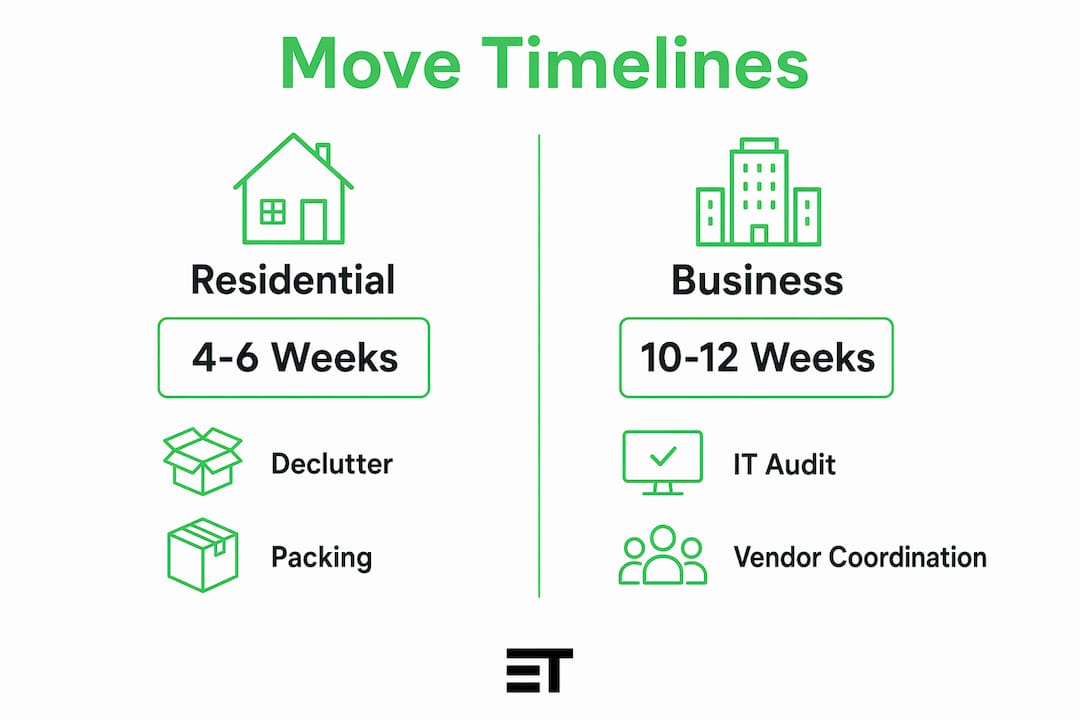
For residential moves, 4 to 6 weeks of preparation is the recognised minimum. That window covers decluttering, sourcing packing materials, notifying utilities, and confirming removalist bookings. Skipping any of these steps does not save time. It transfers the cost to moving day itself, where delays are far more expensive.
For business moves, the stakes are higher and the lead time longer. Commercial office relocations require 10 to 12 weeks of planning to coordinate vendors, IT infrastructure, and staff logistics without disrupting operations. A business that starts planning four weeks out is not being efficient. It is setting itself up for downtime, missed deadlines, and emergency service fees.
The best relocation strategies share three traits: they front-load the decision-making, they assign clear ownership to each task, and they build in buffer time for the items most likely to go wrong, particularly utilities and internet connectivity.

Planning timelines are the backbone of any efficient moving process, and the right structure differs significantly between a home move and a commercial relocation.
A well-run home move follows a clear sequence across six weeks. The first three weeks focus entirely on decluttering and decisions. Purging possessions before packing dramatically reduces the volume you need to move and cuts both packing time and removalist costs. Sell, donate, or dispose of anything you have not used in 12 months.
Weeks three to six shift to active packing, starting with rooms you use least: spare bedrooms, storage areas, seasonal items. Notify your electricity, gas, water, and internet providers during week four. Book your removalist no later than week three, particularly if you are moving during peak periods like school holidays or end of financial year.
Pro Tip: Activate your new utilities 24 hours before you arrive. Overlapping utility services by a single day prevents emergency connection fees that regularly exceed $150 and removes one major source of move-day stress.
Commercial moves require a longer runway because the dependencies are more complex. IT infrastructure, internet provisioning, furniture fitout, and staff communication all need to happen in a specific order. Internet and telecom provisioning for offices can take 30 to 90 days or longer depending on the building type and permit requirements. Ordering connectivity the day you sign your lease is not premature. It is the correct move.
Weeks one to four cover lease confirmation, appointing a relocation coordinator, and auditing your current IT assets. Weeks five to eight handle vendor quotes, furniture planning, and internet ordering. Weeks nine to twelve focus on packing, IT labelling, staff briefings, and the physical move itself. Build your office relocation checklist around these phases rather than a flat to-do list.
Packing is where most moves lose time, and the losses are almost entirely preventable. The two biggest mistakes are packing too late and packing without a system. Both are solved by starting earlier than feels necessary and treating every box as a labelled, trackable unit.
Pro Tip: Use clear plastic tubs for the first-night box and for items you need to access within 48 hours of arrival. Unlike cardboard, they are stackable, waterproof, and immediately visible without opening.
| Material | Best use | Advantage |
|---|---|---|
| Clear plastic tubs | First-night essentials, frequently needed items | Visible contents, reusable, waterproof |
| Double-walled cardboard boxes | Books, kitchenware, heavy items | Structural strength under load |
| Wardrobe boxes | Hanging clothes | Clothes arrive wrinkle-free, no refolding needed |
| Bubble wrap sheets | Fragile items, glassware | Reliable cushioning without bulk |
| Packing paper | Filling box gaps, wrapping ceramics | Cheaper than bubble wrap for non-fragile items |
Inventory management apps like Sortly let you photograph box contents, assign a box number, and search for any item by name. For moves with more than 30 boxes, this system pays for itself in time saved during unpacking. For practical packing advice specific to Australian conditions, the approach is the same whether you are in a Perth apartment or a four-bedroom house.
Technology is the highest-risk category in any office move. Unlike furniture, which is visible and physical, IT infrastructure failures are invisible until the moment they cause downtime. The cost of a single day of lost connectivity for a 20-person office is significant. Prevention requires treating technology as a critical-path item, not an afterthought.
Before anything is packed, conduct a full IT asset audit. Every monitor, workstation, server, printer, and peripheral needs a label that identifies its owner, its destination desk, and its connection requirements. This is not bureaucratic overhead. It is the difference between a two-hour setup at the new office and a two-day troubleshooting exercise.
Connectivity provisioning is a critical-path item for office moves. Order internet and phone services the day your lease is signed, not the week before you move. Delays in provisioning are the single most common cause of post-move downtime for small and medium businesses.
A tech dry run, scheduled two to three weeks before the move date, tests every system in the new space before staff arrive. This includes network ports, AV equipment in meeting rooms, access control systems, and workstation connectivity. A pre-move tech walkthrough catches wiring gaps, missing hardware, and configuration errors while there is still time to fix them without pressure.
Pro Tip: Assign a dedicated relocation coordinator who owns the IT checklist and serves as the single point of contact between your IT provider, the removalist, and building management. A single project owner prevents the task drift that causes critical items to fall through the gaps in complex moves.
| Technology task | Recommended timing | Risk if delayed |
|---|---|---|
| Order internet and telecom | Day of lease signing | 30 to 90 day provisioning delays |
| IT asset audit and labelling | 6 weeks before move | Misplaced hardware, setup delays |
| Tech dry run | 2 to 3 weeks before move | Undiscovered wiring or config issues |
| Data backup | 1 week before move | Data loss during physical transport |
| Staff IT briefing | 1 week before move | Confusion and slow reconnection on day one |
For a detailed office relocation plan that integrates these technology steps with your broader move timeline, building this structure early is what separates a two-day recovery from a two-week one.
Cost-effective moving techniques are not about cutting corners. They are about removing waste from the process before it becomes expensive. The most reliable way to reduce moving costs is to reduce the volume of what you move.
Selling or donating furniture and appliances before a move reduces truck size requirements, packing time, and removalist hours. A single large item removed from the move can save more than the cost of a charity pickup. Consolidating vendors, using one removalist for both packing and transport rather than separate contractors, also reduces coordination overhead and often unlocks better pricing.
Mail forwarding lasts 12 months for standard first-class mail but frequently misses financial institution correspondence and government notices. Relying on forwarding alone is a risk. Update your address directly with the ATO, Medicare, your bank, your superannuation fund, and your vehicle registration authority within the first week after moving.
Utility scheduling errors are among the most avoidable moving costs. Activating services 24 hours early at the new address and confirming disconnection dates at the old one removes the risk of paying for two properties simultaneously or arriving to no power.
Pro Tip: Update your driver’s licence address within the required timeframe after moving. In Western Australia, failure to notify the Department of Transport within five days of a change of address is a fineable offence. The same applies to your electoral roll registration, which carries its own compliance requirements.
For families watching their budget, affordable moving options exist that do not require sacrificing professional handling or insurance coverage. The key is booking early and being flexible on the move date where possible.
Efficient relocation methods succeed when planning starts early, execution is phased, and technology and utilities are treated as critical-path items rather than last-minute tasks.
| Point | Details |
|---|---|
| Start planning early | Residential moves need 4 to 6 weeks; business moves need 10 to 12 weeks minimum. |
| Phase your packing | Declutter first, then pack by room with clear labelling to cut unpacking time significantly. |
| Treat connectivity as critical | Order office internet the day you sign the lease to avoid 30 to 90 day provisioning delays. |
| Overlap utility activation | Activate new services 24 hours before arrival to avoid emergency fees above $150. |
| Update addresses directly | Mail forwarding is a backstop only; update the ATO, Medicare, and your bank within the first week. |
After working with hundreds of residential and commercial clients across Perth, the pattern I see most often is not poor packing or wrong truck sizes. It is the assumption that a move can be managed reactively. People treat the planning phase as optional and the execution phase as where the real work happens. That is backwards.
The moves that go smoothly are the ones where decisions were made weeks earlier. The removalist was booked before the date felt urgent. The internet was ordered before anyone thought to ask about it. The first-night box was packed before the chaos of moving day made thinking clearly impossible. Structure does not remove the unpredictability of a move. It contains it.
I have also seen technology become a genuine liability in office moves when it is treated as a day-of task. A business that moves on a Friday and discovers on Monday that their internet will not be active for another three weeks has not saved money by delaying the order. It has created a crisis that costs far more than the provisioning fee would have.
The other thing worth saying plainly: apps and checklists are tools, not solutions. Sortly is excellent for inventory. A shared Google Sheet works for team coordination. But none of these replace a person who owns the move and makes decisions when something unexpected happens. For complex commercial moves, that person is worth appointing formally, with a clear brief and authority to act.
The moves I have seen go wrong almost always share one trait: too many people assumed someone else was handling the critical items. Assign ownership early, confirm it in writing, and check in weekly. That single habit prevents more problems than any checklist.
— Emmanuel
Emmanuel Transport brings professional removalist expertise to both residential and commercial moves across Perth and surrounding suburbs, with fully insured vehicles, transparent pricing, and experienced staff who treat your belongings with care.

Whether you are moving a family home or coordinating a full office relocation, Emmanuel Transport’s professional removalist services are built around the same phased, structured approach this guide covers. The team handles packing, transport, and furniture placement, reducing the coordination burden on you significantly. For Perth residents, the residential removals guide for 2026 outlines exactly what to expect from a professionally managed move. Get a free quote today and take the first step toward a move that runs on schedule.
Residential move preparation requires at least 4 to 6 weeks to cover decluttering, packing, utility notifications, and removalist bookings without last-minute pressure.
Commercial office moves require a minimum of 10 to 12 weeks of planning to coordinate IT infrastructure, vendor contracts, internet provisioning, and staff logistics without operational disruption.
Office internet provisioning can take 30 to 90 days or longer depending on building type and permits, making it the most common cause of post-move downtime for small and medium businesses.
A first-night box should contain bedding, a change of clothes, phone chargers, toiletries, medications, and basic kitchen items. Keeping essentials accessible on arrival prevents wasted time searching through packed boxes during the most tiring part of any move.
The most reliable cost-saving technique is reducing move volume before moving day by selling or donating unused items. Scheduling utility activation 24 hours early at the new address also prevents emergency connection fees that regularly exceed $150.