
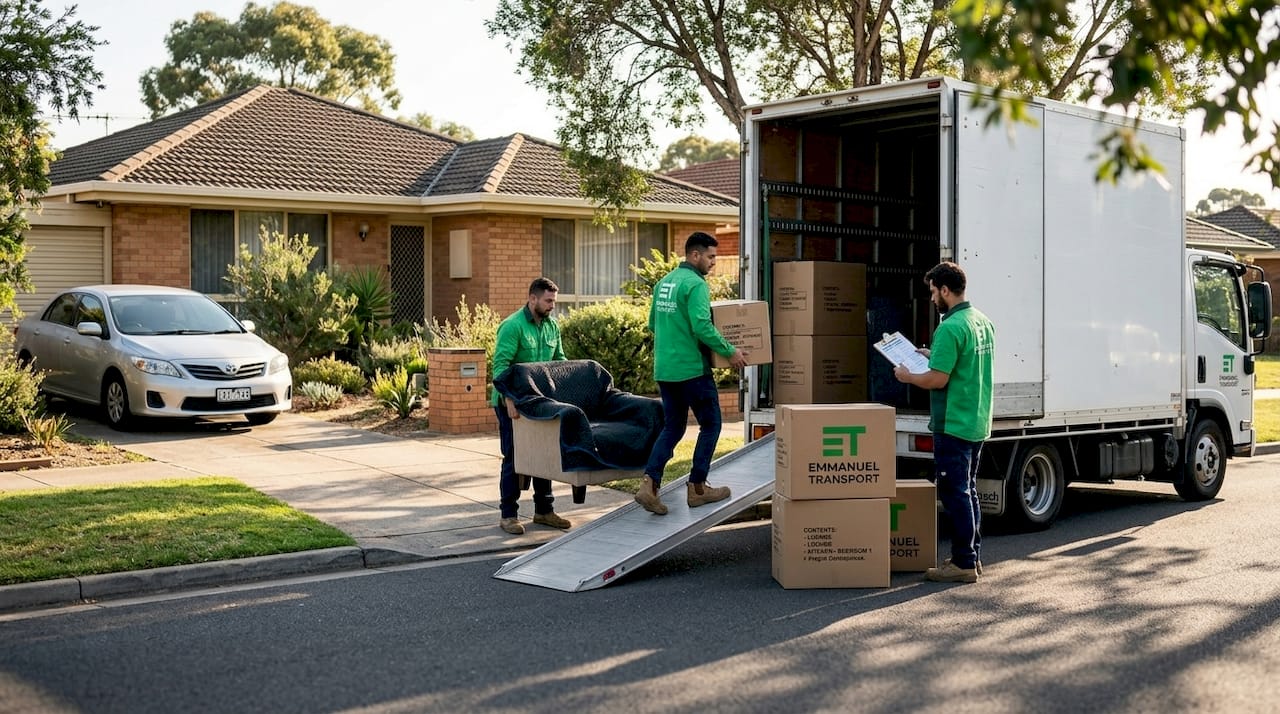
Types of moving services are defined by who handles packing, loading, transport, and unpacking, and that single factor determines your cost, effort, and risk on move day. Full-service removalists sit at one end of the spectrum, managing every task for you. Truck rentals and labour-only options sit at the other, putting most of the work in your hands. Between those extremes, moving containers offer a hybrid that suits a surprising number of situations. Understanding moving service types before you book is the difference between a move that runs to plan and one that blows your budget or your back.
1. Full-service moving: the highest-convenience option
Full-service moving is the arrangement where a professional removalist company handles every stage of your relocation, from packing your crockery to placing furniture in your new home. Full-service is ideal when time constraints, move complexity, or heavy and fragile goods make a DIY approach impractical. You pay for that convenience, but you also transfer the physical and logistical burden entirely to trained professionals.
What full-service movers typically handle:
- Packing and wrapping all items, including fragile goods
- Disassembly and reassembly of furniture
- Loading and securing items in the truck
- Transport to the destination
- Unloading and placement in designated rooms
- Optional unpacking and rubbish removal
Typical costs in 2026 for full-service moving range from $4,000 to $12,000 or more, depending on home size, distance, and the volume of goods. That range reflects the genuine complexity of the service. A two-bedroom apartment moving across Perth will sit at the lower end, while a four-bedroom house relocating interstate will push toward the top.
Full-service is the right call for long-distance moves, households with antiques or high-value art, and anyone with physical limitations or a tight professional schedule. The tradeoff is cost and the need to trust strangers with your possessions. Choosing a licensed, insured removalist and confirming valuation coverage before move day reduces that risk considerably.

Pro Tip: Confirm your valuation coverage selection in writing before move day. Default coverage under Released Value Protection pays only $0.60 per pound per item, which is far below replacement value for most furniture and electronics.
2. Moving containers: the flexible hybrid
Moving containers are a portable storage unit delivered to your property, which you pack at your own pace before the company transports it to your destination. PODS is the most widely recognised brand in this category globally, though similar services operate across Australia. Containers offer flexible scheduling because you control the packing timeline, which removes the pressure of a single moving day.
The cost sits between full-service and truck rental. Container moves typically cost between $2,000 and $6,500, making them a genuine middle ground for budget-conscious movers who still want professional transport.
| Feature | Moving containers | Full-service movers |
|---|---|---|
| Who packs | You | Removalist team |
| Transport | Company | Company |
| Scheduling flexibility | High | Moderate |
| Typical cost (2026) | $2,000–$6,500 | $4,000–$12,000+ |
| Storage option | Often available | Rarely included |
When moving containers make sense:
- You need storage between settlement dates
- You are moving interstate and want to avoid a rushed single-day pack
- You have the physical ability to pack but not to drive a large truck
- Your budget sits below full-service but above pure DIY
The main limitation is that you still do all the packing and loading yourself. If you underestimate the time or physical effort required, the flexibility advantage disappears quickly. For interstate moving solutions, containers are often an underrated option worth pricing alongside full-service quotes.
3. Truck rental: the lowest-cost self-service option
Truck rental is the arrangement where you hire a vehicle, pack it yourself, drive it to your destination, and unload without professional assistance. This is the most hands-on of all moving service types and the most affordable for those willing to do the work. Self-service options require high physical effort and coordination, but they afford real cost savings and scheduling flexibility.
Truck rental costs typically fall between $1,000 and $4,500 depending on vehicle size, distance, and hire duration. That figure does not include fuel, tolls, packing materials, or the cost of any additional help you bring in. Those extras add up faster than most people expect.
Truck rental suits you if:
- You are moving locally within the same city or suburb
- You have friends or family available to help with loading
- You are physically fit and comfortable driving a large vehicle
- Your budget is tight and your timeline is flexible
The hidden cost in truck rental is time. A full-service move that takes a professional team four hours can take an inexperienced group eight or more. Factor in the physical recovery time after a heavy DIY move, particularly if you are moving a multi-bedroom home. For cost-saving moving strategies, truck rental works best for small, local moves with minimal furniture.
4. Labour-only movers: targeted help without the truck
Labour-only movers are professionals hired specifically to load and unload your truck or container, without providing transport. Labour-only movers provide loading and unloading help that fits into self-service models, giving you a cost-saving middle ground between full DIY and full-service. You hire the truck, you pack the boxes, but trained removalists handle the heavy lifting.
Costs for labour-only services typically range from $400 to $1,800 depending on the number of workers and hours required. This makes it one of the most affordable ways to protect your back and your furniture without paying for a complete removalist package.
This option works particularly well for apartment moves, where the volume of goods is manageable but stairwells and lifts make solo loading genuinely difficult. It also suits people who are confident packing their own belongings but recognise the risk of injury when moving heavy items like sofas, fridges, and bed frames. For apartment moving situations in Perth, labour-only services are frequently the most practical and affordable choice.
The coordination requirement is higher with this model. You are responsible for booking the truck, managing timing, and directing the labour team on the day. Any delay with the truck hire directly affects the labour booking, so tight scheduling is non-negotiable.
5. Commercial moving services: office and business relocations
Commercial moving is a specialist category covering office relocations, retail fit-outs, and business equipment transfers. The service type mirrors residential options, with full-service commercial movers at the premium end and self-managed truck hire at the budget end. The critical difference is that commercial moves involve IT equipment, filing systems, and operational continuity that residential moves do not.
Professional commercial moving companies plan relocations around business hours to minimise downtime. A well-run office move happens over a weekend, with workstations operational by Monday morning. That level of coordination requires a removalist with commercial experience, not just residential expertise.
The cost of commercial moves varies too widely for a single range because it depends on office size, equipment volume, and whether after-hours rates apply. Get itemised quotes from at least two providers and confirm that their insurance covers IT equipment and sensitive documents. The role of moving companies in commercial relocations extends well beyond carrying boxes. It includes protecting business continuity.
6. Valuation coverage and moving insurance: what you must know
Moving insurance and valuation coverage are not the same thing, and confusing them is one of the most expensive mistakes you can make when comparing different moving options. Valuation coverage is a legal liability framework set by the removalist. Moving insurance is a separate financial product purchased from an insurer.
Released Value Protection sets mover liability at $0.60 per pound per article. On a 10-kilogram television worth $2,000, that pays out roughly $13. This is the default coverage on most moves unless you actively upgrade it.
Full Value Protection requires an additional fee but ensures repair, replacement, or cash settlement up to the declared shipment value. This is the coverage worth paying for on any move involving electronics, art, jewellery, or antiques.
| Coverage type | Cost | Payout basis | Best for |
|---|---|---|---|
| Released Value Protection | Free | $0.60/lb per item | Budget moves, low-value goods |
| Full Value Protection | Additional fee | Repair, replace, or cash settlement | High-value or fragile items |
| Third-party insurance | Separate premium | Broader risks including theft and fire | Comprehensive protection |
Third-party moving insurance complements mover valuation by covering broader risks like theft, fire, and certain weather damage. Federal regulations require movers to offer valuation options, but they do not require them to cover every risk scenario. For high-value goods, third-party insurance is not optional. It is the only way to close the gap between what a removalist will pay and what your items are actually worth.
Pro Tip: Document your valuation coverage selection in writing before the move begins. Selecting coverage in writing is the only way to avoid defaulting to the minimum liability rate on interstate moves, where claims are most common.
7. How to choose the right moving service for your situation
Matching your service type to your risk and effort preferences reduces stress more reliably than any other single decision in the moving process. The right service is not always the cheapest one. It is the one that aligns with your physical capacity, your timeline, and the complexity of what you are moving.
Use this comparison to narrow your options:
| Service type | Typical cost (2026) | Effort required | Best scenario |
|---|---|---|---|
| Full-service movers | $4,000–$12,000+ | Minimal | Large homes, interstate, fragile items |
| Moving containers | $2,000–$6,500 | Moderate | Flexible timelines, interstate, storage needed |
| Truck rental | $1,000–$4,500 | High | Local moves, tight budgets, physically able |
| Labour-only | $400–$1,800 | Moderate | Apartment moves, heavy lifting assistance |
Decision checklist before you book:
- Physical capacity: Can you safely lift and carry heavy furniture for several hours?
- Timeline: Do you have days to pack at your own pace, or is your move date fixed?
- Distance: Local moves under 50 kilometres suit truck rental. Interstate moves suit containers or full-service.
- Item value: High-value or fragile goods justify full-service and Full Value Protection.
- Budget flexibility: If your budget is fixed, calculate the true cost of truck rental including fuel, materials, and your time.
Special situations deserve specific guidance. Fragile items like pianos, large artworks, or antique furniture should always travel with a full-service mover who carries specialist equipment and appropriate insurance. Tight deadlines, such as a same-day move or a last-minute settlement, favour full-service because the team arrives ready to work immediately. For stress-free professional moves, the investment in full-service pays for itself in reduced risk and physical recovery time.
Budget-conscious movers who are physically capable and moving locally will find that truck rental or labour-only combinations deliver genuine savings. The key is honest self-assessment. Underestimating a move is far more expensive than overestimating it.
Key takeaways
The right type of moving service is determined by matching your physical capacity, budget, and move complexity to the service that minimises your total cost including time, effort, and risk.
| Point | Details |
|---|---|
| Service type drives cost and effort | Full-service costs $4,000–$12,000+; truck rental starts at $1,000, but requires significant physical effort. |
| Containers suit flexible timelines | Moving containers let you pack at your own pace and often include storage between settlement dates. |
| Default coverage is inadequate | Released Value Protection pays $0.60 per pound per item. Upgrade to Full Value Protection for meaningful cover. |
| Labour-only fills a practical gap | Hiring removalists for loading only cuts costs while protecting you from injury on heavy items. |
| Document your insurance choice | Written confirmation of valuation coverage is the only protection against default minimum liability. |
Emmanuel’s take on choosing a moving service in Australia
Most people approach a move by asking “what is the cheapest option?” That is the wrong question. The right question is “what is the cheapest option I can actually execute without something going wrong?”
I have seen this play out repeatedly. A family books a truck rental to save $3,000 on a full-service quote. They underestimate the packing time, the truck is returned late, and they pay penalty fees. One person injures their back on a fridge. They end up hiring emergency labour on the day at premium rates. The total cost exceeds what full-service would have charged, and the move takes two days instead of one.
Moving containers are genuinely underrated in Australia. Most people have not considered them because the marketing is less visible than full-service removalists or truck hire companies. But for anyone moving interstate with a flexible settlement date, a container gives you professional transport without the pressure of a single-day pack. That flexibility alone is worth the cost difference over truck rental for most households.
On insurance, my honest observation is that most consumers skip Full Value Protection because they do not read the fine print on Released Value Protection until after something breaks. At $0.60 per pound, a damaged 15-kilogram television pays out less than $15. Read the valuation options before you sign anything, not after.
My recommendation for Perth residents is to use a local removalist with commercial and residential experience for anything beyond a simple local move. Local knowledge, reliable scheduling, and genuine accountability matter more than a slightly lower quote from a provider you cannot verify.
— Emmanuel
Move smarter with Emmanuel Transport
Emmanuel Transport covers the full range of moving service types for Perth residents and businesses, from complete residential removals in Perth to labour-only assistance and commercial office relocations. Every move is handled by experienced staff in fully insured vehicles, with transparent pricing and no hidden fees.

Whether you need a full-service team for a complex interstate move or targeted loading help for an apartment relocation, Emmanuel Transport matches the service to your actual needs. Explore Perth moving services or request a free quote today to get a clear cost estimate before you commit to anything.
FAQ
What are the main types of moving services available?
The four main types are full-service movers, moving containers, truck rentals, and labour-only movers. Each differs by who handles packing, loading, transport, and unloading, which directly affects cost and effort required.
How much does a full-service move cost in Australia?
Full-service moving typically costs between $4,000 and $12,000 or more in 2026, depending on home size, distance, and the volume of goods being transported.
Why is moving insurance important?
Moving insurance protects you when default valuation coverage falls short. Released Value Protection pays only $0.60 per pound per item, which rarely covers the actual replacement value of damaged goods.
When should I choose a moving container over a removalist?
Moving containers suit situations where you need flexible packing time, storage between settlement dates, or an interstate move at a lower cost than full-service. You handle the packing; the company handles transport.
Can I hire movers just for loading and unloading?
Yes. Labour-only movers provide loading and unloading assistance without transport, typically costing between $400 and $1,800. This option works well for apartment moves or anyone who has hired their own truck but needs help with heavy items.
Recommended
