
Moving furniture in Perth sounds straightforward until you are standing in a narrow hallway with a three-seater couch wedged at an awkward angle, your back already aching, and a scratched skirting board staring back at you. Without the right know-how, relocating even a single room of furniture carries real risks, from personal injury to costly damage to your belongings and property. This guide cuts through the guesswork and delivers practical, field-tested advice drawn from local experience, so your next move goes smoothly from start to finish.
Table of Contents
- Set up before move day: preparation is key
- Safe lifting and handling techniques
- Protecting your furniture from damage
- Furniture moving tools and what to use when
- When to call the professionals
- The real secret to stress-free furniture moves: what most guides miss
- Make your next move seamless with expert help
- Frequently asked questions
Key Takeaways
| Point | Details |
|---|---|
| Preparation prevents problems | Getting organised before move day saves time and avoids costly mistakes. |
| Safety above speed | Lifting furniture the right way protects you and your belongings. |
| Protect against damage | Invest in blankets, wrap, and proper packing for a smooth move. |
| Use the right tools | Moving equipment like dollies and sliders make hard jobs easy. |
| Know your limits | Calling professionals can save effort and prevent expensive mishaps. |
Set up before move day: preparation is key
Most moving disasters are not caused by bad luck. They are caused by skipping the preparation stage. When you invest time upfront in planning, you dramatically reduce the chance of something going wrong on the day itself.
Start with a written checklist. Walk through your home and list every large furniture piece that needs to move. Note its approximate dimensions, weight, and any special handling requirements. Then map out the access routes, the front door, hallways, staircases, lifts, and any tight corners. This single step alone saves enormous time on move day because you are not making decisions under pressure.
Measure everything before you move anything. This sounds obvious, but it is one of the most commonly skipped steps. Measure your doorways, stairwells, and lift dimensions, then compare them against the measurements of your furniture. A standard Australian interior doorway is roughly 820mm wide, but older Perth homes and apartment blocks often have narrower passages. Knowing this in advance lets you plan whether a piece needs to be tilted, disassembled, or taken through an alternative route.
Disassemble what you can. Flat-pack furniture, bed frames, bookshelves, and dining tables almost always come apart. Removing legs, shelves, and drawers before move day reduces bulk and weight significantly. Keep all screws and fittings in labelled zip-lock bags taped to the relevant piece. This takes about twenty minutes per item but can save hours of frustration at the other end.
Gather your supplies early. You will need moving blankets, furniture straps, a trolley or dolly, packing tape, and stretch wrap. Do not wait until the morning of the move to source these. Many Perth hardware stores and removalist suppliers rent or sell moving kits. Effective preparation minimises last-minute stress and avoids the kind of damage that is expensive and upsetting to deal with later.
Notify your neighbours and building management. If you live in an apartment or a townhouse complex, blocking a lift or stairwell with furniture is a genuine inconvenience to others. Give at least 48 hours’ notice, and if your building requires a lift booking or a lift pad installation, arrange that well in advance. Some Perth apartment buildings require a bond for lift use during moves, so check your lease or body corporate rules.
Pro Tip: Take photos of all your furniture before the move, including existing scratches and dents. This protects you from disputes about damage and gives you a clear record if anything does get knocked around in transit. It also helps when reviewing protecting furniture strategies after the move.
- List all large items and their dimensions.
- Measure every access point in both the origin and destination properties.
- Disassemble beds, tables, and shelving units in advance.
- Source blankets, straps, tape, and trolleys before move day.
- Notify neighbours and book lift access if required.
Safe lifting and handling techniques
With preparations in place, the focus shifts to how to physically move items safely. This is where most injuries happen, and it is entirely preventable with the right approach.
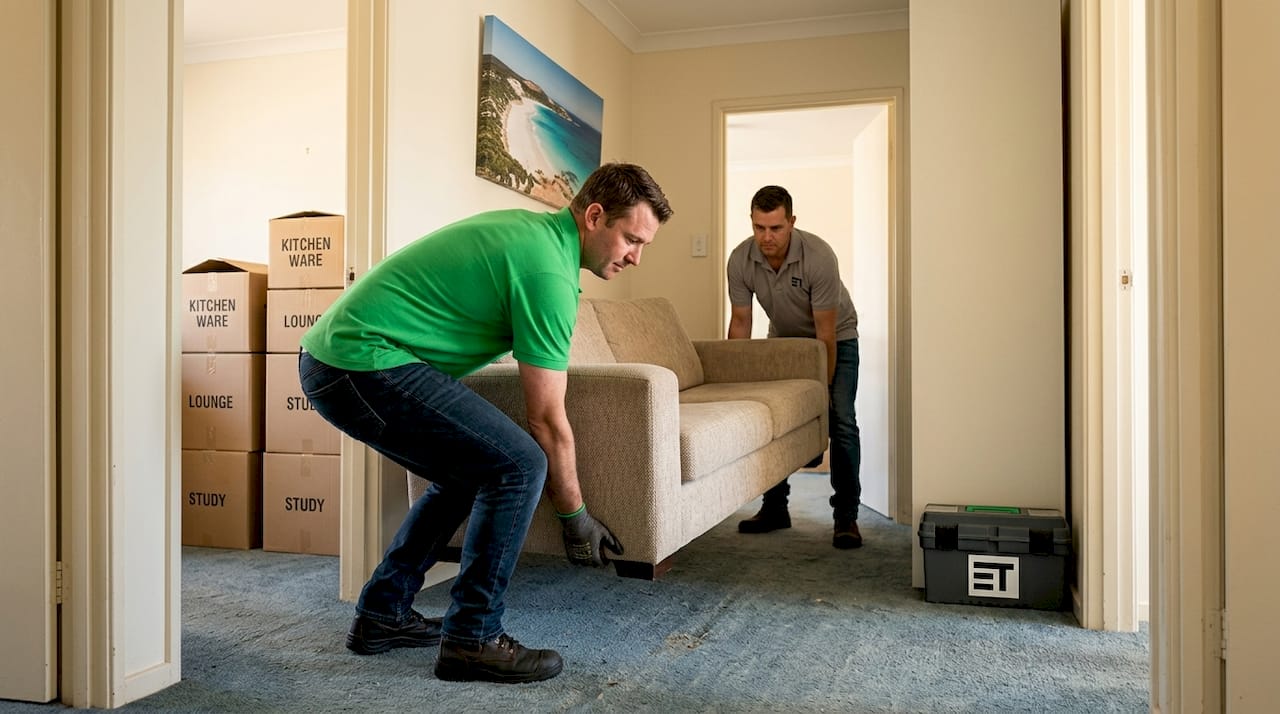
Lift with your legs, not your back. Every removalist knows this rule, yet it is broken constantly by people in a hurry. Stand close to the item, bend your knees, keep your spine straight, and drive upward through your legs. Your leg muscles are far stronger than your lower back, and using them correctly means the difference between a smooth lift and a sprained lumbar.
Keep your posture straight throughout the carry. Once you have lifted an item, resist the urge to twist your torso to navigate corners. Instead, move your feet and turn your whole body. Twisting while carrying weight is one of the leading causes of soft tissue injuries during moves. Move slowly and deliberately, especially on stairs.
Communication is everything when carrying with a partner. Agree on clear, simple signals before you start. Phrases like “ready,” “lift,” “set down,” and “stop” prevent the kind of miscommunication that leads to dropped items or pinched fingers. One person should lead and call the movements, particularly on stairs or through tight spaces. Never assume your partner knows what you are about to do.
- Bend at the knees and keep your back straight.
- Move your feet rather than twisting your torso.
- Use clear verbal signals when working with a partner.
- Wear supportive footwear with grip, not thongs or bare feet.
- Take breaks to avoid fatigue-related accidents.
Use sliders and dollies for heavy or awkward pieces. Furniture sliders placed under the legs of heavy items allow you to glide them across smooth floors with minimal effort. A four-wheeled dolly is ideal for large, heavy pieces like wardrobes, fridges, and bookshelves. When moving heavy furniture, a dolly reduces the physical strain dramatically and speeds up the process.
Never attempt dragging techniques unless you have received formal training.
Drag pad techniques carry real safety risks and can cause serious injury to untrained individuals, as well as damage to floors and furniture.
Pro Tip: If a piece of furniture feels too heavy for two people to lift comfortably, it almost certainly is. Add a third person or use mechanical assistance. Ego has no place in a safe move.
Protecting your furniture from damage
After learning how to handle items safely, it is vital to prevent accidental damage during transport. Even carefully lifted furniture can be scratched, dented, or soaked if it is not properly protected.
Moving blankets are your first line of defence. These thick, padded covers wrap around furniture surfaces and absorb the knocks and scrapes that inevitably happen during loading and unloading. Drape them over corners, tabletops, and cabinet faces. Secure them with packing tape or stretch wrap so they do not slip during transit. Protection materials like blankets, pads, and shrink-wrap genuinely reduce the risk of damage in transit, and they are inexpensive to hire or buy.
Shrink-wrap adds a second layer of protection. Wrapping furniture in clear plastic stretch film keeps blankets in place, protects against moisture and light rain, and prevents drawers and doors from swinging open during the move. It is particularly useful for upholstered items like sofas and armchairs, which can absorb dirt and moisture if left uncovered.
Secure drawers and doors before moving. An open drawer catching on a door frame can cause significant damage to both the furniture and the property. Use masking tape or stretch film to hold drawers and cabinet doors closed. Avoid using strong adhesive tapes directly on finished timber surfaces, as they can strip the finish when removed.
Remove detachable parts wherever possible. Glass tabletops, mirror panels, removable shelves, and decorative hardware should all come off before the item is moved. Wrap glass and mirrors in bubble wrap, then in moving blankets, and transport them vertically rather than flat. Review furniture packing tips for more detail on wrapping specific item types.
- Wrap all surfaces in moving blankets before loading.
- Apply stretch film over blankets to keep them secure.
- Tape or film all drawers and doors shut.
- Remove glass, mirrors, and decorative hardware separately.
- Transport glass items vertically and clearly labelled as fragile.
| Protection method | Best used for | Cost to hire or buy |
|---|---|---|
| Moving blankets | Timber, metal, and upholstered surfaces | Low |
| Stretch film | Sofas, chairs, and wrapped bundles | Very low |
| Bubble wrap | Glass, mirrors, and fragile hardware | Low |
| Corner protectors | Sharp edges on tables and cabinets | Very low |
| Furniture pads | High-value or antique pieces | Low to moderate |
Pro Tip: When using removal blankets, double-layer the coverage on corners and edges. These are the points most likely to make contact with door frames and walls during transit, and a single layer of padding often is not enough to prevent marks.
Furniture moving tools and what to use when
Protection sorted, the right tools further simplify and secure the moving process. Choosing the wrong tool for a job wastes time and increases the risk of injury or damage.
Dollies for large, heavy items. A four-wheeled platform dolly is the workhorse of any serious furniture move. It is ideal for wardrobes, large appliances, heavy bookshelves, and stacked boxes. The dolly takes the weight off your body entirely and allows one person to move items that would otherwise require three or four. Different furniture moving tools suit different item shapes and weights, so matching the tool to the task matters.
Furniture sliders for smooth floors. Sliders are flat discs placed under furniture legs that allow items to glide across timber, tiles, or vinyl with very little effort. They are not suited to carpet or outdoor surfaces, but on smooth indoor floors they are remarkably effective. A set of four sliders costs very little and can be reused across multiple moves.
Furniture straps and lifting harnesses. Moving straps loop under furniture and over your shoulders or forearms, distributing weight more evenly and reducing the load on your lower back. They are particularly useful on stairs, where a dolly cannot always be used. Two people using straps can safely carry items that would be dangerous to carry by hand alone.
Gloves for grip and hand protection. Moving gloves with rubberised palms give you a far more secure grip on smooth or polished surfaces. They also protect your hands from sharp edges, staples, and splinters. A decent pair costs under twenty dollars and is absolutely worth it.
Ramps for loading vans. A loading ramp bridges the gap between the ground and the van floor, allowing you to roll heavy items up on a dolly rather than lifting them. This is one of the most underused tools in DIY moves and one of the most effective at preventing back injuries.
| Tool | Best for | Surface type | Approx. hire cost |
|---|---|---|---|
| Platform dolly | Large, heavy items | Hard floors and smooth paths | Low per day |
| Furniture sliders | Medium to heavy items | Smooth indoor floors only | Very low |
| Moving straps | Stairs and awkward shapes | All surfaces | Low per day |
| Loading ramp | Van loading and unloading | Outdoor and driveway | Low per day |
| Moving gloves | All tasks | All surfaces | Purchase only |
- Always check dolly weight ratings before loading.
- Use sliders on clean floors to prevent scratching.
- Adjust strap length before lifting, not during.
- Ramps should be secured to the van before use.
Pro Tip: For additional moving tips on tool selection, consider the shape of the item as much as its weight. A long, narrow item like a dining table is often harder to manage than a heavier but more compact wardrobe, simply because of how the weight is distributed.
When to call the professionals
Even with strong tools and careful handling, some moves call for outside help. Knowing when to make that call is not a sign of weakness. It is simply good judgement.
The item is too large, delicate, or valuable to risk. A grand piano, an antique sideboard, a large marble dining table, or a custom-built wardrobe are all examples of items where DIY handling carries significant risk. The cost of a professional removalist is almost always less than the cost of repairing or replacing a damaged piece. Professional movers minimise risk for oversized, heavy, or expensive items by using specialist equipment and trained techniques.
Access is restricted or the layout is complex. Narrow staircases, low ceilings, tight lift dimensions, and multi-storey buildings all add complexity that can quickly exceed the capability of an untrained team. Professionals deal with these scenarios every day and have the experience to navigate them without damage.
Injury risk is high. If you or your helpers have existing back problems, joint issues, or limited physical fitness, attempting to move heavy furniture is genuinely dangerous. A single injury can mean weeks off work and significant medical costs, far more than the price of hiring a removalist.
You are short on time. A professional team can move a full house of furniture in the time it takes an untrained group to move a single room. If you are on a tight settlement or lease deadline, professional help is often the most cost-effective option when you factor in your own time.
“Hiring professionals is not just about muscle. It is about experience, equipment, and accountability. When something goes wrong during a DIY move, the cost falls entirely on you.”
- Specialist items like antique furniture require custom padding and trained handlers.
- Moving a piano is one of the most technically demanding furniture tasks and should always involve professionals.
- Fully insured removalists protect you financially if anything is damaged in transit.
- Professional movers carry public liability insurance, which DIY moves do not provide.
The real secret to stress-free furniture moves: what most guides miss
Let’s be honest about something. Most furniture moving guides focus heavily on gear, hacks, and clever tricks. And while those things matter, they are not what actually determines whether a move goes well or badly. The real differentiator is almost always something far less glamorous: slowing down and thinking clearly.
We have seen countless moves in Perth where people had every piece of equipment available and still ended up with a damaged cabinet or a strained back. Why? Because they were rushing. They skipped the measurement step because they assumed it would be fine. They lifted without communicating with their partner. They tried to squeeze a bookshelf through a doorway that was clearly too narrow, rather than taking the time to disassemble it.
Rushing or ignoring basic safety precautions causes most mishaps, not complex scenarios. This is a finding that lines up entirely with what we see on the ground. The complicated moves, the pianos and the antiques and the awkward staircases, those get treated with respect. It is the “easy” moves that catch people out, because familiarity breeds complacency.
There is also something worth saying about physical limits. Many people treat asking for help as an admission of failure. It is not. Knowing that a piece of furniture is beyond your safe capacity to move, and acting on that knowledge by calling in a professional or adding another person to the team, is exactly the kind of decision-making that prevents injuries and protects your belongings. The most seamless moves we have been part of are not the ones with the most equipment. They are the ones where everyone involved communicated openly, worked at a sensible pace, and paid attention to the small details, like whether a blanket had slipped, or whether a strap needed adjusting before the next lift.
The approach to protecting furniture is a good example of this. The technique itself is simple. The discipline to actually do it every single time, even when you are tired and just want to get the last few items loaded, is where most people fall short. Build the habit, not just the knowledge.
Make your next move seamless with expert help
You now have a solid foundation of practical knowledge to approach your Perth furniture move with confidence. But knowing what to do and having the right team behind you are two very different things.

At Emmanuel Transport, we take the stress out of furniture relocation for homeowners, renters, and small businesses across Perth and its surrounding suburbs. Whether you need guidance on more expert furniture moving tips or want professional hands managing your furniture protection solutions from start to finish, our experienced team is ready to help. We offer fully insured vehicles, transparent pricing, and friendly staff who treat your belongings with genuine care. Use our moving house checklist to get organised, then reach out for an obligation-free quote. Let us handle the heavy lifting while you focus on settling in.
Frequently asked questions
What’s the safest way to move a couch through narrow spaces?
Remove the legs and cushions first, then measure both the couch and the passage carefully. Use moving straps or sliders to manoeuvre gently, and tilt the couch on its side if needed. Preparation and safe handling ensure safe passage for large furniture through tight areas.
How do I protect furniture from rain during a Perth move?
Cover pieces with removal blankets or plastic wrap before loading, and load sensitive items last to minimise their time exposed outdoors. Furniture must be covered to prevent weather damage during moves, particularly during Perth’s unpredictable winter months.
Are moving tools like dollies and sliders worth renting?
Yes, for most heavy or awkward furniture, renting proper tools makes the move considerably safer and easier. Dollies and sliders ease moving heavy furniture significantly and reduce the risk of injury and property damage.
Should I hire removalists for a small flat move?
If you have bulky, heavy, or valuable items, professional movers reduce risk and save time even for smaller moves. Professional movers minimise risk and protect valuable items during relocation, often making the cost worthwhile when weighed against potential damage or injury.
What’s the best way to move antique or sentimental furniture?
Hire a mover with specialist experience in antiques, use custom padding and crating where necessary, and confirm insurance cover before the move begins. Professional movers have the right methods and insurance for antiques, giving you genuine peace of mind throughout the process.
Recommended
- Perth Relocation: 2026 moving & packing tips for a seamless move | Emmanuel Transport Removalists Perth
- Expert Tips for Packing Furniture: Safe Moving with Emmanuel Transport
- 8 Essential Furniture Moving Tips for a Seamless 2025 Move | Emmanuel Transport Removalists Perth
- Protect Furniture When Moving: Expert Tips by Emmanuel Transport in 2026
