
Moving house is one of those experiences that looks straightforward on paper until you’re standing in your living room at 7 am, surrounded by boxes, realising the hired van is too small and your mate who promised to help has just cancelled. Thousands of Perth homeowners and renters attempt DIY moves every year believing they’ll save money, only to face unexpected damage, physical exhaustion, and costs that quietly balloon beyond what a professional removalist would have charged in the first place. This guide walks you through the real reasons professional removal services exist, what they genuinely protect you from, and how to choose one that won’t leave you with nasty surprises.
Table of Contents
- The real risks of moving house yourself
- How removalists safeguard your belongings and property
- Reducing stress, strain, and risk of injury
- Ensuring a smooth move: timing, certainty and cost transparency
- What to check before choosing a removalist
- The uncomfortable truth most moving guides miss
- Next steps: make your Perth move easy and safe
- Frequently asked questions
Key Takeaways
| Point | Details |
|---|---|
| Reduce risk of damage | Removalists use purpose-built equipment and proven methods to prevent harm to your belongings and home. |
| Avoid stress and injury | Professional movers handle heavy lifting and logistics, so you skip the strain and stay safe. |
| Save time and stay on track | Removalists provide clear schedules and minimise moving-day surprises or delays. |
| Know your total costs | Reputable services offer upfront quotes and help you avoid hidden fees or surprise charges. |
| Expert handling matters | From specialist packing to careful navigation of Perth properties, experience makes your move hassle-free. |
The real risks of moving house yourself
There’s a compelling logic to DIY moves. You control the timeline, you avoid paying someone else, and it feels like a manageable weekend project. But the reality on moving day almost always looks different from the plan.
Physical injury is the risk most people underestimate. Sofas, fridges, washing machines, and bookshelves are not just heavy; they’re awkward. Getting them through doorways, around corners, and down stairs requires specific technique. Lifting heavy items incorrectly is one of the most common causes of serious back strain and soft tissue injuries, and removalists train specifically in safe lifting methods and use purpose-built equipment to prevent exactly this. A back injury on moving day doesn’t just ruin the move; it can affect you for weeks or months afterward.
Beyond injury, there are the logistical traps that catch even experienced self-movers:
- Hiring a van that’s too small, forcing multiple trips and blowing out the schedule
- Underestimating how long packing and loading actually takes
- Running out of time on lease changeover day with half your belongings still unpacked
- Struggling to park a large vehicle at both your old and new addresses
- Relying on helpers who arrive late, leave early, or simply aren’t strong enough for the job
And then there are the hidden costs that don’t show up in the original “this will be cheaper” calculation. You pay for van hire, fuel, packing materials, and your own lost time. If something gets damaged because it wasn’t secured properly, you pay to repair or replace it. If you scratch a wall or doorframe at a rental property, that comes out of your bond. These costs stack up fast.
“I thought we’d be done by lunchtime. We finished at 11 pm and I still had to return the van the next morning. Never again.” — A sentiment shared by countless Perth movers every year.
Reading cheap Perth removalist reviews from locals who tried both approaches makes this pattern very clear: the DIY move rarely ends up cheaper once you account for everything.
Pro Tip: Most DIY moves take at least 40% longer than the mover originally estimated. If you’re changing over a lease on the same day, that time buffer disappears fast.
How removalists safeguard your belongings and property
One of the most visible differences between a professional move and a DIY move is how items are actually handled. Professional removal teams don’t just carry things from A to B; they use a systematic process designed to prevent damage at every stage.
Professional Perth removalists reduce the risk of damage and protect both belongings and property using purpose-built equipment and packing methods developed over thousands of moves. This matters enormously when you’re moving expensive furniture, fragile items, electronics, or artwork.
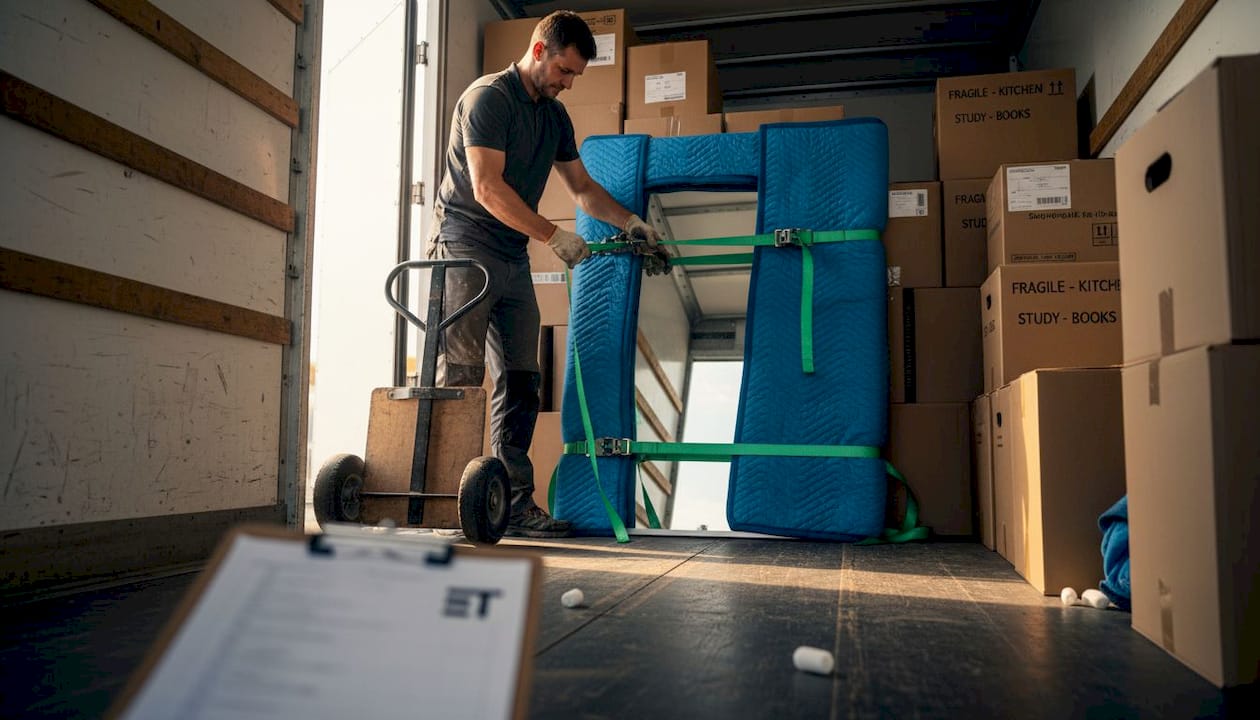
Here’s a look at the equipment professional teams use compared to what most DIY movers have available:
| Item | Professional removalists | Typical DIY move |
|---|---|---|
| Furniture blankets | Thick padded moving blankets for every piece | Old bedsheets or towels, if remembered at all |
| Trolleys and dollies | Heavy-duty equipment rated for appliances | Manual carry or borrowed trolley |
| Straps and tie-downs | Ratchet straps securing every load | Rope or bungee cords, often insufficient |
| Floor protection | Runners and corner guards throughout | Usually none |
| Wrapping materials | Stretch wrap, foam, and custom padding | Bubble wrap if you remembered to buy it |
| Loading method | Systematic weight distribution and layering | Load as you go, hope for the best |
This gap in equipment alone explains a large portion of the damage claims that come from DIY moves. A wardrobe loaded without padding against a washing machine on a bumpy Perth road will come off second best every time.
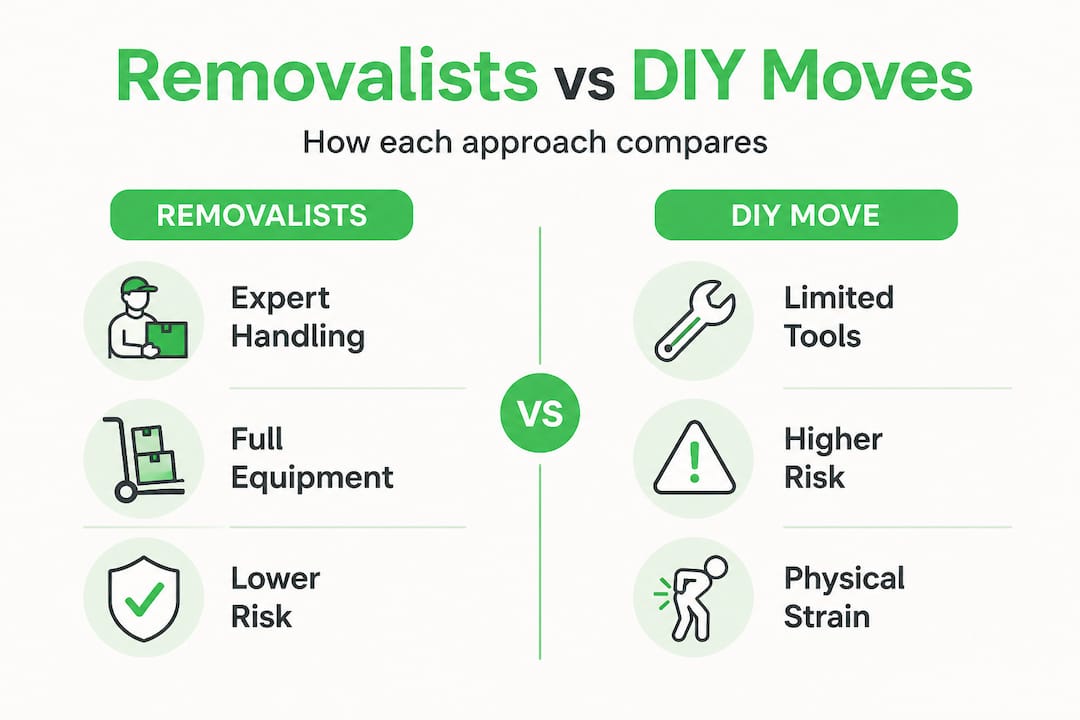
Knowing how to approach protecting furniture during moves is genuinely worth understanding before any move, whether you use professionals or not. And if you’re handling some of the packing yourself, resources on packing furniture safely can save you a lot of grief.
What professional teams handle with particular care:
- Glass tabletops and mirror frames, which are almost always packed vertically with specialist padding
- Antique or timber furniture, which needs protection from moisture as well as impact
- Large appliances, which require secure positioning to prevent internal damage during transit
- Flat-screen televisions, which are among the most frequently damaged items in DIY moves
The systematic nature of professional loading also means the truck is packed in a specific order, with heavier items anchored low and fragile items cushioned and separated. That order makes unloading faster, too.
Reducing stress, strain, and risk of injury
Moving house is consistently ranked as one of life’s most stressful events. Part of that stress is emotional, but a substantial part is purely physical. When you’re already tired from weeks of packing and sorting, the last thing your body needs is several hours of heavy manual labour.
Hiring removalists to avoid injury and reduce physical strain during heavy lifting and manoeuvring through stairs, tight hallways, and narrow access is one of the most straightforward reasons people choose professional services. Experienced removalists use specific techniques for moving in challenging spaces.
Here’s how a professional team typically approaches a difficult move:
- Assessment before loading. The team walks through both properties before carrying a single item, identifying access challenges, tight corners, and anything that needs special handling.
- Disassembly where needed. Beds, large wardrobes, and flat-pack furniture are broken down to manageable pieces before being moved.
- Two-person lifts as standard. Anything over a certain weight threshold is always a team lift, never a solo attempt.
- Equipment before muscle. Trolleys, sliders, and ramps are used before anyone tries to carry something manually.
- Stair protocols. Dedicated techniques for staircase movement prevent both injury and wall damage.
- Communication throughout. Verbal cues between team members keep every lift coordinated and safe.
This approach isn’t just about protecting the removalists. It protects your property from scuffs, dents, and scratches that happen when heavy items are mishandled in confined spaces.
Pro Tip: Injuries sustained during moving are one of the top causes of moving-day regret. A sprained wrist or strained back doesn’t just hurt; it leaves you unable to unpack, assemble furniture, or set up your new home for days or even weeks.
For Perth residents navigating everything from small apartment moves to large family homes, the 2026 Perth moving guide covers what to expect at each stage and how to prepare, regardless of move size.
Ensuring a smooth move: timing, certainty and cost transparency
Timing is everything on moving day. If you’re on a lease changeover, your old home needs to be empty and clean before your landlord does the inspection, and your keys for the new place might not be available until midday. That’s a tight window. One delay ripples into another, and suddenly you’re trying to move furniture in the dark.
Professional removalists provide greater scheduling certainty around lease end and settlement timing, reducing the chance of delays and surprise charges. This is a significant practical benefit. Reputable companies confirm arrival times, communicate clearly on the day, and work to a plan that accounts for realistic timeframes.
The flip side is that not all removalist companies operate this way. Hidden costs and poor communication are among the most common complaints raised in Perth removalist reviews. Review platforms consistently show patterns of customers who were quoted a low hourly rate only to find the final bill included travel time, minimum booking lengths, stair surcharges, and wrapping fees that were never mentioned upfront.
Here’s how transparent and ambiguous quotes differ in practice:
| Quote element | Transparent removalist | Ambiguous removalist |
|---|---|---|
| Travel time | Clearly stated or excluded | Charged from depot, not disclosed |
| Minimum hours | Stated upfront | Revealed on invoice |
| Stair or access surcharge | Included or explained | Added on the day |
| Packing materials | Itemised or included | Added as a surprise at end |
| Insurance or liability | Explained clearly | Vague or absent |
| Cancellation policy | Written and accessible | Verbal only |
When vetting a removalist, ask these questions before booking:
- Is travel time to and from our addresses included in the quoted rate?
- Are there any minimum hour requirements?
- Do you charge extra for stairs, lifts, or narrow access?
- What does your insurance cover if something is damaged?
- What happens if you’re delayed or running late?
- Is this a written quote or an estimate that can change?
“The difference between a good and a bad moving experience often comes down to what was communicated before moving day, not what happened during it.”
Hidden pricing complaints are a major theme in moving industry reviews, with customers frequently describing how a low headline rate grew significantly through travel charges, waiting time, and extras they weren’t warned about. Getting everything in writing before you confirm is the single most effective way to protect yourself.
What to check before choosing a removalist
Choosing the right removalist involves more than finding the lowest quote online. The cheapest option that turns up unreliable, underequipped, or without proper insurance will cost you far more than a slightly higher quote from a team you can trust.
Industry review evidence consistently highlights the same risk factors: undisclosed pricing drivers, poor communication, and teams that don’t have the right equipment for the job. Here’s a checklist to work through before confirming any booking:
- Read reviews on multiple platforms, not just the company’s own website
- Ask for a written, itemised quote with all potential charges listed
- Confirm the team has appropriate insurance covering your goods in transit
- Ask whether the truck and equipment are owned by the company or subcontracted
- Check whether the crew are experienced employees or casual labour hired for the day
- Clarify the cancellation and rescheduling policy before you pay any deposit
- Ask specifically about your property’s access: stairs, narrow driveways, lifts, or parking restrictions
A useful way to compare options is to look at what each company includes as standard:
| Potential issue | What to ask | Red flag |
|---|---|---|
| Access challenges | Is there a surcharge for stairs or tight access? | No mention of it until moving day |
| Insurance coverage | What are you covered for if something breaks? | “We’re careful” with no policy detail |
| Arrival time | Do you confirm a time window before the day? | “We’ll call when we’re on our way” |
| Quote accuracy | Is this a firm quote or an estimate? | Estimate with no cap or ceiling |
| Staff experience | How long has your team been working together? | “We’ll send whoever’s available” |
Finding Perth removalist ratings and reading detailed customer accounts gives you a realistic picture of what each company actually delivers, not just what they promise on their website.
Trust signals worth looking for include a physical address, a working phone number, prompt responses to enquiries, and a willingness to answer specific questions rather than giving vague, generic assurances.
The uncomfortable truth most moving guides miss
Here’s what years of helping Perth residents move has taught us: most moving stress doesn’t come from the physical act of moving. It comes from decisions made weeks before moving day, usually out of anxiety about cost.
The urge to cut corners is understandable. Moving is expensive, and when you’re already paying bond, rent, and connection fees, every dollar matters. So people look for the cheapest quote, or decide to do it themselves, or ask a friend with a ute to help. And in a minority of cases, it works out fine.
But in a significant number of cases, it creates a different and more expensive problem. A cheap removalist who doesn’t show up, or shows up hours late, or sends two people for a four-bedroom house, turns moving day into a crisis. A DIY move that takes twice as long eats into lease handover time. Damaged furniture costs money to repair or replace.
Reading cheap removalist experiences from real Perth customers makes this pattern impossible to ignore. The reviews are full of people who chose on price and paid for it in other ways. The painful irony is that the stress and cost of a botched cheap move almost always exceeds what a reputable mid-range service would have charged.
The real value of a good removalist isn’t just the physical moving. It’s the certainty. Knowing someone experienced is handling your belongings, keeping to a schedule, and communicating clearly takes an enormous amount of pressure off an already demanding day. That certainty has a value that doesn’t show up in any quote comparison.
What seasoned movers consistently say they wish they’d known before their first move: hire people you trust, get everything in writing, and don’t judge the quote on hourly rate alone. The total cost of a move includes your time, your energy, your bond, your furniture, and your sanity. Factor all of that in.
Next steps: make your Perth move easy and safe
If this guide has helped clarify what’s at stake on moving day, the next step is turning that knowledge into action.

Emmanuel Transport works with Perth homeowners and renters to take the hard work and guesswork out of moving day. Whether you’re relocating a studio apartment or a large family home, our experienced team arrives with the right equipment, a clear plan, and a commitment to keeping your belongings safe from start to finish. Before you finalise your moving plan, the moving out checklist for 2026 is a practical resource that walks you through every stage of preparation, and our guide to protecting furniture during the move covers what to do regardless of who’s carrying the boxes. Get in touch for a free, itemised quote and see what a stress-free Perth move actually looks like.
Frequently asked questions
What’s the biggest risk if I move house myself instead of using removalists?
DIY moves carry a high risk of physical injury and unexpected damage to furniture or property. Lifting heavy items incorrectly is a leading cause of back and strain injuries, and professional removalists use trained techniques and purpose-built equipment to prevent this.
Do removalists really help avoid last-minute moving day delays?
Yes, professional removalists plan moving day in detail and confirm timing so you’re not left waiting. Professional teams provide greater certainty around move timing and reliable companies confirm arrival times and set clear expectations before moving day begins.
How can I avoid hidden costs when hiring a Perth removalist?
Get a written, itemised quote and ask specifically about travel time, stair surcharges, and minimum booking lengths. Perth customer reviews frequently describe how a low hourly rate grew via travel time, minimum booking lengths, and undisclosed extras that weren’t mentioned before booking.
What makes a removalist service worth the cost?
Their expertise reduces risk, physical strain, and potential delays, making your move smoother and safer overall. Purpose-built equipment and packing methods used by professional Perth removalists protect both your belongings and your property in ways that improvised DIY approaches simply cannot match.
Recommended
- 8 Proven Ways to Conquer Moving Day Stress in 2026 | Emmanuel Transport Removalists Perth
- 7 Ways to Conquer Moving House Stress in 2025 | Emmanuel Transport Removalists Perth
- The Ultimate Moving Out List: 10 Steps for a Seamless 2026 Relocation | Emmanuel Transport Removalists Perth
- Why Choose Professional Furniture Removalists in Perth | Emmanuel Transport Removalists Perth
