
Most Perth residents assume that getting the cheapest moving quote means getting the best deal. It’s an understandable assumption, but it’s also one that regularly leads to bill shock on moving day. Comparing moving quotes properly is about far more than scanning for the lowest number. It’s about understanding what each quote actually covers, how it protects your belongings, and whether you’re genuinely comparing the same service. This article breaks down what makes up a moving quote, why price alone can mislead you, and how to compare quotes like an experienced mover so your Perth relocation goes smoothly.
Table of Contents
- What does a moving quote actually cover?
- Price isn’t everything: the real differences between quotes
- Insurance coverage and protection: what’s really included?
- How to compare moving quotes step-by-step
- Why most people get moving quotes wrong — and how to avoid their mistakes
- Ready to compare moving quotes for your Perth move?
- Frequently asked questions
Key Takeaways
| Point | Details |
|---|---|
| Check scope and type | Always compare moving quotes of the same scope and type for a fair assessment. |
| Scrutinise inclusions and exclusions | Review every quote for hidden fees and service differences—avoid unexpected costs. |
| Insurance matters | Ensure your quote includes suitable protection for your contents and ask about claim processes. |
| Price is not everything | Lowest price may hide crucial exclusions—focus on transparency and overall value. |
| Leverage for negotiation | Clear, itemised quotes help you negotiate confidently and secure a fair deal. |
What does a moving quote actually cover?
Before you can compare quotes meaningfully, you need to understand what’s inside them. A moving quote is not just a price tag. It’s a description of a service, and the details of that service vary significantly between companies.
The three main types of moving quotes
There are three common quote formats you’ll encounter when searching for Perth removalists:
- Binding quotes lock in the final price regardless of how long the job takes or how much stuff you have. What you see is what you pay, as long as the scope doesn’t change.
- Non-binding quotes are estimates only. Your final bill could be higher or lower depending on actual time, weight, and conditions on the day.
- Not-to-exceed quotes set a maximum price ceiling but may come in lower if the job is simpler than expected. These offer the best of both worlds for the customer.
The problem is that most people receive a mix of these formats without realising it. One company sends you a binding quote; another sends you a non-binding estimate. You compare the two numbers directly, and suddenly you’re treating two entirely different commitments as if they’re the same thing.
To compare fairly, homeowners and renters should ensure quotes are comparable on quote type and scope, whether binding vs non-binding, and whether costs are itemised. Otherwise you’re comparing different jobs rather than the same service.
Itemised vs lump-sum quotes
Equally important is whether your quote breaks down the costs or bundles them together. An itemised quote lists charges separately: labour, truck hire, fuel levy, packing materials, and any special handling fees. A lump-sum quote gives you one number with no visibility into what drives it.
Getting accurate moving quotes that are itemised lets you spot discrepancies immediately. If Company A charges $150 for packing materials and Company B includes them in the labour rate, you need to know that before you declare Company B more expensive.
What often gets left out of quotes
Some of the most frustrating moving day surprises come from services that aren’t included in the initial quote. Common exclusions include:
- Stair fees: Charged per flight when removalists need to carry items up or down stairs.
- Long carry fees: Applied when the truck can’t park close to your home and removalists must carry items over a longer distance.
- Shuttle fees: Charged when a smaller vehicle is needed to access your street or building before transferring to the main truck.
- Overtime charges: Added when the job runs past a standard hourly window, especially relevant for non-binding quotes.
- Disassembly and reassembly: Often not included in base rates for furniture like bed frames or flat-pack wardrobes.
You can use a removalist cost calculator to get a clearer picture of what your move might actually cost when these extras are factored in.
Pro Tip: Always ask every removalist company for an itemised quote, even if they initially offer a lump-sum price. Tell them you want to see each cost broken out separately. This makes side-by-side comparison far easier and gives you something concrete to negotiate with.
Price isn’t everything: the real differences between quotes
Now that you understand what goes into a quote, it’s time to look at how price differences between companies can be genuinely misleading. The cheapest quote on paper often isn’t the cheapest job in reality.
How hidden fees change the final number
Consider this real-world example. You receive two quotes for a two-bedroom home move in Perth:
| Item | Quote A | Quote B |
|---|---|---|
| Base labour (3 hours) | $390 | $450 |
| Truck hire | Included | Included |
| Fuel levy | $35 | Included |
| Stair fee (2 flights) | $80 | Included |
| Packing materials | $60 | Included |
| Overtime (30 min over) | $65/hr pro-rata | Included |
| Estimated total | $595+ | $450 |
Quote A looks cheaper at first glance. By the time moving day arrives, though, the actual cost could be $595 or more depending on how the job runs. Quote B costs more upfront but delivers far greater certainty and better overall value.

This is not an unusual scenario. Quote comparison is not only about total price; it’s also about transparency of inclusions and exclusions, including scope, valuation coverage, stairs and long-carry fees, and how overtime is treated. These details reduce uncertainty and give you real negotiation power.
Transparency as a negotiation tool
When you have an itemised quote, you’re in a far stronger position to negotiate. You can say, “Your competitor includes stair fees and packing materials in their base price. Can you match that?” without an itemised breakdown, that conversation is almost impossible to have.
Some removalist companies use opacity as a pricing strategy. They know that customers tend to lead with price, so they offer a low headline number and make their margin on add-ons. Others, like those using tracking technology on their vehicles, are focused on operational efficiency and pass genuine savings on to customers. Companies that invest in their operations typically have less need to pad their bills with surprise charges.
Why the lowest quote can cost you the most
A lower quote can also signal a lower level of service. Under-resourced companies may send fewer removalists, use older vehicles, or rush the job to fit their hourly model. The result can be damaged furniture, longer hours, and a stressed-out moving day.
When you review a movers cost guide for Perth, you’ll see that average rates cluster within a reasonable band. If a quote comes in significantly below that band, it’s worth asking why. The answer is usually found in what’s been left out.
“The cheapest quote is the one that matches your actual needs most closely, not the one with the smallest number at the top of the page.”
Use a cost calculator to model out what each quote would actually cost once you add the likely extras. That exercise alone can completely flip which quote looks most attractive.
Insurance coverage and protection: what’s really included?
Price and scope are only two of the three pillars of a good quote comparison. The third, and arguably the most overlooked, is insurance coverage. What happens if something gets damaged or lost during your move?
Why insurance terms vary so much
Not all removalist companies offer the same level of protection. Some include basic transit insurance as standard. Others offer it as an optional add-on. A few provide no insurance at all and simply rely on their general liability. The difference between these options could cost you thousands of dollars if something goes wrong.
When comparing quotes, look specifically at:
- What items are covered: Are fragile items, electronics, and artwork included, or are they excluded by default?
- Coverage limits: Is there a maximum payout per item or per claim? A $5,000 coverage cap doesn’t help much if your dining table and TV are both written off.
- Claims process: How do you lodge a claim? What documentation do you need? How long does it take to resolve?
- Exclusions: Many policies exclude damage caused by inadequate packing if the customer packed the items themselves.
- Third-party insurance options: Some companies allow you to purchase additional coverage. Others require you to arrange this separately.
Contents and protection terms can differ significantly between providers, so comparing quotes helps you confirm the stated insurance coverage and claims process included in each price.
Renters vs homeowners: why your situation matters
Your existing home contents insurance may or may not cover your belongings during a move. Homeowners with contents insurance sometimes assume they’re covered in transit, but many standard policies don’t extend to this scenario. Renters are often in an even more uncertain position.
If you’re a renter, it’s especially important to verify what the removalist’s policy actually covers before you sign anything. You can check what home contents insurance options exist to supplement your removalist’s coverage if needed.
For those planning larger moves, understanding interstate moving costs that include insurance is critical. Interstate jobs carry more risk simply because of the distance, transit time, and the number of handling stages involved. And if you’re trying to benchmark whether your quotes are reasonable, reviewing removalists cost Perth data can help you understand what’s standard in the local market.
Pro Tip: Ask every removalist for their insurance schedule, which is the actual policy document or a summary of its terms. A reputable company will provide this without hesitation. If a company can’t or won’t show you their insurance details, treat that as a significant red flag.
How to compare moving quotes step-by-step
You now have the building blocks. Here’s how to put them together into a practical process for comparing moving quotes in Perth.
Step 1: Request the same type of quote from every company
Before you even look at prices, standardise your inputs. Ask every company for a binding or not-to-exceed quote. Explain that you want an itemised breakdown. If you give every company the same brief, their responses become far more comparable.
When getting accurate quotes, provide a detailed inventory of your belongings, confirm your pickup and delivery addresses, specify access conditions like stairs or narrow driveways, and set a realistic timeframe. The more information you give, the more accurate and comparable each response will be.
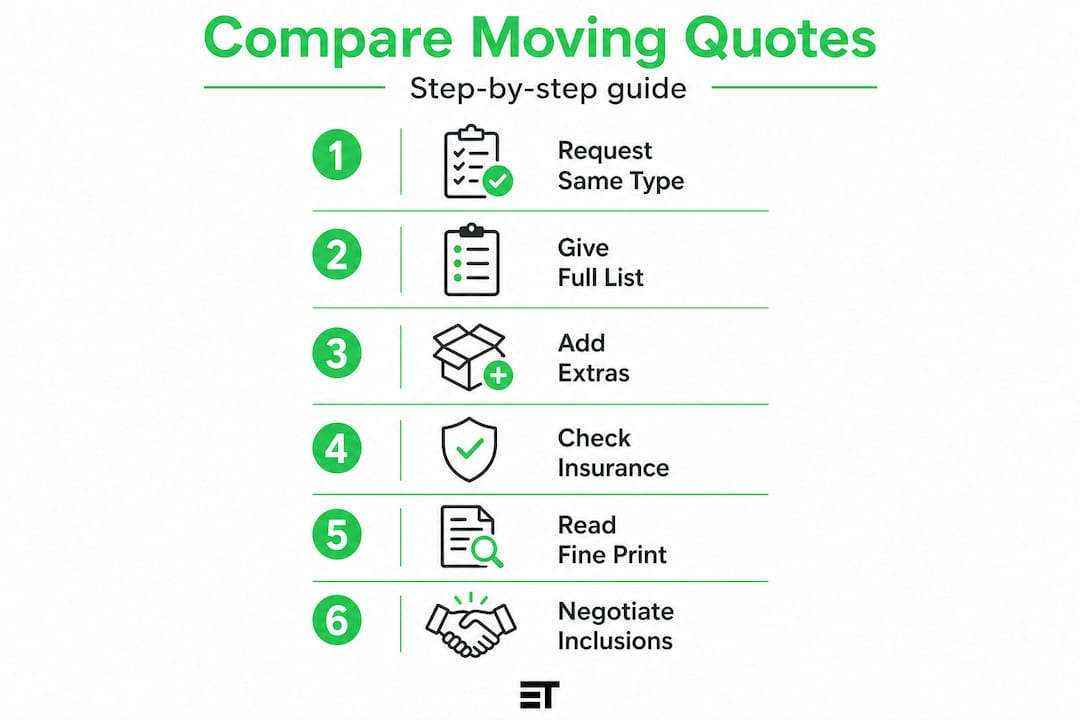
Step 2: Check inclusions and exclusions line by line
Create a simple spreadsheet or table. List each company across the top and each potential cost item down the side. Mark what’s included, what’s excluded, and what’s optional at extra cost. Common items to check include:
- Labour (number of removalists and hours included)
- Truck hire and fuel levy
- Stair fees and long carry fees
- Packing materials and boxes
- Disassembly and reassembly of furniture
- Shuttle fees for restricted access
- Overtime rates
- Insurance coverage type and limits
Step 3: Add likely extras to each quote
Once you’ve identified the exclusions in each quote, estimate what they’ll cost you to add. If Company A excludes stair fees and you have a two-storey home, add that to their total. This step often changes the ranking significantly.
Step 4: Compare insurance terms separately
Treat insurance as its own comparison category. Don’t let a lower price distract you from weaker coverage. If one company offers genuinely better insurance at a slightly higher price, that extra cost may be well worth it.
To compare moving options, ensure quotes are comparable on type and scope, because comparing different job types leads to poor decisions.
Step 5: Read the fine print and ask questions
Before making a final decision, read each quote’s terms and conditions carefully. Look for clauses about cancellation fees, what happens if the truck breaks down, how they handle delays, and what recourse you have if something goes wrong.
A free moving quote Perth resource can help you understand what to ask for and what good practice looks like from Perth-based providers.
Step 6: Negotiate
Once you have comparable, itemised quotes, use that information to negotiate. Tell Company A what Company B includes at a similar price. Ask if they can match specific inclusions. Companies that want your business will often accommodate reasonable requests, especially if you’re comparing their quote against a transparent competitor.
Pro Tip: Don’t negotiate on price alone. Instead, negotiate on inclusions. Ask companies to add stair coverage or packing materials rather than simply dropping their hourly rate. You often get more value this way, and the company maintains a workable margin, which keeps your moving day well-resourced.
Why most people get moving quotes wrong — and how to avoid their mistakes
Here’s a perspective that most moving guides won’t give you. The biggest mistake Perth residents make when comparing quotes isn’t choosing the wrong company. It’s asking the wrong question.
Almost everyone begins with “What’s your cheapest rate?” That question is almost useless. It invites a deceptive response, because any company can offer a low rate and make it up elsewhere. The better question is “What does this price include, and what will I pay extra for?”
We’ve seen this pattern play out many times. A customer chooses a quote that’s $80 cheaper than ours, then calls us after moving day because their bill ended up $350 more than the original quote. The extra charges were all legitimate under the original quote’s terms. They just weren’t visible upfront.
The real cost of movers in Perth is almost always somewhere in the middle of the market. Quotes well below average are almost always missing something. Quotes well above average need to justify the premium through substantially better service or coverage.
There’s also a psychological trap worth naming. When you receive three quotes and two are similar in price while one is significantly lower, there’s a natural pull toward the lower number. It feels like a win. But the outlier is usually an outlier for a reason. Either they’ve missed something in their assessment, they’re planning to make it up in extras, or they’re running a leaner operation that carries more risk for you.
The transparency principle is what separates good quote comparison from bad. Looking at inclusions and exclusions, valuation coverage, and overtime treatment gives you real negotiation leverage and reduces the chance of an unpleasant surprise.
Our genuine advice: spend 30 minutes building a comparison spreadsheet before you make any decision. That half hour of effort could save you hundreds of dollars and a very stressful moving day.
Ready to compare moving quotes for your Perth move?
You’ve done the research. Now it’s time to put that knowledge into action with a local team that makes quote comparison simple.

Emmanuel Transport provides fully itemised, transparent quotes for every Perth move, so you always know exactly what you’re paying for before the truck arrives. Whether you’re moving a small rental or a large family home, our experienced team covers everything from packing through to furniture reassembly. Explore our house removal guide to understand what a complete move looks like, or check out our removalists Perth page to learn about our services and coverage areas. And when you’re ready to start planning, our moving house checklist walks you through every step of the process so nothing gets missed on the day.
Frequently asked questions
What details should I check in a moving quote?
Check the quote type (binding, non-binding, or not-to-exceed), the full scope of services, all inclusions and exclusions, and the insurance or protection coverage. Missing scope and valuation details can significantly change your final costs.
Are insurance terms different for homeowners and renters?
Yes, homeowners and renters often have quite different contents and protection coverage situations. Always verify each quote’s insurance details directly, as contents and protection terms can vary considerably between providers and policies.
Why do some moving quotes seem much cheaper than others?
Cheaper quotes often exclude key services such as stair fees, packing materials, or adequate insurance. Quote comparison is not only about total price; transparency of inclusions and exclusions determines whether the lower number is genuinely better value.
How can I negotiate a better deal from movers?
Negotiate on inclusions rather than just price. When your quotes are itemised and comparable, you can use that transparency for negotiation leverage and ask companies to match specific inclusions rather than simply lowering their hourly rate.
What should I do if moving companies use different quote formats?
Request itemised quotes from every company and ask each one to use the same format. Consumer guidance recommends comparing the same type of quote and checking the structure carefully before making any decision.
Recommended
