Your new fridge is on the way, or you've found a seller and need it moved across Perth fast. That part feels simple until delivery day turns up and someone says, “It won't clear the front door,” or the fridge arrives, gets plugged in too soon, and starts its life the wrong way.
That's where most expensive mistakes happen. Not in the buying. In the measuring, access planning, handling, and the small rules hardly anyone explains clearly. In fridge delivery Perth jobs, the trouble usually isn't the fridge itself. It's the path into the home, the stairs, the parking, the old unit still sitting in place, or a rushed switch-on after transport.
A good delivery proceeds smoothly. A bad one burns time, causes damage, and can leave you paying for a failed attempt you thought was covered. If you want the move done properly, these are the checks that matter.
Table of Contents
- The Pre-Move Check Measuring for a Perfect Fit
- Preparing Your Fridge for a Safe Journey
- Choosing the Right Perth Fridge Delivery Service
- Safe Handling on Delivery Day and After
- Navigating Perth's Unique Delivery Hurdles
- Frequently Asked Questions About Fridge Delivery
The Pre-Move Check Measuring for a Perfect Fit
The biggest mistake in fridge delivery Perth jobs is simple. People measure the fridge opening in the kitchen, but they don't measure the trip from the truck to that spot.
That's how you end up with a fridge that technically suits the kitchen but can't get through the gate, front door, hallway turn, stairwell, or lift. Such circumstances lead to “fit-fail” trouble, and it's one of the most avoidable problems on any appliance move.

Measure the whole path, not just the fridge cavity
Use a tape measure and write every number down. Don't rely on eye judgment. Check:
- Fridge dimensions. Measure height, width, and depth of the unit, including handles if they're already fitted.
- Front gate and external path. Tight gate posts, sharp corners, retaining walls, and narrow side access often cause the first hold-up.
- Entry door width and height. Open the door fully and measure the actual clear opening, not the frame from edge to edge.
- Hallways and corners. A narrow hall with a turn can be harder than a small doorway.
- Stairwells. Check width, headroom, landings, and handrails.
- Lift dimensions. In apartment buildings, measure the lift opening and the inside depth.
- Final fridge space. Leave room for ventilation, door swing, and access to power and water points where relevant.
If you're not sure what truck and access setup may suit the job, a truck size calculator for Perth moves can help you think through scale before booking.
Practical rule: Measure the narrowest point on the route, not the easiest one.
Where fit-fail problems usually happen
The expensive part is that failed delivery attempts often aren't treated as a harmless reschedule. A key warning from Appliances Online's delivery information is tied to a broader issue: 40% of UK and US appliance delivery disputes stem from measurement errors, and customers can lose $250–$400 on a failed attempt when fit-fail liability isn't made clear.
Perth homes create their own version of this problem. Older units can have tighter stair access. Some suburban homes have recessed entries or awkward hallway turns. Double-door fridges and commercial-style models create even less margin for error.
A few extra checks help:
| Checkpoint | What to confirm |
|---|---|
| Door removal | Ask whether fridge doors or house doors may need to come off |
| Stair access | Confirm if turns and landings allow safe rotation |
| Flooring | Note polished timber, tiles, or uneven outdoor pavers |
| Existing appliance | Make sure the old fridge is disconnected and out of the way |
If you're comparing larger hospitality units with domestic models, guides on energy-efficient commercial fridges are useful because they highlight how appliance size, airflow clearance, and door configuration can change delivery planning before the unit even arrives.
Preparing Your Fridge for a Safe Journey
Once the measurements are sorted, the next part is hands-on. A fridge that isn't prepared properly creates leaks, mould smells, loose shelves, damaged doors, and scratched walls before the movers have even reached the truck.
For an old fridge being removed, preparation is about stability and cleanliness. For a new fridge being delivered into position, it's about making the space ready so the team isn't working around clutter, pets, boxes, or a half-disconnected old appliance.

Get the appliance ready the day before
This is the checklist that saves mess and delays:
- Empty everything out. Don't leave sauces in the door, ice trays in the freezer, or loose containers inside.
- Defrost fully. If there's built-up ice, give it time to melt well before pickup.
- Clean and dry the interior. A dry fridge travels better and won't greet you with stale odours at the other end.
- Remove or secure shelves and drawers. If they stay inside, pad them so they don't rattle and crack.
- Unplug and coil the cable. Tape or secure it so nobody trips while moving.
- Close the doors properly. Use appropriate wrapping or securing methods that won't mark the finish.
If you want help with the prep side, including wrapping and protecting awkward items around the home, dedicated packing services for Perth moves make a big difference on jobs where time is tight.
Protect the route inside the home
People often focus on the fridge and forget the house. The route matters just as much as the item.
- Clear obstacles early. Move pot plants, mats, stools, kids' toys, and hallway furniture.
- Protect fragile surfaces. Timber floors, fresh paint, stone edges, and glass balustrades need attention before lifting starts.
- Secure pets and kids. Delivery teams need a clean, predictable path.
- Check the old fridge. If it's being removed, empty it, clean it, and make sure any removable parts are sorted before the crew arrives.
A well-prepared fridge takes less handling, and less handling usually means less risk.
Choosing the Right Perth Fridge Delivery Service
A fridge can arrive at the right address and still be a failed delivery.
We see that in Perth more than people expect. The truck turns up on time, the box is spotless, then the crew hits a stair turn that was never mentioned, a double-door opening that is 15 millimetres too tight, or an apartment loading bay with a booking rule nobody checked. At that point, someone pays for a second trip, extra labour, or damage repairs. Retailers rarely spell out that risk clearly. They also do not always explain what happens once the fridge is inside and who is responsible if it does not fit the final space.
What to check before you book
Service level matters, but fit-fail risk matters just as much.
Some delivery teams only bring the fridge to the front door or garage. Others will place it in position, remove packaging, and take the old unit away. Those are different jobs with different labour, equipment, and liability. If the booking only covers a basic drop-off, do not expect the crew to start removing doors, shifting furniture, or waiting around while access problems get sorted.
Ask these questions before you pay:
- What is the delivery point? Kerbside, front door, room-of-choice, or placed in the kitchen.
- What happens if the fridge does not fit? Ask about return fees, re-delivery charges, and who signs off on access suitability.
- Do you carry fridges up stairs or through tight apartment access? Some crews do. Some subcontractors do not.
- Will the team remove doors if needed? Many will not, and cabinet or entry door removal is often outside scope.
- Do you take away packaging and the old fridge? Get that confirmed in writing.
- What protection is used inside the home? Appliance trolley, straps, blankets, and floor protection should be standard.
- Are there post-delivery handling rules? A good provider should tell you when the fridge can be plugged in after transport.
That last point gets missed often.
A fridge that has travelled on an angle may need to stand upright before it is switched on, depending on manufacturer guidance. If a crew drops it and leaves without explaining that, the customer can make an expensive mistake within the hour.
Cheap delivery often costs more later
Low-price delivery suits simple jobs. Ground floor house, wide access, no old unit to remove, no setup needed. That is fine.
The problem starts when people book the cheapest option for a difficult property. Perth homes vary a lot. New apartments in the inner suburbs, older homes with narrow laundries, steep external stairs, rear-lane access, and tight garage entries all change the job. A team that mainly moves boxed furniture can struggle with a 100-kilo fridge that needs controlled handling through finished interiors.
That is why customers booking Perth moving services for homes and businesses usually get a better result when access is awkward. The crew is more likely to ask the right questions before the truck leaves the depot.
Appliance experience changes the outcome
Ryder's advice on last-mile appliance delivery points to the value of white-glove appliance experience and clear service agreements. On the ground, that means the team knows how to assess access, confirm what is included, and avoid making promises the booking cannot support.
General freight crews are not always the right fit for fridge work. Fridges are top-heavy, easy to twist in a doorway, and easy to dent at the corners. Add polished floors, tight hall turns, or a customer who assumes installation is included, and small gaps in planning become real costs.
Ask one blunt question before booking: “If my fridge gets to the kitchen and does not fit the cavity or doorway, what happens next, and who pays?”
A provider that answers clearly is usually a safer choice than one that just says delivery is included.
Safe Handling on Delivery Day and After
Delivery day is where good planning pays off. If the path is clear and the team knows the access conditions, the move is controlled from the start. If those details were guessed, the job gets risky quickly.

What a careful delivery team does differently
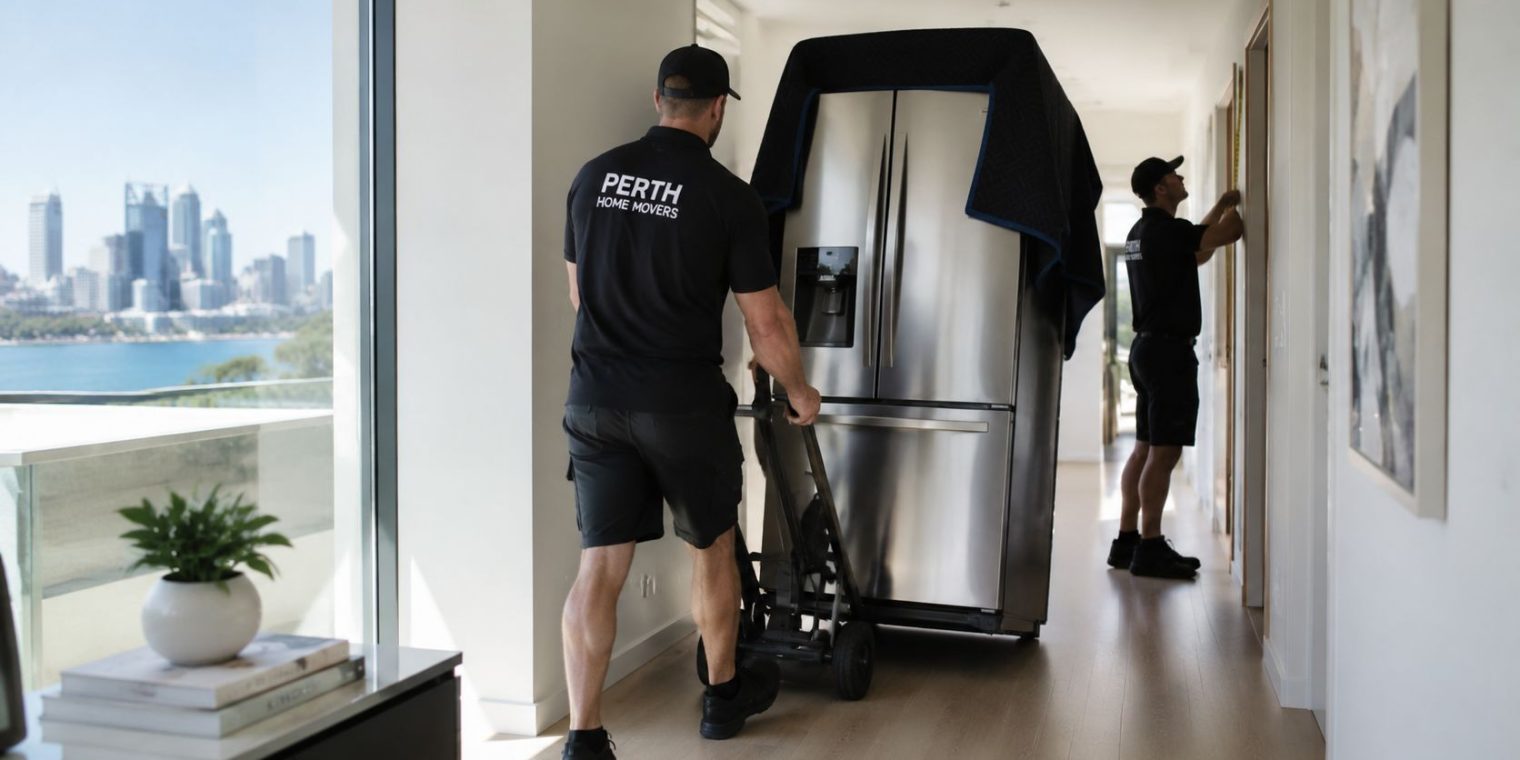
A professional crew doesn't rush the first five minutes. They check the path, look at floor surfaces, confirm the final location, and decide how the fridge will travel through each tight point before lifting begins.
On awkward jobs, they'll control angle and pace carefully. That matters on hall turns, stair landings, and polished floors where one fast movement can chip paint, twist a door, or damage the appliance casing.
For white goods in Australia, a logistics discussion on shipping refrigerators and other bulky items notes that logistics costs can account for 15–20% of the total retail price because this last-mile work is labour-intensive and often needs specialised trucks with lift gates, securing straps, protective packing, experienced handlers, and real-time tracking.
That's why fridge handling shouldn't be treated like a basic courier job.
The upright waiting rule after delivery
The most overlooked rule comes after the team leaves. If the fridge was laid down or significantly tilted during transport or access manoeuvring, you can't assume it's ready to switch on immediately.
Most manufacturers require the fridge to stand upright for up to 24 hours before power-on. According to the handling warning referenced in this fridge transport discussion, 15–20% of new fridge failures in Australia occur within 3 months due to improper standing time after prone delivery, and resulting compressor repairs can run $500–$1,200.
Don't plug the fridge in just because it's in position. First ask whether it was laid down or heavily tilted during delivery, then follow the required upright settling time.
A short explainer on moving orientation helps show why this matters:
Once it's in place, keep the final checks simple:
- Confirm it's level
- Make sure ventilation space is clear
- Check the door swing
- Wait the required upright time before powering on
- Listen for normal start-up sounds once switched on
Navigating Perth's Unique Delivery Hurdles
Perth looks easy on a map because the roads are broad and the suburbs spread out. In practice, fridge delivery Perth jobs vary sharply from one address type to the next.
A single-storey home in a quiet suburb is one thing. An apartment with lift booking rules, limited loading access, and a narrow corridor is another. A café replacing a failed display fridge has a completely different set of timing and access pressures.

Houses, units, and commercial sites all have different traps
Detached homes usually have fewer building rules, but access can still be messy. Narrow driveways, sloped blocks, side gates, and long distances from kerb to kitchen all change the carrying plan.
Units and apartments need more coordination. Lift bookings, loading bay rules, caretaker approval, and fixed delivery windows can make a simple move feel tight. If the building has a small lift, the whole plan may shift to stairs or a different handling method.
Commercial sites care more about timing than convenience. Delivering before opening, after trading hours, or during a quiet service window often matters more than shaving a little off the transport fee.
Local access issues that change the job
A useful Perth example from a Reddit discussion on fridge delivery pricing involved a $90 delivery and installation fee for a job with a 20-minute drive and a fridge carried up two flights of stairs. That's a good reminder that access complexity directly affects price.
Here's where local friction usually shows up:
| Location type | Common hurdle | What helps |
|---|---|---|
| Inner-city homes | Tight street parking | Reserve space early and clear frontage |
| Older apartments | Narrow stairwells or lifts | Measure landings and building access |
| New estates | Long carry distance from street | Confirm driveway and entry access |
| Shops and cafés | Limited trading windows | Book around operations, not just convenience |
Perth jobs often look straightforward until access gets checked properly. The suburb matters less than the final twenty metres into the property.
Frequently Asked Questions About Fridge Delivery
A lot of fridge delivery problems show up after the truck arrives. The fridge looked right in the showroom, the order went through, and only then does someone realise the doors need to come off, the water line is still connected, or the unit has been laid down and switched on too soon. We deal with these calls regularly in Perth, and they usually cost more to fix than to prevent.
Common questions
Can the delivery team disconnect my old fridge?
Sometimes, but only if that service has been agreed upfront. Basic delivery often stops at transport and placement. If your old fridge has a plumbed water line, ask specifically who is disconnecting it and whether any licensed trade is required. That point gets missed often.
Will they take the old fridge away?
Sometimes, but never assume it is included. Some providers offer removal and recycling as part of a higher-tier appliance service, while others leave the old unit in place unless it is booked in advance. Ask whether they want it emptied, defrosted, and disconnected before arrival. If not, you can end up with a new fridge delivered and the old one still blocking the kitchen.
What if my delivery is delayed?
Ask how updates are sent before booking the job. A delay is manageable. A missed lift slot, loading bay booking, or caretaker window is where the true cost starts. In apartments, a late truck can mean rebooking the whole delivery or paying extra handling on another day.
Can weekend delivery cost more?
Yes. The day itself is only part of the price. Access conditions, stairs, distance, and whether the crew is expected to unpack, position, or remove an old unit matter just as much. Get the full scope in writing so you are comparing like with like.
Should I leave food in the fridge for a short move?
No. Empty it completely. Even a short Perth metro run can turn into a longer job if parking is tight, access is delayed, or the fridge needs extra handling at the property. Loose shelves, drawers, and food weight also increase the risk of internal damage.
Can a fridge be laid down during the move?
Sometimes the access route leaves no other option, but that should be discussed before the job starts. Different units have different handling limits. If a fridge travels on its side, it usually needs to stand upright for a period before being switched on. Ignore that and you risk compressor trouble that the retailer or manufacturer may not wear.
Who is responsible if the fridge does not fit through the door or into the space?
This is one of the most overlooked issues. In many jobs, fit-fail risk sits with the customer unless the delivery company has agreed to assess access and dimensions beforehand. Retailers rarely spell this out clearly. Measure the fridge, the boxed dimensions if relevant, and every tight point on the route. Front door, hallway turns, overhead cupboards, island clearance, and the final alcove all matter.
Can the delivery crew remove fridge doors to get it inside?
Sometimes, but only if the model allows it and the team has agreed to do that work. Door removal changes the handling time and can affect alignment or seals if it is rushed. On some models, it is straightforward. On others, especially units with water or electronics in the door, it needs more care than a standard drop-off service allows.
If you want a fridge moved without the usual guesswork, Emmanuel Transport handles Perth metro moves with the kind of planning these jobs need. Whether you're dealing with tight apartment access, a single-item pickup, or a full house move with white goods included, their team can help you organise the right vehicle, the right handling approach, and a clear quote before moving day.